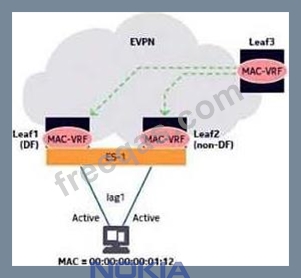
Consider the exhibit. Which of the following statements about the operation of all-active multi-homing is FALSE?
Correct Answer: B
Comprehensive and Detailed 150 to 250 words of Explanation From [SR Linux EVPN and Data Center Interconnect/Course Guide/topics]: In an all-active Layer 2 EVPN multi-homing design, the host is normally dual-attached through a LAG to multiple leaf routers that share the same Ethernet Segment Identifier. Leaf1 and Leaf2 both participate in the Ethernet Segment and may receive traffic from the host. For BUM traffic sourced by the host, the host-side hashing can send frames toward either attached leaf. For BUM traffic sent from the EVPN overlay toward the multi-homed segment, DF election controls which PE forwards that replicated traffic toward the local Ethernet Segment to prevent duplicate delivery. The false statement is option B. A remote leaf such as Leaf3 does not simply enable ECMP on the MAC-VRF to load-balance traffic between Leaf1 and Leaf2. EVPN all-active forwarding uses Ethernet Segment discovery, Ethernet A-D routes, aliasing, and split-horizon procedures to determine valid next-hops and prevent loops. ECMP alone is an underlay or routing-table behavior; it is not the MAC-VRF mechanism that authorizes multi-homed L2 forwarding across an Ethernet Segment. Reference: all-active L2 EVPN multi-homing, Ethernet Segment association, DF election, aliasing.
Question 2
Which of the following statements about MAC mobility is TRUE?
Correct Answer: C
Comprehensive and Detailed 150 to 250 words of Explanation From [SR Linux EVPN and Data Center Interconnect/Course Guide/topics]: MAC mobility is the EVPN mechanism used when a host MAC moves from one PE to another. The control plane uses a MAC Mobility extended community and sequence number behavior to determine the most recent valid location for the MAC. When a PE locally learns a MAC that was previously learned through EVPN, it advertises the MAC with an incremented sequence number, allowing remote PEs to prefer the newer location. Therefore, option B is wrong because the sequence number is not decremented. Option A is also wrong because the original PE does not advertise the locally learned MAC with a maximum sequence value as a normal mobility procedure. Option D is inaccurate because PEs do not need direct MAC table synchronization; they rely on EVPN control-plane advertisements and withdrawals. The true statement is option C: the originating PE generates a withdraw message after the same locally learned MAC ages out. This withdrawal removes stale reachability from remote PEs and prevents continued forwarding toward a PE that no longer has the host locally attached. Reference: EVPN MAC mobility, sequence-number handling, MAC route withdrawal after aging.
Question 3
When configuring the EVPN MP-BGP route reflector sessions between the leaf and spine routers, which of the following statements is TRUE?
Correct Answer: A
Comprehensive and Detailed 150 to 250 words of Explanation From [SR Linux EVPN and Data Center Interconnect/Course Guide/topics]: In SR Linux BGP configuration, parameters defined at a more specific hierarchy level can override broader protocol-level settings. Therefore, if a `local-as` value is configured within the BGP group used for EVPN MP-BGP route-reflector sessions, that value overrides the AS number configured directly under the BGP protocol for that group's sessions. Option A is correct. Option B is false because the cluster ID is configured on the route reflector, not on every participating client. The cluster ID identifies the RR cluster and helps prevent route-reflection loops. Option C is false because redundant route reflectors normally operate in parallel rather than as strict primary/backup devices; clients can peer with both for resilience. Option D is misleading because EVPN route reflectors are used to avoid a full mesh of overlay MP-BGP EVPN sessions between leaves, not to replace ordinary underlay eBGP leaf-spine routing sessions. In a clean fabric design, the underlay provides IP reachability, while the EVPN overlay uses MP-BGP sessions, often via route reflectors, to distribute tenant reachability. Reference: SR Linux BGP hierarchy, EVPN route reflector sessions, local-AS override, cluster ID behavior.
Question 4
Which of the following statements about the decoupled gateway-based data center interconnect solution is TRUE?
Correct Answer: B
Comprehensive and Detailed 150 to 250 words of Explanation From [SR Linux EVPN and Data Center Interconnect/Course Guide/topics]: A decoupled gateway-based DCI model separates the data center border-leaf function from the WAN PE function. This separation is the key design point. The border leaf remains part of the data center EVPN/VXLAN environment, while the WAN PE participates in WAN VPN transport and policy enforcement. Because the roles are split across two devices, the handoff between the border leaf and WAN PE provides a clean administrative and operational boundary. That boundary is useful for security policy, QoS marking, traffic classification, and troubleshooting ownership. The WAN does not need direct reachability to every leaf and route reflector as in a gateway-less model. The WAN PE also does not peer directly with the data center route reflector in a decoupled model; route exchange occurs through the border-leaf/WAN-PE handoff. VXLAN tunnels between leaf routers across different data centers are characteristic of gateway-less extension, not decoupled gateway operation. Therefore, the statement about clear demarcation between the data center border leaf and WAN PE is the accurate description. Reference: decoupled gateway-based DCI, security/QoS demarcation, WAN PE separation.
Question 5
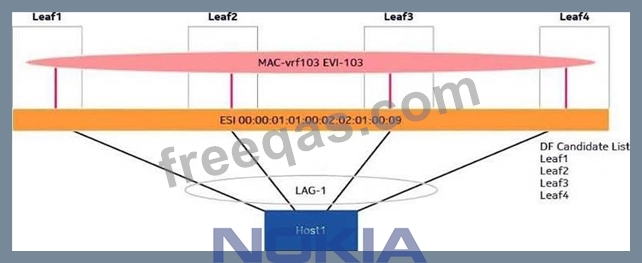
Consider the exhibit. Leaf1 and Leaf2 have the Ethernet segment configured to use the default election algorithm while Leaf3 and Leaf4 are configured to use the preference-based algorithm with Leaf3 having the higher preference value. The DF candidate list is the same on all leaf routers. Which of the following leafs is the DF for mac-vrf103?
Correct Answer: C
Comprehensive and Detailed 150 to 250 words of Explanation From [SR Linux EVPN and Data Center Interconnect/Course Guide/topics]: Designated Forwarder election determines which PE forwards BUM traffic from the EVPN overlay toward a multi-homed Ethernet Segment for a given service. In this scenario, all leaf routers share the same DF candidate list for mac-vrf103, but the election configuration is not identical. Leaf1 and Leaf2 use the default algorithm, while Leaf3 and Leaf4 use the preference-based algorithm. Under preference-based DF election, the candidate with the highest configured preference is selected over lower-preference candidates, assuming the candidate list is valid and consistent. The question states that Leaf3 has the higher preference value compared with Leaf4. Therefore, Leaf3 becomes the DF for mac-vrf103. This is the correct outcome because the preference-based election explicitly overrides simple default behavior by assigning operator-defined priority to a PE. In production designs, this is useful when the operator wants deterministic forwarding placement, maintenance control, or service-specific primary-path selection rather than relying only on the default modulo-based DF selection process. Reference: EVPN DF election, preference-based algorithm, MAC-VRF service forwarding.