FreeQAs
 Request Exam  Contact
  • Home
  • View All Exams
  • New QA's
  • Upload
PRACTICE EXAMS:
  • Oracle
  • Fortinet
  • Juniper
  • Microsoft
  • Cisco
  • Citrix
  • CompTIA
  • VMware
  • ISC
  • SAP
  • EMC
  • PMI
  • HP
  • Salesforce
  • Other
  • Oracle
    Oracle
  • Fortinet
    Fortinet
  • Juniper
    Juniper
  • Microsoft
    Microsoft
  • Cisco
    Cisco
  • Citrix
    Citrix
  • CompTIA
    CompTIA
  • VMware
    VMware
  • ISC
    ISC
  • SAP
    SAP
  • EMC
    EMC
  • PMI
    PMI
  • HP
    HP
  • Salesforce
    Salesforce
  1. Home
  2. Nokia Certification
  3. 4A0-D03 Exam
  4. Nokia.4A0-D03.v2026-10-12.q20 Dumps
  • «
  • 1
  • 2
  • 3
  • 4
  • 5
  • »
Download Now

Question 6

Consider the exhibit.
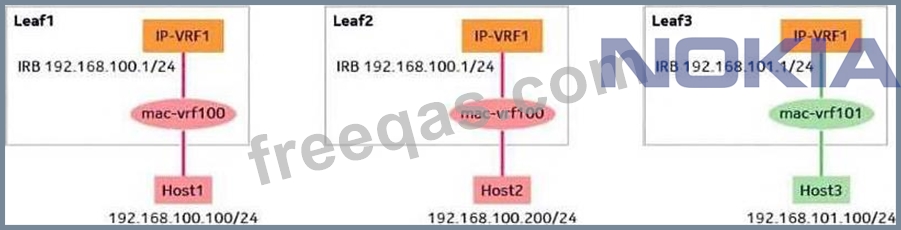
The network is configured for interface-less symmetric routing with an ECMP of 4 enabled on all leaf routers.
Which of the following statements is FALSE?

Correct Answer: A
Comprehensive and Detailed 150 to 250 words of Explanation From [SR Linux EVPN and Data Center Interconnect/Course Guide/topics]:
In interface-less symmetric L3 EVPN routing, hosts in a subnet may be attached to different leaf routers, while inter-subnet forwarding is performed through the IP-VRF using VXLAN routed interfaces. The ingress and egress PEs both participate in L3 forwarding, and the routed VXLAN interface provides the per-IP-VRF overlay data-plane construct needed for symmetric routing. The IRB interfaces on the local MAC-VRFs must advertise learned local host routes so that remote PEs have the necessary host reachability information. The MAC-VRFs also need the appropriate EVPN control-plane configuration so host MAC/IP information can be exchanged, while the IP-VRF participates in L3 VPN-style route exchange for routed reachability. Option A is false because anycast gateway is not optional in this design for Leaf1 and Leaf2. Anycast gateway allows the same default-gateway IP and virtual MAC behavior to exist consistently on multiple leaves serving the same subnet. Without it, host default-gateway behavior would be inconsistent and traffic mobility across the fabric would break expected distributed gateway operation. Reference: interface-less symmetric routing, IRB, anycast gateway, routed VXLAN interface.
insert code

Question 7

Which of the following statements about configuring and using an integrated routing and bridging (IRB) interface is TRUE?

Correct Answer: C
Comprehensive and Detailed 150 to 250 words of Explanation From [SR Linux EVPN and Data Center Interconnect/Course Guide/topics]:
An IRB interface is the logical connection point between a Layer 2 MAC-VRF and a Layer 3 IP-VRF. It provides the routed gateway function for hosts in the bridge domain while allowing traffic to move into the routed VRF for inter-subnet forwarding. The correct statement is that when an IRB sub-interface has multiple IP addresses, one can be designated as the primary. This is important because the primary address is used for normal gateway or subnet behavior when more than one address is present on the same routed interface context. Option A is inaccurate because the question is about an IRB sub-interface, not a generic subinterface selection between bridge or routed access modes. Option B is not the defining multi-homing model; EVPN multi-homing is implemented through Ethernet Segment association and MAC-VRF attachment behavior, not by adding multiple IRB subinterfaces for multi-homing. Option D is also wrong because the IRB is the shared logical link between the MAC-VRF and IP-VRF; the design does not require separate IRB subinterfaces on each side as independent constructs. Reference: SR Linux IRB configuration, MAC-VRF to IP-VRF interconnection, primary IP addressing.
insert code

Question 8

When PEs are connected to an Ethernet segment with at least one active MAC-VRF, which of the following statements about the AD per EVI updates sent by a PE is FALSE?

Correct Answer: D
Comprehensive and Detailed 150 to 250 words of Explanation From [SR Linux EVPN and Data Center Interconnect/Course Guide/topics]:
Ethernet Auto-Discovery per EVI information is used in EVPN multi-homing to advertise that a PE has reachability to a particular Ethernet Segment for a specific EVPN instance. Remote PEs use this information for aliasing, allowing them to forward known unicast traffic toward a multi-homed Ethernet Segment through eligible PEs rather than relying only on the PE that advertised a specific MAC route. In VXLAN-based EVPN, the update also carries information needed by remote peers to select the proper data-plane encapsulation and VNI for the service. The multi-homing behavior advertised with the Ethernet Segment enables remote peers to understand whether the attachment is operating in all-active or single-active mode. Option D is the false statement in this context because route-target handling is a general BGP EVPN import/export mechanism associated with VPN route policy and extended communities; it is not the specific operational function that defines AD per EVI behavior. The AD per EVI route's purpose is Ethernet Segment reachability for an EVI, not route-target-based service identification by itself. Reference: EVPN route type 1, AD per EVI, aliasing and multi-homing signaling.
insert code

Question 9

A host is connected to multiple PEs through multi-homing.
Which of the following is NOT a function of the EVPN route-type 4 route?

Correct Answer: D
insert code

Question 10

Consider the exhibit.

Which of the following is NOT configured on dcgw10 to support the Layer 3 VPN connectivity?

Correct Answer: B
Comprehensive and Detailed 150 to 250 words of Explanation From [SR Linux EVPN and Data Center Interconnect/Course Guide/topics]:
In an integrated gateway-based data center interconnect design, the gateway must interwork between the data center EVPN/VXLAN domain and the WAN VPN transport domain. For Layer 3 VPN connectivity on a Nokia 7750 SR integrated gateway, the base BGP instance must support the relevant VPN address families, such as VPN-IPv4 and EVPN, because the gateway participates in control-plane exchange between the data center and WAN sides. The VPRN must also be associated with the WAN transport, normally through MPLS tunnel binding, and the VRF target must match the corresponding VPRN on the remote gateway so that VPN routes are imported and exported correctly. A routed VXLAN interface, however, is an SR Linux IP-VRF/VXLAN construct used for symmetric L3 EVPN forwarding inside a VXLAN-based data center fabric. In this question, dcgw10 is acting as the integrated WAN gateway for L3VPN connectivity, so a routed VXLAN interface is not the required configuration item on the VPRN instance. Reference: integrated gateway DCI, VPRN over MPLS, EVPN-to-VPN interworking.
insert code
  • «
  • 1
  • 2
  • 3
  • 4
  • 5
  • »
[×]

Download PDF File

Enter your email address to download Nokia.4A0-D03.v2026-10-12.q20 Dumps

Email:

FreeQAs

Our website provides the Largest and the most Latest vendors Certification Exam materials around the world.

Using dumps we provide to Pass the Exam, we has the Valid Dumps with passing guranteed just which you need.

  • DMCA
  • About
  • Contact Us
  • Privacy Policy
  • Terms & Conditions
©2026 FreeQAs

www.freeqas.com materials do not contain actual questions and answers from Cisco's certification exams.

