FreeQAs
 Request Exam  Contact
  • Home
  • View All Exams
  • New QA's
  • Upload
PRACTICE EXAMS:
  • Oracle
  • Fortinet
  • Juniper
  • Microsoft
  • Cisco
  • Citrix
  • CompTIA
  • VMware
  • ISC
  • SAP
  • EMC
  • PMI
  • HP
  • Salesforce
  • Other
  • Oracle
    Oracle
  • Fortinet
    Fortinet
  • Juniper
    Juniper
  • Microsoft
    Microsoft
  • Cisco
    Cisco
  • Citrix
    Citrix
  • CompTIA
    CompTIA
  • VMware
    VMware
  • ISC
    ISC
  • SAP
    SAP
  • EMC
    EMC
  • PMI
    PMI
  • HP
    HP
  • Salesforce
    Salesforce
  1. Home
  2. Nokia Certification
  3. 4A0-D03 Exam
  4. Nokia.4A0-D03.v2026-10-12.q20 Dumps
  • «
  • 1
  • 2
  • 3
  • 4
  • 5
Download Now

Question 16

Consider the exhibit.
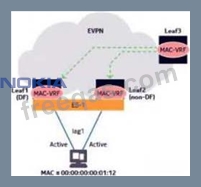
Which of the following statements about the configuration and operation of this setup is FALSE?

Correct Answer: D
Comprehensive and Detailed 150 to 250 words of Explanation From [SR Linux EVPN and Data Center Interconnect/Course Guide/topics]:
This scenario describes all-active Layer 2 EVPN multi-homing with a host connected through a LAG to Leaf1 and Leaf2. The LAG subinterface is associated with the MAC-VRF on both participating leaves, and the Ethernet Segment ES-1 is configured for all-active multi-homing. In all-active operation, both leaf routers can be active attachment points for host-originated traffic, and remote traffic can use EVPN multi-homing mechanisms to reach the segment. Option D is false because the host does not know or use the EVPN Designated Forwarder state when sending BUM traffic. The host forwards over its LAG based on its local LAG hashing and LACP behavior. DF election is an EVPN PE-side mechanism used mainly to control which PE forwards BUM traffic from the EVPN overlay toward the Ethernet Segment, preventing duplicate delivery to the multihomed access network. The host itself does not selectively forward all BUM traffic toward the DF. That distinction is critical: DF controls overlay-to-segment replication, while the host's LAG controls host-to-leaf link selection. Reference: all-active L2 EVPN multi-homing, host LAG behavior, DF election scope, BUM forwarding.
insert code

Question 17

Which of the following statements about an integrated routing and bridging (IRB) interface is FALSE?

Correct Answer: B
Comprehensive and Detailed 150 to 250 words of Explanation From [SR Linux EVPN and Data Center Interconnect/Course Guide/topics]:
An IRB interface provides the logical L3 gateway function between a Layer 2 MAC-VRF and a Layer 3 IP-VRF on the same PE. It allows locally bridged hosts to route into the tenant IP-VRF while preserving EVPN control-plane signaling for MAC/IP reachability. The IRB subinterface must have at least one IP address because it acts as the routed gateway for the subnet, and it may also be configured with ACLs to apply traffic policy at the L3 boundary. Option B is false because it incorrectly generalizes the IRB relationship. In SR Linux EVPN service modeling, an IRB subinterface connects a MAC-VRF to an IP-VRF in a controlled one-to-one service attachment context; the design is not that both IP-VRFs and MAC-VRFs arbitrarily contain multiple IRB interfaces for the same relationship. A MAC-VRF has its IRB gateway association into the IP-VRF, and the IP-VRF may connect to multiple MAC-VRFs through distinct IRB contexts, but the statement as written is not the correct rule for IRB interface behavior. Reference: SR Linux IRB interface operation, MAC-VRF/IP-VRF interconnection, gateway IP and ACL support.
insert code

Question 18

A host is connected to a MAC-VRF on leaf1 and leaf2. The MAC-VRF interfaces on leaf1 and leaf2 are associated to an Ethernet segment configured for active-standby multi-homing.
Which of the following statements is FALSE?

Correct Answer: D
Comprehensive and Detailed 150 to 250 words of Explanation From [SR Linux EVPN and Data Center Interconnect/Course Guide/topics]:
In active-standby, or single-active, Layer 2 EVPN multi-homing, only one PE is active for the Ethernet Segment and MAC-VRF at a time. Leaf1 and Leaf2 participate in DF election, and the elected DF becomes the active forwarding PE for that service attachment. Because this is not all-active multi-homing, the non-DF must not forward traffic to the host for the protected service. This prevents duplicate frames, incorrect MAC learning, and loops on the access side. The DF accepts traffic from the host and forwards BUM traffic received from remote PEs toward the host-facing segment. Option D is false because it claims that the non-DF can forward unicast traffic from remote PEs to the host. In single-active operation, remote peers must direct traffic to the active PE, and the standby PE remains ready to take over only after DF state changes. This is the operational distinction from all-active multi-homing, where more than one PE may be used for forwarding depending on the traffic type and aliasing behavior. Reference: single-active L2 EVPN multi-homing, DF role, non-DF forwarding suppression.
insert code

Question 19

Which of the following statements about a BGP route target is FALSE?

Correct Answer: D
Comprehensive and Detailed 150 to 250 words of Explanation From [SR Linux EVPN and Data Center Interconnect/Course Guide/topics]:
A BGP route target is an extended community used to control which EVPN routes are imported into which MAC-VRF or IP-VRF. It is carried with EVPN updates and acts as the import/export policy tag for tenant service membership. The statement that it is a BGP extended community is correct. It is also correct that route targets support multi-tenant operation, because they allow different EVPN instances to carry potentially overlapping MAC or IP information while importing only the routes intended for that service. However, option D is false in the wording used here. The route target does not itself identify the EVPN instance in the control plane as a unique route identifier. That role is more closely associated with the route distinguisher and EVPN NLRI construction, while the route target determines import eligibility. A route target tells a receiving PE whether the route belongs in a local service instance, but it is not the unique identity of the EVPN route. This distinction is critical: route distinguishers make routes unique; route targets control route distribution and service membership. Reference: EVPN route targets, BGP extended communities, route import/export policy, RD versus RT function.
insert code

Question 20

Consider the exhibit.

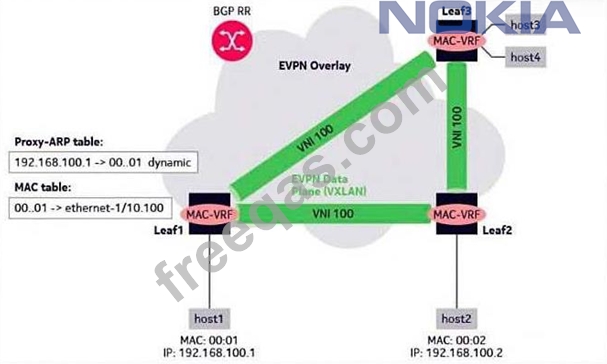
Leaf-1 has received an ARP request from host-1 for host-2. Leaf-1 has added host-1's MAC address in its MAC table and host-1's MAC/IP addresses in its proxy-ARP table.
Which of the following steps is FALSE?


Correct Answer: A
Comprehensive and Detailed 150 to 250 words of Explanation From [SR Linux EVPN and Data Center Interconnect/Course Guide/topics]:
When Leaf-1 receives an ARP request from Host-1, it learns the source MAC address in the local MAC table and learns the source IP/MAC binding in the proxy ARP table. For EVPN distribution, the relevant control-plane advertisement is an EVPN route type 2 MAC/IP advertisement containing Host-1's MAC and the actual host IP address, 192.168.100.1. This allows remote PEs to populate their EVPN-derived forwarding and proxy ARP state with the correct endpoint binding. Option A is false because advertising the host MAC with the IP address set to 0.0.0.0 does not represent the learned MAC/IP binding required for proxy ARP synchronization. A MAC-only RT-2 advertisement may exist in EVPN contexts, but the question specifically states that Leaf-1 has learned the MAC/IP binding through ARP and is distributing that information. Therefore, the valid advertisement must include the real host IP address. Remote PEs use the MAC/IP route to learn the endpoint, not an all-zero IP placeholder for this proxy ARP learning event. Reference: EVPN RT-2 MAC/IP advertisement, proxy ARP table population, endpoint synchronization.
insert code
  • «
  • 1
  • 2
  • 3
  • 4
  • 5
[×]

Download PDF File

Enter your email address to download Nokia.4A0-D03.v2026-10-12.q20 Dumps

Email:

FreeQAs

Our website provides the Largest and the most Latest vendors Certification Exam materials around the world.

Using dumps we provide to Pass the Exam, we has the Valid Dumps with passing guranteed just which you need.

  • DMCA
  • About
  • Contact Us
  • Privacy Policy
  • Terms & Conditions
©2026 FreeQAs

www.freeqas.com materials do not contain actual questions and answers from Cisco's certification exams.