FreeQAs
 Request Exam  Contact
  • Home
  • View All Exams
  • New QA's
  • Upload
PRACTICE EXAMS:
  • Oracle
  • Fortinet
  • Juniper
  • Microsoft
  • Cisco
  • Citrix
  • CompTIA
  • VMware
  • ISC
  • SAP
  • EMC
  • PMI
  • HP
  • Salesforce
  • Other
  • Oracle
    Oracle
  • Fortinet
    Fortinet
  • Juniper
    Juniper
  • Microsoft
    Microsoft
  • Cisco
    Cisco
  • Citrix
    Citrix
  • CompTIA
    CompTIA
  • VMware
    VMware
  • ISC
    ISC
  • SAP
    SAP
  • EMC
    EMC
  • PMI
    PMI
  • HP
    HP
  • Salesforce
    Salesforce
  1. Home
  2. Nokia Certification
  3. 4A0-D03 Exam
  4. Nokia.4A0-D03.v2026-10-12.q20 Dumps
  • «
  • 1
  • 2
  • 3
  • 4
  • 5
  • »
Download Now

Question 11

Which of the following statements about EVPN PE-CE routing, using BGP as the routing protocol, is FALSE?

Correct Answer: C
Comprehensive and Detailed 150 to 250 words of Explanation From [SR Linux EVPN and Data Center Interconnect/Course Guide/topics]:
In EVPN PE-CE routing, the PE exchanges ordinary IPv4 or IPv6 unicast routing information with the CE. When the PE learns CE prefixes, it imports them into the tenant IP-VRF and advertises them to other EVPN PEs as EVPN route type 5 IP Prefix routes. Conversely, when the PE receives EVPN routes from remote PEs, it can advertise corresponding IPv4/IPv6 BGP updates toward the CE, subject to policy. Import and export policies are essential because they control which customer routes are accepted, which EVPN-learned routes are advertised, and how attributes are modified. Option C is false because iBGP is not the preferred PE-CE model in this context. eBGP is typically preferred between PE and CE because it creates a clean administrative routing boundary between the provider/data-center edge and the customer or external router. Using eBGP also simplifies route policy, loop prevention, and operational separation. The CE does not need to participate in the EVPN overlay; it speaks standard BGP unicast with the PE, while the PE performs the EVPN RT-5 advertisement into the fabric. Reference: EVPN PE-CE BGP routing, eBGP preference, RT-5 prefix advertisement, import/export policy.
insert code

Question 12

Which of the following statements describes the function or operation of the integrated gateway-based data center interconnect solution?

Correct Answer: D
Comprehensive and Detailed 150 to 250 words of Explanation From [SR Linux EVPN and Data Center Interconnect/Course Guide/topics]:
In an integrated gateway-based DCI design, the same physical or logical router performs both the data center gateway role and the WAN PE role. This is why option D is correct. The device terminates or participates in the data center-side EVPN service and also handles the WAN-side VPN transport, including route translation or re-advertisement where needed. This approach avoids exposing every data center leaf router to the WAN and avoids requiring route reflector reachability between data centers. It also avoids building VXLAN tunnels directly between all leaf routers in separate data centers. Those characteristics belong to gateway-less DCI, where the EVPN overlay stretches more directly across the WAN and the WAN must carry the underlay or overlay reachability required by the data center leaves. Integrated gateway design is more controlled: the gateway is the interworking point, which makes it suitable when the provider or operator wants a strong service boundary and centralized DCI policy enforcement. Reference: integrated gateway-based DCI, single-router gateway/WAN PE function, EVPN/VPN interworking.
insert code

Question 13

Which EVPN route-type (RT) is used in multi-homing scenarios to support aliasing and fast convergence?

Correct Answer: A
Comprehensive and Detailed 150 to 250 words of Explanation From [SR Linux EVPN and Data Center Interconnect/Course Guide/topics]:
The EVPN route type used for aliasing and fast convergence in multi-homing is RT-1, the Ethernet Auto-Discovery route. RT-1 has two important forms: Ethernet A-D per Ethernet Segment and Ethernet A-D per EVI. These routes advertise reachability to a multi-homed Ethernet Segment and to a specific EVPN instance on that segment. Remote PEs use this information for aliasing, meaning they can forward traffic toward any eligible PE attached to the same Ethernet Segment, even when a specific MAC was advertised by only one PE. RT-1 also supports fast convergence because withdrawal of Ethernet A-D routes quickly informs remote PEs that an attachment path or PE is no longer valid, avoiding slow MAC aging as the primary failure-detection mechanism. RT-4 Ethernet Segment routes are related to multi-homing, but their main function is Ethernet Segment discovery and Designated Forwarder election. RT-2 advertises host MAC/IP reachability, and RT-3 builds multicast/BUM replication lists. Therefore, RT-1 is the precise answer for aliasing and fast convergence. Reference: EVPN multi-homing route types, Ethernet Auto-Discovery, aliasing and convergence behavior.
insert code

Question 14

Which of the following is NOT part of the description of a BGP route-distinguisher?

Correct Answer: D
Comprehensive and Detailed 150 to 250 words of Explanation From [SR Linux EVPN and Data Center Interconnect/Course Guide/topics]:
A route distinguisher is used in MP-BGP VPN and EVPN address families to make otherwise overlapping tenant routes unique in the BGP control plane. In EVPN, different tenants or EVPN instances may legitimately use the same MAC or IP values. The route distinguisher makes the NLRI globally unique by prepending a unique value to the tenant route. It is typically unique per PE and per EVI, and it is carried in EVPN route advertisements. However, the route distinguisher does not control route import, export, or service membership. That role belongs to the route target, which is a BGP extended community used by receiving PEs to decide which EVPN instance should import the route. Therefore, option D is not part of the correct description of a route distinguisher. Saying that the RD identifies the EVPN instance in the control plane confuses RD uniqueness with route-target membership. The RD makes routes unique; the route target associates those routes with the appropriate MAC-VRF or IP-VRF import policy. Reference: EVPN route distinguisher, overlapping tenant addresses, route target separation.
insert code

Question 15

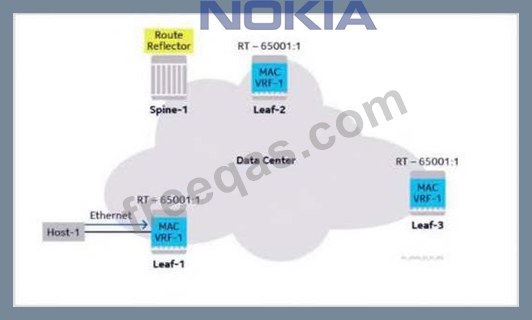
Consider the exhibit.

All three of the leafs have a MP-BGP EVPN session to the route-reflector Spine-1. Leaf-1, Leaf-2 and Leaf-3 have existing instances of an L2 EVPN named MAC VRF-1. Host-1 has just sent its first Ethernet frame into MAC VRF-1 on Leaf-1.
Which of the following steps is FALSE?


Correct Answer: B
Comprehensive and Detailed 150 to 250 words of Explanation From [SR Linux EVPN and Data Center Interconnect/Course Guide/topics]:
When Host-1 sends its first Ethernet frame into MAC VRF-1, Leaf-1 performs normal local data-plane MAC learning on the access interface and installs Host-1's MAC address into the MAC forwarding table. In an L2 EVPN MAC-VRF, host MAC reachability is then advertised into the EVPN control plane using EVPN route type 2, the MAC/IP Advertisement route. Route type 5 is not used for host MAC advertisement; RT-5 is used for IP prefix advertisement in Layer 3 EVPN services. Therefore, option B is false because it incorrectly states that Leaf-1 generates an EVPN RT-5 update with the host MAC address. In this topology, Leaf-1 sends the correct EVPN update to the route reflector, Spine-1. The route reflector then reflects the update to Leaf-2 and Leaf-3, and those remote leaves import the route if the route target matches their MAC VRF-1 import policy. The route target controls service membership, ensuring that only PEs participating in the same EVPN instance import the MAC route. Reference: L2 EVPN MAC learning, RT-2 MAC/IP advertisement, route-reflector distribution, route-target import.
insert code
  • «
  • 1
  • 2
  • 3
  • 4
  • 5
  • »
[×]

Download PDF File

Enter your email address to download Nokia.4A0-D03.v2026-10-12.q20 Dumps

Email:

FreeQAs

Our website provides the Largest and the most Latest vendors Certification Exam materials around the world.

Using dumps we provide to Pass the Exam, we has the Valid Dumps with passing guranteed just which you need.

  • DMCA
  • About
  • Contact Us
  • Privacy Policy
  • Terms & Conditions
©2026 FreeQAs

www.freeqas.com materials do not contain actual questions and answers from Cisco's certification exams.