FreeQAs
 Request Exam  Contact
  • Home
  • View All Exams
  • New QA's
  • Upload
PRACTICE EXAMS:
  • Oracle
  • Fortinet
  • Juniper
  • Microsoft
  • Cisco
  • Citrix
  • CompTIA
  • VMware
  • ISC
  • SAP
  • EMC
  • PMI
  • HP
  • Salesforce
  • Other
  • Oracle
    Oracle
  • Fortinet
    Fortinet
  • Juniper
    Juniper
  • Microsoft
    Microsoft
  • Cisco
    Cisco
  • Citrix
    Citrix
  • CompTIA
    CompTIA
  • VMware
    VMware
  • ISC
    ISC
  • SAP
    SAP
  • EMC
    EMC
  • PMI
    PMI
  • HP
    HP
  • Salesforce
    Salesforce
  1. Home
  2. Salesforce Certification
  3. MuleSoft-Platform-Architect-I Exam
  4. Salesforce.MuleSoft-Platform-Architect-I.v2025-10-22.q61 Dumps
  • «
  • 1
  • 2
  • 3
  • 4
  • 5
  • 6
  • 7
  • 8
  • 9
  • 10
  • …
  • »
  • »»
Download Now

Question 11

An API implementation is updated. When must the RAML definition of the API also be updated?

Correct Answer: A
Correct Answer : When the API implementation changes the structure of the request or response messages
*****************************************
>> RAML definition usually needs to be touched only when there are changes in the request/response schemas or in any traits on API.
>> It need not be modified for any internal changes in API implementation like performance tuning, backend system migrations etc..
insert code

Question 12

A company requires Mule applications deployed to CloudHub to be isolated between non-production and production environments. This is so Mule applications deployed to non-production environments can only access backend systems running in their customer-hosted non-production environment, and so Mule applications deployed to production environments can only access backend systems running in their customer-hosted production environment. How does MuleSoft recommend modifying Mule applications, configuring environments, or changing infrastructure to support this type of per-environment isolation between Mule applications and backend systems?

Correct Answer: D
Correct Answe r: Create separate Anypoint VPCs for non-production and production environments, then configure connections to the backend systems in the corresponding customer-hosted environments.
*****************************************
>> Creating different Business Groups does NOT make any difference w.r.t accessing the non-prod and prod customer-hosted environments. Still they will be accessing from both Business Groups unless process network restrictions are put in place.
>> We need to modify or couple the Mule Application Implementations with the environment. In fact, we should never implements application coupled with environments by binding them in the properties. Only basic things like endpoint URL etc should be bundled in properties but not environment level access restrictions.
>> IP addresses on CloudHub are dynamic until unless a special static addresses are assigned. So it is not possible to setup firewall rules in customer-hosted infrastrcture. More over, even if static IP addresses are assigned, there could be 100s of applications running on cloudhub and setting up rules for all of them would be a hectic task, non-maintainable and definitely got a good practice.
>> The best practice recommended by Mulesoft (In fact any cloud provider), is to have your Anypoint VPCs seperated for Prod and Non-Prod and perform the VPC peering or VPN tunneling for these Anypoint VPCs to respective Prod and Non-Prod customer-hosted environment networks.
Reference:
Bottom of Form
Top of Form
insert code

Question 13

Refer to the exhibit. An organization is running a Mule standalone runtime and has configured Active Directory as the Anypoint Platform external Identity Provider. The organization does not have budget for other system components.

What policy should be applied to all instances of APIs in the organization to most effecuvelyKestrict access to a specific group of internal users?

Correct Answer: A
Correct Answer : Apply a basic authentication - LDAP policy; the internal Active Directory will be configured as the LDAP source for authenticating users.
*****************************************
>> IP Whitelisting does NOT fit for this purpose. Moreover, the users workstations may not necessarily have static IPs in the network.
>> OAuth 2.0 enforcement requires a client provider which isn't in the organizations system components.
>> It is not an effective approach to let every user create separate client credentials and configure those for their usage.
The effective way it to apply a basic authentication - LDAP policy and the internal Active Directory will be configured as the LDAP source for authenticating users.
insert code

Question 14

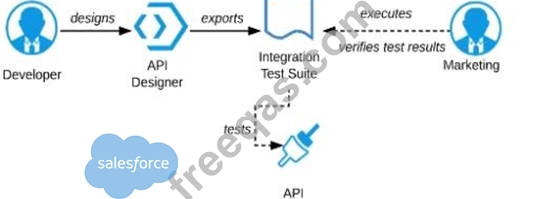
Refer to the exhibit.

A RAML definition has been proposed for a new Promotions Process API, and has been published to Anypoint Exchange.
The Marketing Department, who will be an important consumer of the Promotions API, has important requirements and expectations that must be met.
What is the most effective way to use Anypoint Platform features to involve the Marketing Department in this early API design phase?
A) Ask the Marketing Department to interact with a mocking implementation of the API using the automatically generated API Console

B) Organize a design workshop with the DBAs of the Marketing Department in which the database schema of the Marketing IT systems is translated into RAML

C) Use Anypoint Studio to Implement the API as a Mule application, then deploy that API implementation to CloudHub and ask the Marketing Department to interact with it

D) Export an integration test suite from API designer and have the Marketing Department execute the tests In that suite to ensure they pass

Correct Answer: A
Correct Answer : Ask the Marketing Department to interact with a mocking implementation of the API using the automatically generated API Console.
*****************************************
As per MuleSoft's IT Operating Model:
>> API consumers need NOT wait until the full API implementation is ready.
>> NO technical test-suites needs to be shared with end users to interact with APIs.
>> Anypoint Platform offers a mocking capability on all the published API specifications to Anypoint Exchange which also will be rich in documentation covering all details of API functionalities and working nature.
>> No needs of arranging days of workshops with end users for feedback.
API consumers can use Anypoint Exchange features on the platform and interact with the API using its mocking feature. The feedback can be shared quickly on the same to incorporate any changes.
insert code

Question 15

What is a typical result of using a fine-grained rather than a coarse-grained API deployment model to implement a given business process?

Correct Answer: B
Correct Answer : A higher number of discoverable API-related assets in the application network.
*****************************************
>> We do NOT get faster response times in fine-grained approach when compared to coarse-grained approach.
>> In fact, we get faster response times from a network having coarse-grained APIs compared to a network having fine-grained APIs model. The reasons are below.
Fine-grained approach:
1. will have more APIs compared to coarse-grained
2. So, more orchestration needs to be done to achieve a functionality in business process.
3. Which means, lots of API calls to be made. So, more connections will needs to be established. So, obviously more hops, more network i/o, more number of integration points compared to coarse-grained approach where fewer APIs with bulk functionality embedded in them.
4. That is why, because of all these extra hops and added latencies, fine-grained approach will have bit more response times compared to coarse-grained.
5. Not only added latencies and connections, there will be more resources used up in fine-grained approach due to more number of APIs.
That's why, fine-grained APIs are good in a way to expose more number of resuable assets in your network and make them discoverable. However, needs more maintenance, taking care of integration points, connections, resources with a little compromise w.r.t network hops and response times.
insert code
  • «
  • 1
  • 2
  • 3
  • 4
  • 5
  • 6
  • 7
  • 8
  • 9
  • 10
  • …
  • »
  • »»
[×]

Download PDF File

Enter your email address to download Salesforce.MuleSoft-Platform-Architect-I.v2025-10-22.q61 Dumps


Email:

FreeQAs

Our website provides the Largest and the most Latest vendors Certification Exam materials around the world.

Using dumps we provide to Pass the Exam, we has the Valid Dumps with passing guranteed just which you need.

  • DMCA
  • About
  • Contact Us
  • Privacy Policy
  • Terms & Conditions
©2026 FreeQAs

www.freeqas.com materials do not contain actual questions and answers from Cisco's certification exams.