When collecting support bundles through NSX Manager, which files should be excluded for potentially containing sensitive information?
Correct Answer: C
According to the VMware NSX Documentation1, core files and audit logs can contain sensitive information and should be excluded from the support bundle unless requested by VMware technical support. Controller files and management files are not mentioned as containing sensitive information.
Question 42
Which TraceFlow traffic type should an NSX administrator use tor validating connectivity between App and DB virtual machines that reside on different segments?
Correct Answer: B
Explanation Unicast is the traffic type that an NSX administrator should use for validating connectivity between App and DB virtual machines that reside on different segments. According to the VMware documentation1, unicast traffic is the traffic type that is used to send a packet from one source to one destination. Unicast traffic is the most common type of traffic in a network, and it is used for applications such as web browsing, email, file transfer, and so on2. To perform a traceflow with unicast traffic, the NSX administrator needs to specify the source and destination IP addresses, and optionally the protocol and related parameters1. The traceflow will show the path of the packet across the network and any observations or errors along the way3. The other options are incorrect because they are not suitable for validating connectivity between two specific virtual machines. Multicast traffic is the traffic type that is used to send a packet from one source to multiple destinations simultaneously2. Multicast traffic is used for applications such as video streaming, online gaming, and group communication4. To perform a traceflow with multicast traffic, the NSX administrator needs to specify the source IP address and the destination multicast IP address1. Broadcast traffic is the traffic type that is used to send a packet from one source to all devices on the same subnet2. Broadcast traffic is used for applications such as ARP, DHCP, and network discovery. To perform a traceflow with broadcast traffic, the NSX administrator needs to specify the source IP address and the destination MAC address as FF:FF:FF:FF:FF:FF1. Anycast traffic is not a valid option, as it is not supported by NSX Traceflow. Anycast traffic is a traffic type that is used to send a packet from one source to the nearest or best destination among a group of devices that share the same IP address. Anycast traffic is used for applications such as DNS, CDN, and load balancing.
Question 43
Which command is used to display the network configuration of the Tunnel Endpoint (TEP) IP on a bare metal transport node?
Correct Answer: B
The command ifconfig is used to display the network configuration of the Tunnel Endpoint (TEP) IP on a bare metal transport node2. The TEP IP is assigned to a network interface on the bare metal server that is used for overlay traffic. The ifconfig command can show the IP address, netmask, broadcast address, and other information of the network interface. For example, the following command shows the network configuration of the TEP IP on a bare metal transport node with interface name ens192: ifconfig ens192 The output of the command would look something like this: ens192: flags=4163<UP,BROADCAST,RUNNING,MULTICAST> mtu 1500 inet 10.10.10.10 netmask 255.255.255.0 broadcast 10.10.10.255 inet6 fe80::250:56ff:fe9a:1b8c prefixlen 64 scopeid 0x20<link> ether 00:50:56:9a:1b:8c txqueuelen 1000 (Ethernet) RX packets 123456 bytes 123456789 (123.4 MB) RX errors 0 dropped 0 overruns 0 frame 0 TX packets 234567 bytes 234567890 (234.5 MB) TX errors 0 dropped 0 overruns 0 carrier 0 collisions 0 The TEP IP in this example is 10.10.10.10. References: * IBM Cloud Docs
Question 44
What are two valid options when configuring the scope of a distributed firewall rule? (Choose two.)
Correct Answer: C,E
C) Segment. This is correct. A segment is a logical construct that represents a layer 2 broadcast domain and a layer 3 subnet in NSX. A segment can be used to group and connect virtual machines, containers, or bare metal hosts that belong to the same application or service. A segment can also be used as the scope of a distributed firewall rule, which means that the rule will apply to all the traffic that enters or exits the segment12 E) Group. This is correct. A group is a logical construct that represents a collection of objects in NSX, such as segments, segment ports, virtual machines, IP addresses, MAC addresses, tags, or security policies. A group can be used to define dynamic membership criteria based on various attributes or filters. A group can also be used as the scope of a distributed firewall rule, which means that the rule will apply to all the traffic that matches the group membership criteria32
Question 45
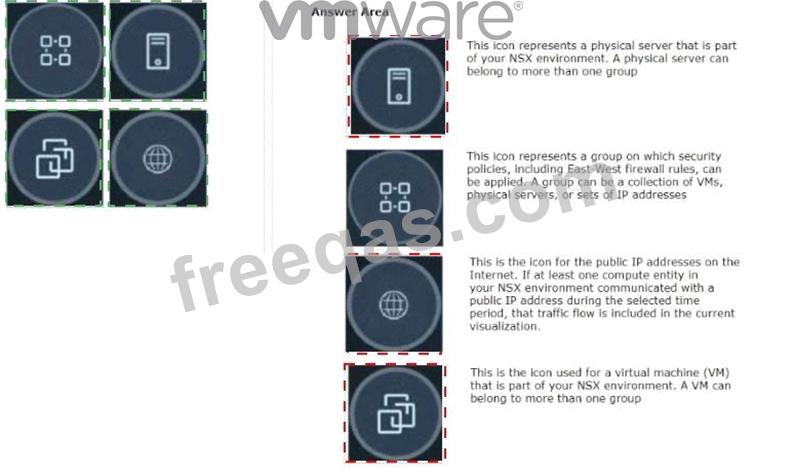
Refer to the exhibits. Drag and drop the NSX graphic element icons on the left found in an NSX Intelligence visualization graph to Its correct description on the right.