FreeQAs
 Request Exam  Contact
  • Home
  • View All Exams
  • New QA's
  • Upload
PRACTICE EXAMS:
  • Oracle
  • Fortinet
  • Juniper
  • Microsoft
  • Cisco
  • Citrix
  • CompTIA
  • VMware
  • SAP
  • EMC
  • PMI
  • HP
  • Salesforce
  • Other
  • Oracle
    Oracle
  • Fortinet
    Fortinet
  • Juniper
    Juniper
  • Microsoft
    Microsoft
  • Cisco
    Cisco
  • Citrix
    Citrix
  • CompTIA
    CompTIA
  • VMware
    VMware
  • SAP
    SAP
  • EMC
    EMC
  • PMI
    PMI
  • HP
    HP
  • Salesforce
    Salesforce
  1. Home
  2. CompTIA Certification
  3. SYO-501 Exam
  4. CompTIA.SYO-501.v2022-03-09.q467 Dumps
  • ««
  • «
  • …
  • 47
  • 48
  • 49
  • 50
  • 51
  • 52
  • 53
  • 54
  • 55
  • 56
  • …
  • »
  • »»
Download Now

Question 251

HOTSPOT
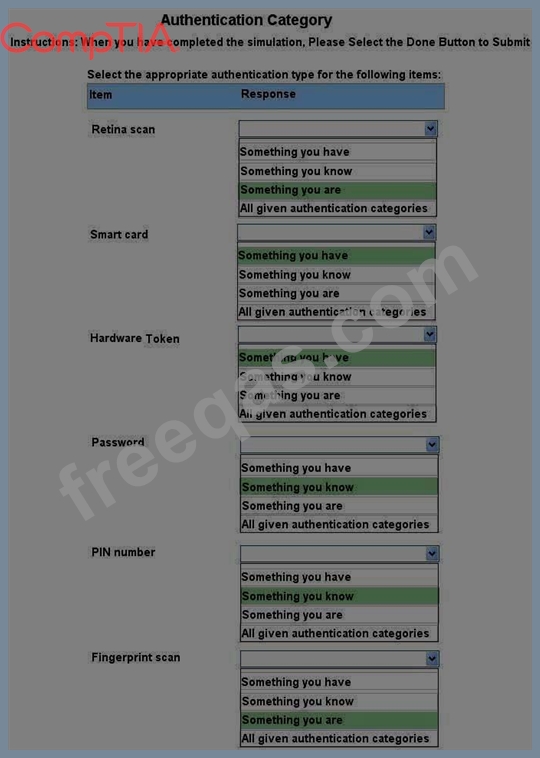
For each of the given items, select the appropriate authentication category from the dropdown choices.
Instructions: When you have completed the simulation, please select the Done button to submit.
Correct Answer:

Something you are includes fingerprints, retina scans, or voice recognition.
Something you have includes smart cards, token devices, or keys.
Something you know includes a password, codes, PINs, combinations, or secret phrases. Somewhere you are including a physical location s or logical addresses, such as domain name, an IP address, or a MAC address.
Something you do includes your typing rhythm, a secret handshake, or a private knock
http://en.wikipedia.org/wiki/Password_authentication_protocol#Working_cycle
http://en.wikipedia.org/wiki/Smart_card#Security
insert code

Question 252

DRAG DROP
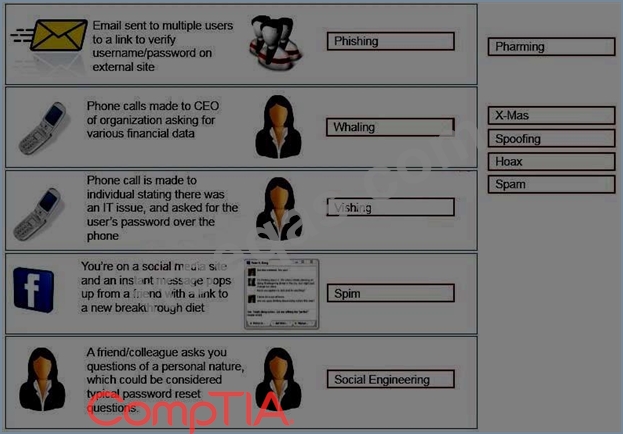
Task: Determine the types of attacks below by selecting an option from the dropdown list.
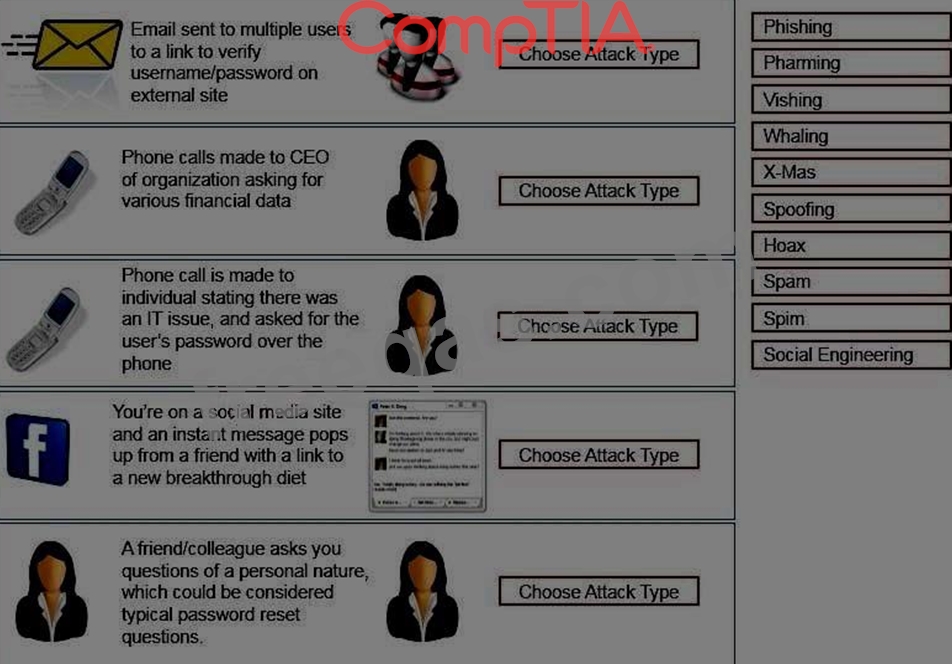
Correct Answer:

A: Phishing is the act of sending an email to a user falsely claiming to be an established legitimate enterprise in an attempt to scam the user into surrendering private information that will be used for identity theft.
Phishing email will direct the user to visit a website where they are asked to update personal information, such as a password, credit card, social security, or bank account numbers, that the legitimate organization already has. The website, however, is bogus and set up only to steal the information the user enters on the page.
B: Whaling is a specific kind of malicious hacking within the more general category of phishing, which involves hunting for data that can be used by the hacker. In general, phishing efforts are focused on collecting personal data about users. In whaling, the targets are high-ranking bankers, executives or others in powerful positions or job titles. Hackers who engage in whaling often describe these efforts as
"reeling in a big fish," applying a familiar metaphor to the process of scouring technologies for loopholes and opportunities for data theft. Those who are engaged in whaling may, for example, hack into specific networks where these powerful individuals work or store sensitive dat a. They may also set up keylogging or other malware on a work station associated with one of these executives. There are many ways that hackers can pursue whaling, leading C-level or top-level executives in business and government to stay vigilant about the possibility of cyber threats.
C: Vishing is the act of using the telephone in an attempt to scam the user into surrendering private information that will be used for identity theft. The scammer usually pretends to be a legitimate business, and fools the victim into thinking he or she will profit.
D: SPIM is a term sometimes used to refer to spam over IM (Instant Messaging). It's also called just spam, instant spam, or IM marketing. No matter what the name, it consists of unwanted messages transmitted through some form of instant messaging service, which can include Short Message Service (SMS) E: Social engineering is a non-technical method of intrusion hackers use that relies heavily on human interaction and often involves tricking people into breaking normal security procedures. It is one of the greatest threats that organizations today encounter. A social engineer runs what used to be called a
"con game." For example, a person using social engineering to break into a computer network might try to gain the confidence of an authorized user and get them to reveal information that compromises the network's security. Social engineers often rely on the natural helpfulness of people as well as on their weaknesses. They might, for example, call the authorized employee with some kind of urgent problem that requires immediate network access. Appealing to vanity, appealing to authority, appealing to greed, and old-fashioned eavesdropping are other typical social engineering techniques.
http://www.webopedia.com/TERM/P/phishing.html
http://www.techopedia.com/definition/28643/whaling
http://www.webopedia.com/TERM/V/vishing.html
http://searchsecurity.techtarget.com/definition/social-engineering
insert code

Question 253

SIMULATION
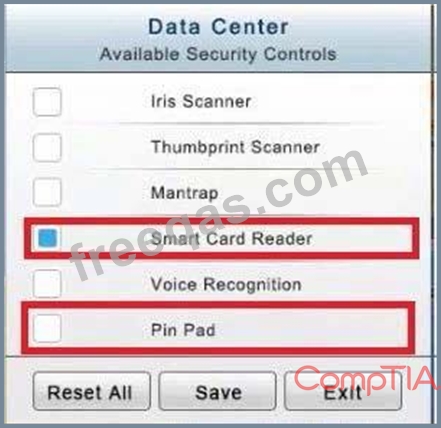
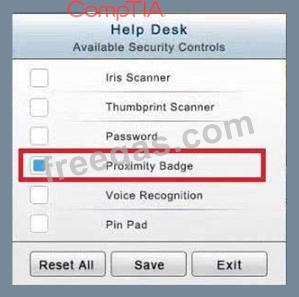
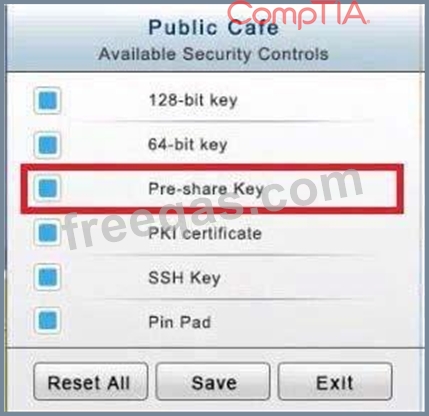
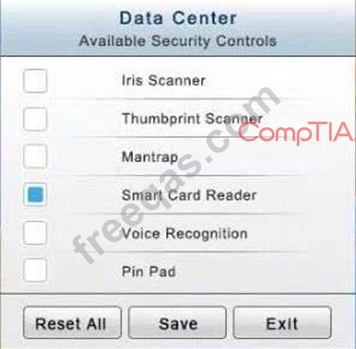
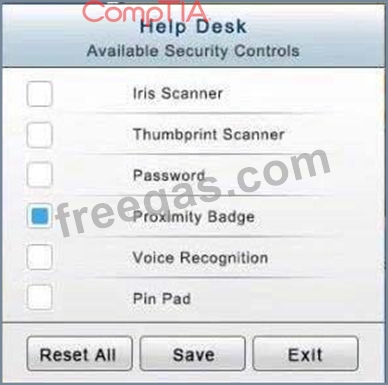
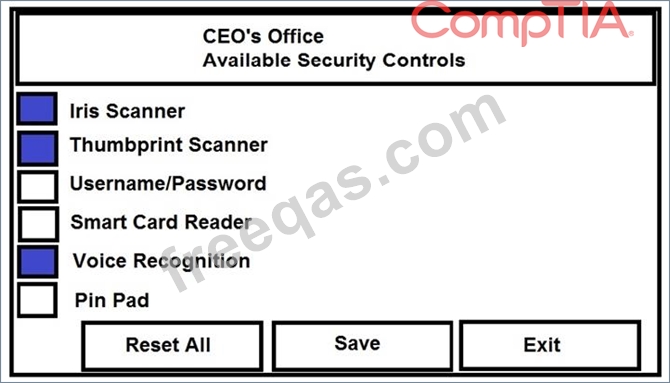
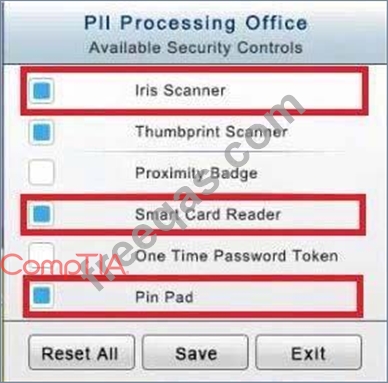
You have just received some room and WiFi access control recommendations from a security consulting company. Click on each building to bring up available security controls. Please implement the following requirements:
The Chief Executive Officer's (CEO) office had multiple redundant security measures installed on the door to the office. Remove unnecessary redundancies to deploy three-factor authentication, while retaining the expensive iris render.
The Public Cafe has wireless available to customers. You need to secure the WAP with WPA and place a passphrase on the customer receipts.
In the Data Center you need to include authentication from the "something you know" category and take advantage of the existing smartcard reader on the door.
In the Help Desk Office, you need to require single factor authentication through the use of physical tokens given to guests by the receptionist.
The PII Office has redundant security measures in place. You need to eliminate the redundancy while maintaining three-factor authentication and retaining the more expensive controls.
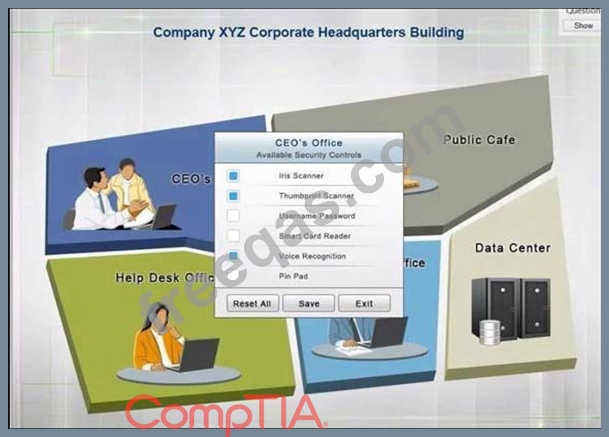
Instructions: The original security controls for each office can be reset at any time by selecting the Reset button. Once you have met the above requirements for each office, select the Save button. When you have completed the entire simulation, please select the Done button to submit. Once the simulation is submitted, please select the Next button to continue.
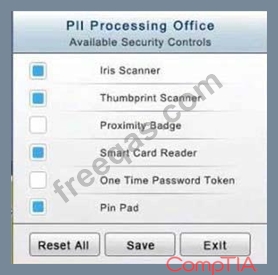

Correct Answer:
See the solution below.
Explanation/Reference:
Explanation:


insert code

Question 254

A security engineer is setting up passwordless authentication for the first time.
INSTRUCTIONS
Use the minimum set of commands to set this up and verify that it works. Commands cannot be reused.
If at any time you would like to bring back the initial state of the simulation, please click the Reset All button.
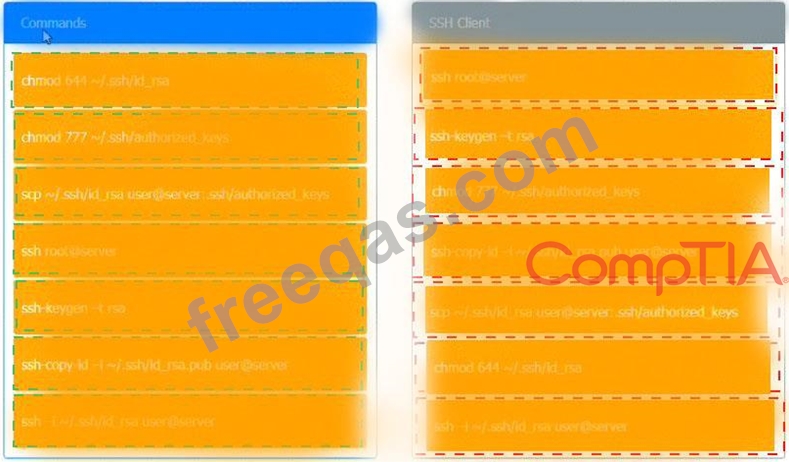
Correct Answer:

Explanation
insert code

Question 255

An organization with very high security needs wants to implement a biometric system. It is required to minimize unauthorized access by ensuring authorized personnel are not denied access. Which of the following solutions will work?


Correct Answer: B
insert code
  • ««
  • «
  • …
  • 47
  • 48
  • 49
  • 50
  • 51
  • 52
  • 53
  • 54
  • 55
  • 56
  • …
  • »
  • »»
[×]

Download PDF File

Enter your email address to download CompTIA.SYO-501.v2022-03-09.q467 Dumps

Email:

FreeQAs

Our website provides the Largest and the most Latest vendors Certification Exam materials around the world.

Using dumps we provide to Pass the Exam, we has the Valid Dumps with passing guranteed just which you need.

  • DMCA
  • About
  • Contact Us
  • Privacy Policy
  • Terms & Conditions
©2025 FreeQAs

www.freeqas.com materials do not contain actual questions and answers from Cisco's certification exams.