FreeQAs
 Request Exam  Contact
  • Home
  • View All Exams
  • New QA's
  • Upload
PRACTICE EXAMS:
  • Oracle
  • Fortinet
  • Juniper
  • Microsoft
  • Cisco
  • Citrix
  • CompTIA
  • VMware
  • SAP
  • EMC
  • PMI
  • HP
  • Salesforce
  • Other
  • Oracle
    Oracle
  • Fortinet
    Fortinet
  • Juniper
    Juniper
  • Microsoft
    Microsoft
  • Cisco
    Cisco
  • Citrix
    Citrix
  • CompTIA
    CompTIA
  • VMware
    VMware
  • SAP
    SAP
  • EMC
    EMC
  • PMI
    PMI
  • HP
    HP
  • Salesforce
    Salesforce
  1. Home
  2. Databricks Certification
  3. Associate-Developer-Apache-Spark-3.5 Exam
  4. Databricks.Associate-Developer-Apache-Spark-3.5.v2025-11-20.q72 Dumps
  • ««
  • «
  • …
  • 7
  • 8
  • 9
  • 10
  • 11
  • 12
  • 13
  • 14
  • 15
  • 16
  • »
Download Now

Question 56

A data scientist is working with a Spark DataFrame called customerDF that contains customer information. The DataFrame has a column named email with customer email addresses. The data scientist needs to split this column into username and domain parts.
Which code snippet splits the email column into username and domain columns?

Correct Answer: B
Option B is the correct and idiomatic approach in PySpark to split a string column (like email) based on a delimiter such as "@".
The split(col("email"), "@") function returns an array with two elements: username and domain.
getItem(0) retrieves the first part (username).
getItem(1) retrieves the second part (domain).
withColumn() is used to create new columns from the extracted values.
Example from official Databricks Spark documentation on splitting columns:
from pyspark.sql.functions import split, col
df.withColumn("username", split(col("email"), "@").getItem(0)) \
.withColumn("domain", split(col("email"), "@").getItem(1))
Why other options are incorrect:
A uses fixed substring indices (substr(0, 5)), which won't correctly extract usernames and domains of varying lengths.
C uses substring_index, which is available but less idiomatic for splitting emails and is slightly less readable.
D removes "@" from the email entirely, losing the separation between username and domain, and ends up duplicating values in both fields.
Therefore, Option B is the most accurate and reliable solution according to Apache Spark 3.5 best practices.
insert code

Question 57

A developer needs to produce a Python dictionary using data stored in a small Parquet table, which looks like this:

The resulting Python dictionary must contain a mapping of region-> region id containing the smallest 3 region_idvalues.
Which code fragment meets the requirements?
A)

B)

C)
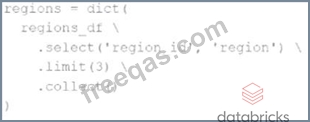
D)

The resulting Python dictionary must contain a mapping ofregion -> region_idfor the smallest
3region_idvalues.
Which code fragment meets the requirements?

Correct Answer: A
Comprehensive and Detailed Explanation From Exact Extract:
The question requires creating a dictionary where keys areregionvalues and values are the correspondingregion_idintegers. Furthermore, it asks to retrieve only the smallest 3region_idvalues.
Key observations:
select('region', 'region_id')puts the column order as expected bydict()- where the first column becomes the key and the second the value.
sort('region_id')ensures sorting in ascending order so the smallest IDs are first.
take(3)retrieves exactly 3 rows.
Wrapping the result indict(...)correctly builds the required Python dictionary:{ 'AFRICA': 0, 'AMERICA': 1,
'ASIA': 2 }.
Incorrect options:
Option B flips the order toregion_idfirst, resulting in a dictionary with integer keys - not what's asked.
Option C uses.limit(3)without sorting, which leads to non-deterministic rows based on partition layout.
Option D sorts in descending order, giving the largest rather than smallestregion_ids.
Hence, Option A meets all the requirements precisely.
insert code

Question 58

A Spark engineer must select an appropriate deployment mode for the Spark jobs.
What is the benefit of using cluster mode in Apache Spark™?

Correct Answer: D
In Apache Spark's cluster mode:
"The driver program runs on the cluster's worker node instead of the client's local machine. This allows the driver to be close to the data and other executors, reducing network overhead and improving fault tolerance for production jobs." (Source: Apache Spark documentation - Cluster Mode Overview)
"The driver program runs on the cluster's worker node instead of the client's local machine. This allows the driver to be close to the data and other executors, reducing network overhead and improving fault tolerance for production jobs." (Source: Apache Spark documentation - Cluster Mode Overview) This deployment is ideal for production environments where the job is submitted from a gateway node, and Spark manages the driver lifecycle on the cluster itself.
Option A is partially true but less specific than D.
Option B is incorrect: the driver never executes all tasks; executors handle distributed tasks.
Option C describes client mode, not cluster mode.
insert code

Question 59

An engineer has a large ORC file located at /file/test_data.orc and wants to read only specific columns to reduce memory usage.
Which code fragment will select the columns, i.e., col1, col2, during the reading process?

Correct Answer: D
The correct way to load specific columns from an ORC file is to first load the file using .load() and then apply .select() on the resulting DataFrame. This is valid with .read.format("orc") or the shortcut .read.orc().
df = spark.read.format("orc").load("/file/test_data.orc").select("col1", "col2") Why others are incorrect:
A performs selection after filtering, but doesn't match the intention to minimize memory at load.
B incorrectly tries to use .select() before .load(), which is invalid.
C uses a non-existent .selected() method.
D correctly loads and then selects.
insert code

Question 60

30 of 55.
A data engineer is working on a num_df DataFrame and has a Python UDF defined as:
def cube_func(val):
return val * val * val
Which code fragment registers and uses this UDF as a Spark SQL function to work with the DataFrame num_df?

Correct Answer: A
To use a Python function as a UDF (User Defined Function) in Spark SQL, it must first be registered using spark.udf.register().
Correct usage:
spark.udf.register("cube_func", cube_func)
num_df.selectExpr("cube_func(num)").show()
This registers cube_func as a callable SQL function available in expressions or queries.
Why the other options are incorrect:
B: You must wrap with udf() or selectExpr; calling plain Python functions won't work.
C: createDataFrame is for building DataFrames, not calling UDFs.
D: DataFrames cannot directly register UDFs.
Reference:
PySpark SQL Functions - spark.udf.register() and selectExpr().
Databricks Exam Guide (June 2025): Section "Using Spark SQL" - user-defined functions and Spark SQL integration.
insert code
  • ««
  • «
  • …
  • 7
  • 8
  • 9
  • 10
  • 11
  • 12
  • 13
  • 14
  • 15
  • 16
  • »
[×]

Download PDF File

Enter your email address to download Databricks.Associate-Developer-Apache-Spark-3.5.v2025-11-20.q72 Dumps


Email:

FreeQAs

Our website provides the Largest and the most Latest vendors Certification Exam materials around the world.

Using dumps we provide to Pass the Exam, we has the Valid Dumps with passing guranteed just which you need.

  • DMCA
  • About
  • Contact Us
  • Privacy Policy
  • Terms & Conditions
©2026 FreeQAs

www.freeqas.com materials do not contain actual questions and answers from Cisco's certification exams.