FreeQAs
 Request Exam  Contact
  • Home
  • View All Exams
  • New QA's
  • Upload
PRACTICE EXAMS:
  • Oracle
  • Fortinet
  • Juniper
  • Microsoft
  • Cisco
  • Citrix
  • CompTIA
  • VMware
  • SAP
  • EMC
  • PMI
  • HP
  • Salesforce
  • Other
  • Oracle
    Oracle
  • Fortinet
    Fortinet
  • Juniper
    Juniper
  • Microsoft
    Microsoft
  • Cisco
    Cisco
  • Citrix
    Citrix
  • CompTIA
    CompTIA
  • VMware
    VMware
  • SAP
    SAP
  • EMC
    EMC
  • PMI
    PMI
  • HP
    HP
  • Salesforce
    Salesforce
  1. Home
  2. Databricks Certification
  3. Associate-Developer-Apache-Spark-3.5 Exam
  4. Databricks.Associate-Developer-Apache-Spark-3.5.v2025-11-20.q72 Dumps
  • ««
  • «
  • …
  • 2
  • 3
  • 4
  • 5
  • 6
  • 7
  • 8
  • 9
  • 10
  • 11
  • …
  • »
  • »»
Download Now

Question 26

A Data Analyst needs to retrieve employees with 5 or more years of tenure.
Which code snippet filters and shows the list?

Correct Answer: A
To filter rows based on a condition and display them in Spark, use filter(...).show():
employees_df.filter(employees_df.tenure >= 5).show()
Option A is correct and shows the results.
Option B filters but doesn't display them.
Option C uses Python's built-in filter, not Spark.
Option D collects the results to the driver, which is unnecessary if .show() is sufficient.
Final answer: A
insert code

Question 27

A data engineer needs to persist a file-based data source to a specific location. However, by default, Spark writes to the warehouse directory (e.g., /user/hive/warehouse). To override this, the engineer must explicitly define the file path.
Which line of code ensures the data is saved to a specific location?
Options:

Correct Answer: C
To persist a table and specify the save path, use:
users.write.option("path","/some/path").saveAsTable("default_table")
The .option("path", ...) must be applied before calling saveAsTable.
Option A uses invalid syntax (write(path=...)).
Option B applies.option()after.saveAsTable()-which is too late.
Option D uses incorrect syntax (no path parameter in saveAsTable).
Reference:Spark SQL - Save as Table
insert code

Question 28

A data engineer observes that an upstream streaming source sends duplicate records, where duplicates share the same key and have at most a 30-minute difference inevent_timestamp. The engineer adds:
dropDuplicatesWithinWatermark("event_timestamp", "30 minutes")
What is the result?

Correct Answer: B
Comprehensive and Detailed Explanation From Exact Extract:
The methoddropDuplicatesWithinWatermark()in Structured Streaming drops duplicate records based on a specified column and watermark window. The watermark defines the threshold for how late data is considered valid.
From the Spark documentation:
"dropDuplicatesWithinWatermark removes duplicates that occur within the event-time watermark window." In this case, Spark will retain the first occurrence and drop subsequent records within the 30-minute watermark window.
Final Answer: B
insert code

Question 29

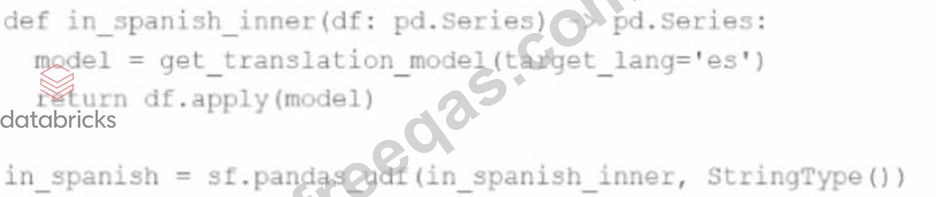
An MLOps engineer is building a Pandas UDF that applies a language model that translates English strings into Spanish. The initial code is loading the model on every call to the UDF, which is hurting the performance of the data pipeline.
The initial code is:
def in_spanish_inner(df: pd.Series) -> pd.Series:
model = get_translation_model(target_lang='es')
return df.apply(model)
in_spanish = sf.pandas_udf(in_spanish_inner, StringType())
How can the MLOps engineer change this code to reduce how many times the language model is loaded?

Correct Answer: D
The provided code defines a Pandas UDF of type Series-to-Series, where a new instance of the language model is created on each call, which happens per batch. This is inefficient and results in significant overhead due to repeated model initialization.
To reduce the frequency of model loading, the engineer should convert the UDF to an iterator-based Pandas UDF (Iterator[pd.Series] -> Iterator[pd.Series]). This allows the model to be loaded once per executor and reused across multiple batches, rather than once per call.
From the official Databricks documentation:
"Iterator of Series to Iterator of Series UDFs are useful when the UDF initialization is expensive... For example, loading a ML model once per executor rather than once per row/batch."
- Databricks Official Docs: Pandas UDFs
Correct implementation looks like:
python
CopyEdit
@pandas_udf("string")
def translate_udf(batch_iter: Iterator[pd.Series]) -> Iterator[pd.Series]:
model = get_translation_model(target_lang='es')
for batch in batch_iter:
yield batch.apply(model)
This refactor ensures the get_translation_model() is invoked once per executor process, not per batch, significantly improving pipeline performance.
insert code

Question 30

A Spark application developer wants to identify which operations cause shuffling, leading to a new stage in the Spark execution plan.
Which operation results in a shuffle and a new stage?

Correct Answer: A
Operations that trigger data movement across partitions (like groupBy, join, repartition) result in a shuffle and a new stage.
From Spark documentation:
"groupBy and aggregation cause data to be shuffled across partitions to combine rows with the same key." Option A (groupBy + agg) → causes shuffle.
Options B, C, and D (filter, withColumn, select) → transformations that do not require shuffling; they are narrow dependencies.
Final answer: A
insert code
  • ««
  • «
  • …
  • 2
  • 3
  • 4
  • 5
  • 6
  • 7
  • 8
  • 9
  • 10
  • 11
  • …
  • »
  • »»
[×]

Download PDF File

Enter your email address to download Databricks.Associate-Developer-Apache-Spark-3.5.v2025-11-20.q72 Dumps


Email:

FreeQAs

Our website provides the Largest and the most Latest vendors Certification Exam materials around the world.

Using dumps we provide to Pass the Exam, we has the Valid Dumps with passing guranteed just which you need.

  • DMCA
  • About
  • Contact Us
  • Privacy Policy
  • Terms & Conditions
©2026 FreeQAs

www.freeqas.com materials do not contain actual questions and answers from Cisco's certification exams.