FreeQAs
 Request Exam  Contact
  • Home
  • View All Exams
  • New QA's
  • Upload
PRACTICE EXAMS:
  • Oracle
  • Fortinet
  • Juniper
  • Microsoft
  • Cisco
  • Citrix
  • CompTIA
  • VMware
  • SAP
  • EMC
  • PMI
  • HP
  • Salesforce
  • Other
  • Oracle
    Oracle
  • Fortinet
    Fortinet
  • Juniper
    Juniper
  • Microsoft
    Microsoft
  • Cisco
    Cisco
  • Citrix
    Citrix
  • CompTIA
    CompTIA
  • VMware
    VMware
  • SAP
    SAP
  • EMC
    EMC
  • PMI
    PMI
  • HP
    HP
  • Salesforce
    Salesforce
  1. Home
  2. Databricks Certification
  3. Associate-Developer-Apache-Spark-3.5 Exam
  4. Databricks.Associate-Developer-Apache-Spark-3.5.v2025-11-20.q72 Dumps
  • ««
  • «
  • …
  • 4
  • 5
  • 6
  • 7
  • 8
  • 9
  • 10
  • 11
  • 12
  • 13
  • …
  • »
  • »»
Download Now

Question 36

A Spark engineer must select an appropriate deployment mode for the Spark jobs.
What is the benefit of using cluster mode in Apache Spark™?

Correct Answer: D
Comprehensive and Detailed Explanation From Exact Extract:
In Apache Spark's cluster mode:
"The driver program runs on the cluster's worker node instead of the client's local machine. This allows the driver to be close to the data and other executors, reducing network overhead and improving fault tolerance for production jobs." (Source: Apache Spark documentation -Cluster Mode Overview) This deployment is ideal for production environments where the job is submitted from a gateway node, and Spark manages the driver lifecycle on the cluster itself.
Option A is partially true but less specific than D.
Option B is incorrect: the driver never executes all tasks; executors handle distributed tasks.
Option C describes client mode, not cluster mode.
insert code

Question 37

2 of 55. Which command overwrites an existing JSON file when writing a DataFrame?

Correct Answer: D
When writing DataFrames to files using the Spark DataFrameWriter API, Spark by default raises an error if the target path already exists. To explicitly overwrite existing data, you must specify the write mode as "overwrite".
Correct Syntax:
df.write.mode("overwrite").json("path/to/file")
This command removes the existing file or directory at the specified path and writes the new output in JSON format.
Other supported save modes include:
"append" - Adds new data to existing files.
"ignore" - Skips writing if the path already exists.
"error" or "errorifexists" - Fails the job if the output path exists (default).
Why other options are incorrect:
A: Defaults to "error" mode, which fails if the path exists.
B: "append" only adds data; it does not overwrite existing data.
C: .option("overwrite") is invalid - mode("overwrite") must be used instead.
Reference (Databricks Apache Spark 3.5 - Python / Study Guide):
PySpark API Reference: DataFrameWriter.mode() - describes valid write modes including "overwrite".
PySpark API Reference: DataFrameWriter.json() - method to write DataFrames in JSON format.
Databricks Certified Associate Developer for Apache Spark Exam Guide (June 2025): Section "Using Spark DataFrame APIs" - Reading and writing DataFrames using save modes, schema management, and partitioning.
insert code

Question 38

A data scientist of an e-commerce company is working with user data obtained from its subscriber database and has stored the data in a DataFrame df_user. Before further processing the data, the data scientist wants to create another DataFrame df_user_non_pii and store only the non-PII columns in this DataFrame. The PII columns in df_user are first_name, last_name, email, and birthdate.
Which code snippet can be used to meet this requirement?

Correct Answer: A
To remove specific columns from a PySpark DataFrame, the drop() method is used. This method returns a new DataFrame without the specified columns. The correct syntax for dropping multiple columns is to pass each column name as a separate argument to the drop() method.
Correct Usage:
df_user_non_pii = df_user.drop("first_name", "last_name", "email", "birthdate") This line of code will return a new DataFrame df_user_non_pii that excludes the specified PII columns.
Explanation of Options:
A . Correct. Uses the drop() method with multiple column names passed as separate arguments, which is the standard and correct usage in PySpark.
B . Although it appears similar to Option A, if the column names are not enclosed in quotes or if there's a syntax error (e.g., missing quotes or incorrect variable names), it would result in an error. However, as written, it's identical to Option A and thus also correct.
C . Incorrect. The dropfields() method is not a method of the DataFrame class in PySpark. It's used with StructType columns to drop fields from nested structures, not top-level DataFrame columns.
D . Incorrect. Passing a single string with comma-separated column names to dropfields() is not valid syntax in PySpark.
Reference:
PySpark Documentation: DataFrame.drop
Stack Overflow Discussion: How to delete columns in PySpark DataFrame
insert code

Question 39

An engineer has a large ORC file located at/file/test_data.orcand wants to read only specific columns to reduce memory usage.
Which code fragment will select the columns, i.e.,col1,col2, during the reading process?

Correct Answer: D
Comprehensive and Detailed Explanation From Exact Extract:
The correct way to load specific columns from an ORC file is to first load the file using.load()and then apply.
select()on the resulting DataFrame. This is valid with.read.format("orc")or the shortcut.read.orc().
df = spark.read.format("orc").load("/file/test_data.orc").select("col1","col2") Why others are incorrect:
Aperforms selection after filtering, but doesn't match the intention to minimize memory at load.
Bincorrectly tries to use.select()before.load(), which is invalid.
Cuses a non-existent.selected()method.
Dcorrectly loads and then selects.
Reference:Apache Spark SQL API - ORC Format
insert code

Question 40

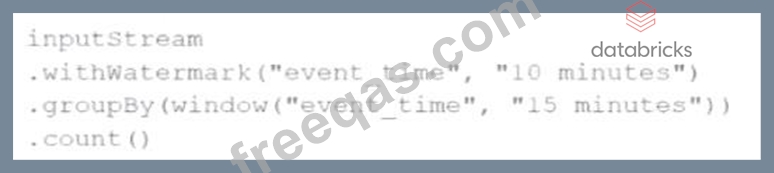
Given this code:

.withWatermark("event_time","10 minutes")
.groupBy(window("event_time","15 minutes"))
.count()
What happens to data that arrives after the watermark threshold?
Options:

Correct Answer: B
According to Spark's watermarking rules:
"Records that are older than the watermark (event time < current watermark) are considered too late and are dropped." So, if a record'sevent_timeis earlier than (max event_time seen so far - 10 minutes), it is discarded.
Reference:Structured Streaming - Handling Late Data
insert code
  • ««
  • «
  • …
  • 4
  • 5
  • 6
  • 7
  • 8
  • 9
  • 10
  • 11
  • 12
  • 13
  • …
  • »
  • »»
[×]

Download PDF File

Enter your email address to download Databricks.Associate-Developer-Apache-Spark-3.5.v2025-11-20.q72 Dumps


Email:

FreeQAs

Our website provides the Largest and the most Latest vendors Certification Exam materials around the world.

Using dumps we provide to Pass the Exam, we has the Valid Dumps with passing guranteed just which you need.

  • DMCA
  • About
  • Contact Us
  • Privacy Policy
  • Terms & Conditions
©2026 FreeQAs

www.freeqas.com materials do not contain actual questions and answers from Cisco's certification exams.