FreeQAs
 Request Exam  Contact
  • Home
  • View All Exams
  • New QA's
  • Upload
PRACTICE EXAMS:
  • Oracle
  • Fortinet
  • Juniper
  • Microsoft
  • Cisco
  • Citrix
  • CompTIA
  • VMware
  • SAP
  • EMC
  • PMI
  • HP
  • Salesforce
  • Other
  • Oracle
    Oracle
  • Fortinet
    Fortinet
  • Juniper
    Juniper
  • Microsoft
    Microsoft
  • Cisco
    Cisco
  • Citrix
    Citrix
  • CompTIA
    CompTIA
  • VMware
    VMware
  • SAP
    SAP
  • EMC
    EMC
  • PMI
    PMI
  • HP
    HP
  • Salesforce
    Salesforce
  1. Home
  2. Databricks Certification
  3. Associate-Developer-Apache-Spark-3.5 Exam
  4. Databricks.Associate-Developer-Apache-Spark-3.5.v2025-11-20.q72 Dumps
  • «
  • 1
  • 2
  • 3
  • 4
  • 5
  • 6
  • 7
  • 8
  • 9
  • 10
  • …
  • »
  • »»
Download Now

Question 6

15 of 55.
A data engineer is working on a Streaming DataFrame (streaming_df) with the following streaming data:
id
name
count
timestamp
1
Delhi
20
2024-09-19T10:11
1
Delhi
50
2024-09-19T10:12
2
London
50
2024-09-19T10:15
3
Paris
30
2024-09-19T10:18
3
Paris
20
2024-09-19T10:20
4
Washington
10
2024-09-19T10:22
Which operation is supported with streaming_df?

Correct Answer: B
In Structured Streaming, only transformation operations are allowed on streaming DataFrames. These include select(), filter(), where(), groupBy(), withColumn(), etc.
Example of supported transformation:
filtered_df = streaming_df.filter("count < 30")
However, actions such as count(), show(), and collect() are not supported directly on streaming DataFrames because streaming queries are unbounded and never finish until stopped.
To perform aggregations, the query must be executed through writeStream and an output sink.
Why the other options are incorrect:
A: count() is an action, not allowed directly on streaming DataFrames.
C: countDistinct() is a stateful aggregation, not supported outside of a proper streaming query.
D: show() is also an action, unsupported on streaming queries.
Reference:
PySpark Structured Streaming Programming Guide - supported transformations and actions.
Databricks Exam Guide (June 2025): Section "Structured Streaming" - performing operations on streaming DataFrames and understanding supported transformations.
insert code

Question 7

25 of 55.
A Data Analyst is working on employees_df and needs to add a new column where a 10% tax is calculated on the salary.
Additionally, the DataFrame contains the column age, which is not needed.
Which code fragment adds the tax column and removes the age column?

Correct Answer: A
To create a new calculated column in Spark, use the .withColumn() method.
To remove an unwanted column, use the .drop() method.
Correct syntax:
from pyspark.sql.functions import col
employees_df = employees_df.withColumn("tax", col("salary") * 0.1).drop("age")
.withColumn("tax", col("salary") * 0.1) → adds a new column where tax = 10% of salary.
.drop("age") → removes the age column from the DataFrame.
Why the other options are incorrect:
B: lit(0.1) creates a constant value, not a calculated tax.
C: .dropField() is not a DataFrame API method (used only in struct field manipulations).
D: Adds 0.1 to salary instead of calculating 10%.
Reference:
PySpark DataFrame API - withColumn(), drop(), and col().
Databricks Exam Guide (June 2025): Section "Developing Apache Spark DataFrame/DataSet API Applications" - manipulating, renaming, and dropping columns.
insert code

Question 8

Which command overwrites an existing JSON file when writing a DataFrame?

Correct Answer: A
The correct way to overwrite an existing file using the DataFrameWriter is:
df.write.mode("overwrite").json("path/to/file")
Option D is also technically valid, but Option A is the most concise and idiomatic PySpark syntax.
Reference:PySpark DataFrameWriter API
insert code

Question 9

A developer initializes a SparkSession:
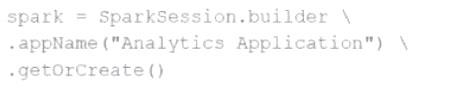
spark = SparkSession.builder \
.appName("Analytics Application") \
.getOrCreate()
Which statement describes thesparkSparkSession?

Correct Answer: C
Comprehensive and Detailed Explanation From Exact Extract:
According to the PySpark API documentation:
"getOrCreate(): Gets an existing SparkSession or, if there is no existing one, creates a new one based on the options set in this builder." This means Spark maintains a global singleton session within a JVM process. Repeated calls togetOrCreate() return the same session, unless explicitly stopped.
Option A is incorrect: the method does not destroy any session.
Option B incorrectly ties uniqueness toappName, which does not influence session reusability.
Option D is incorrect: it contradicts the fundamental behavior ofgetOrCreate().
(Source:PySpark SparkSession API Docs)
insert code

Question 10

What is the risk associated with this operation when converting a large Pandas API on Spark DataFrame back to a Pandas DataFrame?

Correct Answer: D
Comprehensive and Detailed Explanation From Exact Extract:
When you convert a largepyspark.pandas(aka Pandas API on Spark) DataFrame to a local Pandas DataFrame using.toPandas(), Spark collects all partitions to the driver.
From the Spark documentation:
"Be careful when converting large datasets to Pandas. The entire dataset will be pulled into the driver's memory." Thus, for large datasets, this can cause memory overflow or out-of-memory errors on the driver.
Final Answer: D
insert code
  • «
  • 1
  • 2
  • 3
  • 4
  • 5
  • 6
  • 7
  • 8
  • 9
  • 10
  • …
  • »
  • »»
[×]

Download PDF File

Enter your email address to download Databricks.Associate-Developer-Apache-Spark-3.5.v2025-11-20.q72 Dumps


Email:

FreeQAs

Our website provides the Largest and the most Latest vendors Certification Exam materials around the world.

Using dumps we provide to Pass the Exam, we has the Valid Dumps with passing guranteed just which you need.

  • DMCA
  • About
  • Contact Us
  • Privacy Policy
  • Terms & Conditions
©2026 FreeQAs

www.freeqas.com materials do not contain actual questions and answers from Cisco's certification exams.