FreeQAs
 Request Exam  Contact
  • Home
  • View All Exams
  • New QA's
  • Upload
PRACTICE EXAMS:
  • Oracle
  • Fortinet
  • Juniper
  • Microsoft
  • Cisco
  • Citrix
  • CompTIA
  • VMware
  • SAP
  • EMC
  • PMI
  • HP
  • Salesforce
  • Other
  • Oracle
    Oracle
  • Fortinet
    Fortinet
  • Juniper
    Juniper
  • Microsoft
    Microsoft
  • Cisco
    Cisco
  • Citrix
    Citrix
  • CompTIA
    CompTIA
  • VMware
    VMware
  • SAP
    SAP
  • EMC
    EMC
  • PMI
    PMI
  • HP
    HP
  • Salesforce
    Salesforce
  1. Home
  2. Databricks Certification
  3. Associate-Developer-Apache-Spark-3.5 Exam
  4. Databricks.Associate-Developer-Apache-Spark-3.5.v2025-11-20.q72 Dumps
  • «
  • 1
  • 2
  • 3
  • 4
  • 5
  • 6
  • 7
  • 8
  • 9
  • 10
  • …
  • »
  • »»
Download Now

Question 16

Given the code fragment:

import pyspark.pandas as ps
psdf = ps.DataFrame({'col1': [1, 2], 'col2': [3, 4]})
Which method is used to convert a Pandas API on Spark DataFrame (pyspark.pandas.DataFrame) into a standard PySpark DataFrame (pyspark.sql.DataFrame)?

Correct Answer: A
Pandas API on Spark (pyspark.pandas) allows interoperability with PySpark DataFrames. To convert a pyspark.pandas.DataFrame to a standard PySpark DataFrame, you use .to_spark().
Example:
df = psdf.to_spark()
This is the officially supported method as per Databricks Documentation.
Incorrect options:
B, D: Invalid or nonexistent methods.
C: Converts to a local pandas DataFrame, not a PySpark DataFrame.
insert code

Question 17

A data scientist is analyzing a large dataset and has written a PySpark script that includes several transformations and actions on a DataFrame. The script ends with acollect()action to retrieve the results.
How does Apache Spark™'s execution hierarchy process the operations when the data scientist runs this script?

Correct Answer: C
Comprehensive and Detailed Explanation From Exact Extract:
In Apache Spark, the execution hierarchy is structured as follows:
Application: The highest-level unit, representing the user program built on Spark.
Job: Triggered by an action (e.g.,collect(),count()). Each action corresponds to a job.
Stage: A job is divided into stages based on shuffle boundaries. Each stage contains tasks that can be executed in parallel.
Task: The smallest unit of work, representing a single operation applied to a partition of the data.
When thecollect()action is invoked, Spark initiates a job. This job is then divided into stages at points where data shuffling is required (i.e., wide transformations). Each stage comprises tasks that are distributed across the cluster's executors, operating on individual data partitions.
This hierarchical execution model allows Spark to efficiently process large-scale data by parallelizing tasks and optimizing resource utilization.
insert code

Question 18

A data engineer is streaming data from Kafka and requires:
Minimal latency
Exactly-once processing guarantees
Which trigger mode should be used?

Correct Answer: A
Comprehensive and Detailed Explanation:
Exactly-once guarantees in Spark Structured Streaming require micro-batch mode (default), not continuous mode.
Continuous mode (.trigger(continuous=...)) only supports at-least-once semantics and lacks full fault- tolerance.
trigger(availableNow=True)is a batch-style trigger, not suited for low-latency streaming.
So:
Option A uses micro-batching with a tight trigger interval # minimal latency + exactly-once guarantee.
Final Answer: A
insert code

Question 19

45 of 55.
Which feature of Spark Connect should be considered when designing an application that plans to enable remote interaction with a Spark cluster?

Correct Answer: D
Spark Connect enables remote execution of Spark jobs by decoupling the client from the driver using the Spark Connect protocol (gRPC).
It allows users to run Spark code from different environments (like notebooks, IDEs, or remote clients) while executing jobs on the cluster.
Key Features:
Enables remote interaction between client and Spark driver.
Supports interactive development and lightweight client sessions.
Improves developer productivity without needing driver resources locally.
Why the other options are incorrect:
A: Spark Connect is not limited to ingestion tasks.
B: It allows multi-language clients (Python, Scala, etc.) but runs via Spark Connect API, not arbitrary remote code.
C: Uses gRPC protocol, not REST.
Reference:
Databricks Exam Guide (June 2025): Section "Using Spark Connect to Deploy Applications" - describes Spark Connect architecture and remote execution model.
Spark 3.5 Documentation - Spark Connect overview and client-server protocol.
insert code

Question 20

A developer initializes a SparkSession:
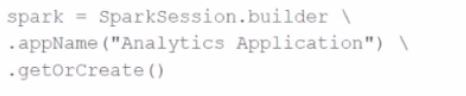
spark = SparkSession.builder \
.appName("Analytics Application") \
.getOrCreate()
Which statement describes the spark SparkSession?

Correct Answer: C
According to the PySpark API documentation:
"getOrCreate(): Gets an existing SparkSession or, if there is no existing one, creates a new one based on the options set in this builder." This means Spark maintains a global singleton session within a JVM process. Repeated calls to getOrCreate() return the same session, unless explicitly stopped.
Option A is incorrect: the method does not destroy any session.
Option B incorrectly ties uniqueness to appName, which does not influence session reusability.
Option D is incorrect: it contradicts the fundamental behavior of getOrCreate().
(Source: PySpark SparkSession API Docs)
insert code
  • «
  • 1
  • 2
  • 3
  • 4
  • 5
  • 6
  • 7
  • 8
  • 9
  • 10
  • …
  • »
  • »»
[×]

Download PDF File

Enter your email address to download Databricks.Associate-Developer-Apache-Spark-3.5.v2025-11-20.q72 Dumps


Email:

FreeQAs

Our website provides the Largest and the most Latest vendors Certification Exam materials around the world.

Using dumps we provide to Pass the Exam, we has the Valid Dumps with passing guranteed just which you need.

  • DMCA
  • About
  • Contact Us
  • Privacy Policy
  • Terms & Conditions
©2026 FreeQAs

www.freeqas.com materials do not contain actual questions and answers from Cisco's certification exams.