FreeQAs
 Request Exam  Contact
  • Home
  • View All Exams
  • New QA's
  • Upload
PRACTICE EXAMS:
  • Oracle
  • Fortinet
  • Juniper
  • Microsoft
  • Cisco
  • Citrix
  • CompTIA
  • VMware
  • ISC
  • SAP
  • EMC
  • PMI
  • HP
  • Salesforce
  • Other
  • Oracle
    Oracle
  • Fortinet
    Fortinet
  • Juniper
    Juniper
  • Microsoft
    Microsoft
  • Cisco
    Cisco
  • Citrix
    Citrix
  • CompTIA
    CompTIA
  • VMware
    VMware
  • ISC
    ISC
  • SAP
    SAP
  • EMC
    EMC
  • PMI
    PMI
  • HP
    HP
  • Salesforce
    Salesforce
  1. Home
  2. ECCouncil Certification
  3. 312-96 Exam
  4. ECCouncil.312-96.v2024-07-23.q33 Dumps
  • «
  • 1
  • 2
  • 3
  • 4
  • 5
  • 6
  • 7
  • 8
  • »
Download Now

Question 6

Ted is an application security engineer who ensures application security activities are being followed during the entire lifecycle of the project. One day, he was analyzing various interactions of users depicted in the use cases of the project under inception. Based on the use case in hand, he started depicting the scenarios where attacker could misuse the application. Can you identify the activity on which Ted is working?

Correct Answer: A
Ted is engaged in the activity of depicting abuse cases. Abuse cases are a form of negative use cases that describe how an application can be misused or attacked. They are used to identify potential security vulnerabilities and to design countermeasures that can prevent or mitigate these attacks. By analyzing the interactions of users as depicted in the use cases, Ted is able to envision scenarios where an attacker could exploit the application, which is essential for strengthening the application's security posture.
References:For specific references, please consult the EC-Council Application Security Engineer (CASE) JAVA related courses and study guides. These resources will provide detailed information on abuse cases and their role in application security. My response is based on the general knowledge of application security practices up to the year 2021. Please note that I do not have real-time access to external databases or the internet for document retrieval.
insert code

Question 7

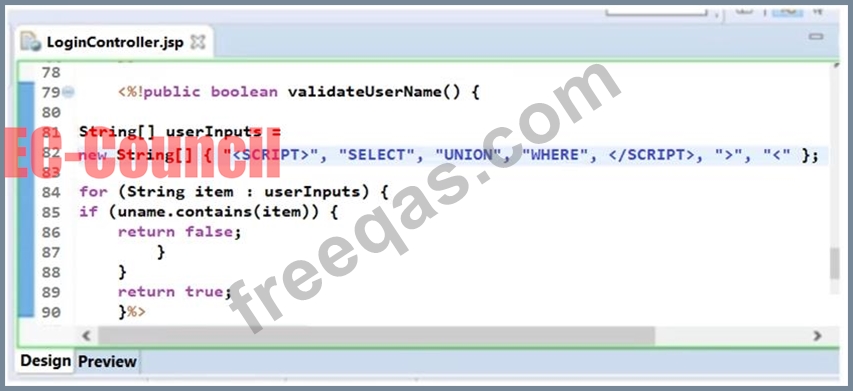
Sam, an application security engineer working in INFRA INC., was conducting a secure code review on an application developed in Jav a. He found that the developer has used a piece of code as shown in the following screenshot. Identify the security mistakes that the developer has coded?
Correct Answer: B
insert code

Question 8

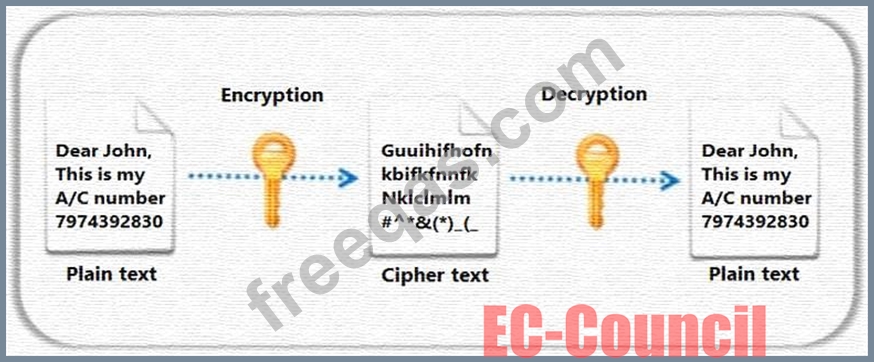
Identify the type of encryption depicted in the following figure.
Correct Answer: C
The image depicts a process where a single key is used for both encryption and decryption, which is characteristic of symmetric encryption. In symmetric encryption, the same key is applied to encrypt plaintext into ciphertext and then used again to decrypt the ciphertext back into the original plaintext. This method is efficient for scenarios where secure channels exist for key exchange.
References:For precise references, please consult the EC-Council Application Security Engineer (CASE) JAVA related courses and study guides, as my capabilities are designed to provide information based on general knowledge and do not include real-time access to external databases or documents.
insert code

Question 9

James is a Java developer working INFR INC. He has written Java code to open a file, read it line by line and display its content in the text editor. He wants to ensure that any unhandled exception raised by the code should automatically close the opened file stream. Which of the following exception handling block should he use for the above purpose?

Correct Answer: C
James should use the Try-With-Resources block to ensure that any unhandled exception raised by the code will automatically close the opened file stream. The Try-With-Resources block is a feature introduced in Java
7 that allows for more efficient management of resources, such as files, that need to be closed after operations on them are completed.
Here's how it works:
* The resource declared within the try parentheses is initialized.
* The try block executes with the resource.
* If an exception occurs, it's caught by an optional catch block.
* After the try (and optionally catch) block execution, the resource is automatically closed.
This approach eliminates the need for a finally block to explicitly close the resource, reducing the risk of resource leaks and making the code cleaner and more readable.
References: The Try-With-Resources block is a well-documented feature in Java and is recommended for managing resources in Java applications as per the EC-Council's Application Security Engineer (CASE) JAVA certification guidelines1. It is also a part of best practices in exception handling in Java, as noted in various Java programming resources2.
insert code

Question 10

Which of the threat classification model is used to classify threats during threat modeling process?


Correct Answer: B
STRIDE is a threat classification model used during the threat modeling process. It stands for Spoofing, Tampering, Repudiation, Information Disclosure, Denial of Service, and Elevation of Privilege. These categories represent the types of threats that can be posed to software systems. STRIDE helps in identifying potential security threats to a system and is commonly used to classify threats in threat modeling.
The STRIDE model is particularly useful because it covers a broad range of security threats and is designed to be easy to understand and apply. Each category of STRIDE addresses a specific area of security concern:
* Spoofing: Impersonating something or someone else.
* Tampering: Modifying data or code.
* Repudiation: Claiming not to have performed an action.
* Information Disclosure: Exposing information to someone not authorized to see it.
* Denial of Service (DoS): Interrupting access to resources.
* Elevation of Privilege: Gaining capabilities without proper authorization.
By using STRIDE, security professionals can systematically identify and address potential vulnerabilities within an application.
References:For detailed information and learning resources, please refer to the EC-Council's Certified Application Security Engineer (CASE) JAVA courses and study guides, which provide extensive coverage on threat modeling and the STRIDE methodology12. These resources will offer a comprehensive understanding of the application of STRIDE in threat modeling. Additionally, the OWASP Foundation provides valuable insights into the threat modeling process, including the use of STRIDE13.
insert code
  • «
  • 1
  • 2
  • 3
  • 4
  • 5
  • 6
  • 7
  • 8
  • »
[×]

Download PDF File

Enter your email address to download ECCouncil.312-96.v2024-07-23.q33 Dumps

Email:

FreeQAs

Our website provides the Largest and the most Latest vendors Certification Exam materials around the world.

Using dumps we provide to Pass the Exam, we has the Valid Dumps with passing guranteed just which you need.

  • DMCA
  • About
  • Contact Us
  • Privacy Policy
  • Terms & Conditions
©2026 FreeQAs

www.freeqas.com materials do not contain actual questions and answers from Cisco's certification exams.