FreeQAs
 Request Exam  Contact
  • Home
  • View All Exams
  • New QA's
  • Upload
PRACTICE EXAMS:
  • Oracle
  • Fortinet
  • Juniper
  • Microsoft
  • Cisco
  • Citrix
  • CompTIA
  • VMware
  • ISC
  • SAP
  • EMC
  • PMI
  • HP
  • Salesforce
  • Other
  • Oracle
    Oracle
  • Fortinet
    Fortinet
  • Juniper
    Juniper
  • Microsoft
    Microsoft
  • Cisco
    Cisco
  • Citrix
    Citrix
  • CompTIA
    CompTIA
  • VMware
    VMware
  • ISC
    ISC
  • SAP
    SAP
  • EMC
    EMC
  • PMI
    PMI
  • HP
    HP
  • Salesforce
    Salesforce
  1. Home
  2. ECCouncil Certification
  3. 312-96 Exam
  4. ECCouncil.312-96.v2024-07-23.q33 Dumps
  • «
  • 1
  • 2
  • 3
  • 4
  • 5
  • 6
  • 7
  • 8
  • »
Download Now

Question 11

Which of the following can be derived from abuse cases to elicit security requirements for software system?

Correct Answer: C
insert code

Question 12

Which of the following Spring Security Framework configuration setting will ensure the protection from session fixation attacks by not allowing authenticated user to login again?

Correct Answer: B
Spring Security provides built-in protection against session fixation attacks. It does this by invalidating the existing session and creating a new one when a user authenticates. This behavior can be configured using the sessionManagement() method in the Java configuration. The newSession strategy, which is the default, changes the session ID upon authentication to protect against session fixation.
Here's an example of how it can be configured:
Java
http.sessionManagement()
sessionFixation().migrateSession();
AI-generated code. Review and use carefully. More info on FAQ.
This configuration ensures that a new session is created, and the old one is invalidated when the user logs in, thus providing protection against session fixation attacks.
References:The information provided is based on the standard configuration practices for Spring Security to protect against session fixation attacks. For more detailed information, you can refer to the official Spring Security documentation123 and other authoritative resources on Spring Security session management.
insert code

Question 13

Which of the risk assessment model is used to rate the threats-based risk to the application during threat modeling process?

Correct Answer: C
STRIDE is a risk assessment model used to identify and rate threats during the threat modeling process. It stands for Spoofing, Tampering, Repudiation, Information Disclosure, Denial of Service, and Elevation of Privilege. Each element of STRIDE represents a specific type of threat that could potentially affect an application, and it is used to systematically assess the security of an application by identifying possible vulnerabilities that could be exploited by these threats.
References: The EC-Council's Certified Application Security Engineer (CASE) JAVA course emphasizes the importance of threat modeling in the software development lifecycle and specifically mentions the use of models like STRIDE to assess and mitigate risks12.
insert code

Question 14

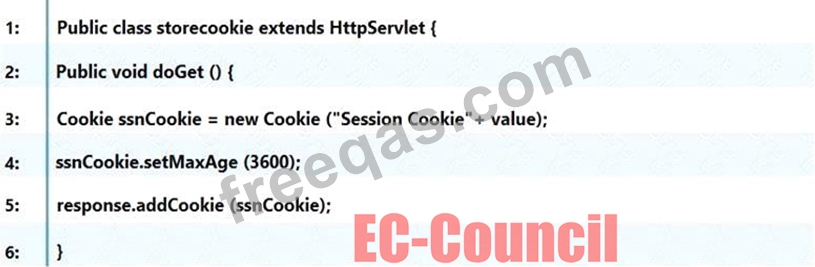
Which line of the following example of Java Code can make application vulnerable to a session attack?
Correct Answer: B
In general, session management is a critical aspect of application security. A common vulnerability related to session management is the improper handling of session tokens, which can lead to session hijacking or fixation attacks. Without seeing the specific code, it's difficult to determine which line would be vulnerable. However, typical issues include:
* Line No. 1: If this line declares the servlet without proper security configuration, it could be vulnerable.
* Line No. 3: If this line involves the creation or handling of a session token without secure attributes (such as HttpOnly or Secure flags), it could make the application vulnerable.
* Line No. 4: If this line sets the session token's expiration too long, it could increase the risk of token theft.
* Line No. 5: If this line sends the session token to the client without encryption, it could be intercepted.
References:For verified answers and detailed explanations, please refer to the official EC-Council Application Security Engineer (CASE) JAVA study guides and courses. You can find more information and resources on their official website and iClass platform.
insert code

Question 15

Stephen is a web developer in the InterCall Systems. He was working on a Real Estate website for one of his clients. He was given a task to design a web page with properties search feature. He designed the following searchpage.jsp
< form Id="form1" method="post" action="SearchProperty.jsp" >
< input type="text" id=''txt_Search" name="txt_Search" placeholder="Search Property..." / >
< input type="Submit" Id="Btn_Search" value="Search" / >
< /form >
However, when the application went to security testing phase, the security tester found an XSS vulnerability on this page. How can he mitigate the XSS vulnerability on this page?


Correct Answer: A
To mitigate the XSS vulnerability on the search page, Stephen should encode the user input before it is output to the browser. This can be done using the ESAPI (Enterprise Security API) encoder, which is a collection of utilities designed to help developers defend against security vulnerabilities such as XSS.
The correct code snippet would be:
Java
out.Write("You Searched for: " + ESAPI.encoder().encodeForHTML(request.getParameter("txt_Search"))); AI-generated code. Review and use carefully. More info on FAQ.
This code ensures that any HTML special characters in the user input are properly encoded, preventing them from being executed as part of the HTML markup. For example, if a user enters a script tag, it will be encoded and displayed as plain text rather than executed.
References:For further details, please refer to the EC-Council's Certified Application Security Engineer (CASE) JAVA courses and study guides, which provide guidelines on secure coding practices, including input validation and output encoding strategies12. Additionally, the OWASP XSS Prevention Cheat Sheet offers comprehensive steps to prevent XSS vulnerabilities2.
insert code
  • «
  • 1
  • 2
  • 3
  • 4
  • 5
  • 6
  • 7
  • 8
  • »
[×]

Download PDF File

Enter your email address to download ECCouncil.312-96.v2024-07-23.q33 Dumps

Email:

FreeQAs

Our website provides the Largest and the most Latest vendors Certification Exam materials around the world.

Using dumps we provide to Pass the Exam, we has the Valid Dumps with passing guranteed just which you need.

  • DMCA
  • About
  • Contact Us
  • Privacy Policy
  • Terms & Conditions
©2026 FreeQAs

www.freeqas.com materials do not contain actual questions and answers from Cisco's certification exams.