FreeQAs
 Request Exam  Contact
  • Home
  • View All Exams
  • New QA's
  • Upload
PRACTICE EXAMS:
  • Oracle
  • Fortinet
  • Juniper
  • Microsoft
  • Cisco
  • Citrix
  • CompTIA
  • VMware
  • ISC
  • SAP
  • EMC
  • PMI
  • HP
  • Salesforce
  • Other
  • Oracle
    Oracle
  • Fortinet
    Fortinet
  • Juniper
    Juniper
  • Microsoft
    Microsoft
  • Cisco
    Cisco
  • Citrix
    Citrix
  • CompTIA
    CompTIA
  • VMware
    VMware
  • ISC
    ISC
  • SAP
    SAP
  • EMC
    EMC
  • PMI
    PMI
  • HP
    HP
  • Salesforce
    Salesforce
  1. Home
  2. Microsoft Certification
  3. AI-200 Exam
  4. Microsoft.AI-200.v2026-11-23.q122 Dumps
  • ««
  • «
  • …
  • 5
  • 6
  • 7
  • 8
  • 9
  • 10
  • 11
  • 12
  • 13
  • 14
  • …
  • »
  • »»
Download Now

Question 41

You plan to deploy an Azure Container app.
You need to configure the container app to support session affinity.
Which ingress type and revision mode should you assign to the container app?

Correct Answer: D
HTTP ingress type and single revision mode must be assigned. Session affinity (sticky sessions) requires an HTTP-based proxy layer to track and route client requests to the same replica, which is incompatible with raw TCP ingress. Single revision mode ensures standard traffic flow without multi-revision splitting complexity.
Reference:
https://learn.microsoft.com/en-us/azure/container-apps/ingress-environment-configuration
insert code

Question 42

A python web API uses OpenTelemetry for tracing. The call downstream service function makes an outbound HTTP request by using the requests library. The following code is the only OpenTelemetry configuration in the application:
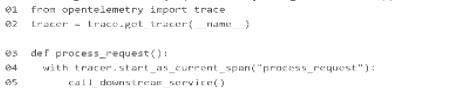
For each of the following statements, select Yes if the statement is true. Otherwise, select No.
NOTE: Each correct selectin is worth one point.

Correct Answer:

Explanation:
insert code

Question 43

Note: This question is part of a series of questions that present the same scenario. Each question in the series contains a unique solution that might meet the stated goals. Some question sets might have more than one correct solution, while others might not have a correct solution.
After you answer a question in this section, you will NOT be able to return to it. As a result, these questions will not appear on the review screen.
You are using Azure Monitor Application Insights to investigate a production API. You open the Logs blade and set the time range to Last 24 hours.
An engineer recommends the following query to count requests by result code and sort the results from most frequent to least frequent:
requests
| summarize request_count = count() by resultCode
| order by request_count desc
You need to determine whether the query returns the number of requests grouped by result code and sorted from most to least frequent.
Solution: The query lists every individual request along with its result code.
Does the solution meet the goal?

Correct Answer: B
Correct:
* The query returns one row per unique resultCode value with the number of requests in each group.
The Kusto Query Language (KQL) query uses the summarize operator, which acts as a grouping and aggregation mechanism.
summarize request_count = count() by resultCode
This groups all the individual rows in the requests table by their unique resultCode. It then counts the total number of logs within each group and places that value into a new column called request_count.
order by request_count desc: This sorts those aggregated rows so that the resultCode with the highest number of requests appears at the top.
Incorrect:
* The result codes are sorted alphabetically.
* The query lists every individual request along with its result code.
Reference:
https://learn.microsoft.com/en-us/azure/azure-monitor/reference/tables/apprequests
insert code

Question 44

You need to translate real-time spoken customer conversations from English to Spanish text during a support call, with minimal latency.
Which Azure AI service should you use?

Correct Answer: B
Use Azure AI Speech with Speech Translation . Microsoft documents Speech Translation as a real-time capability that accepts a live audio stream in a source language and returns translated text, synthesized speech, or both in one or more target languages. This matches the scenario precisely: the input is spoken English during a live support call, the required output is Spanish text, and latency must be minimal.
Speech Translation can be implemented through the Speech SDK , which returns intermediate recognition and translation results as speech is detected. That streaming behavior is materially better suited to live conversations than a workflow that first transcribes audio and then separately calls a text-only translation API.
Microsoft specifically positions Speech Translation for low-latency, real-time speech-to-text and speech-to- speech translation scenarios.
Azure AI Translator translates text and therefore would require a separate speech-to-text stage before translation. Azure AI Language provides NLP capabilities such as classification, sentiment, and entity extraction rather than live speech translation. Azure AI Document Intelligence extracts structured information from documents and forms and is unrelated to streaming conversational audio.
Therefore, Azure AI Speech (Speech Translation) is the correct choice.
Study Guide references: Azure AI Speech # Speech Translation; real-time transcription and translation; Speech SDK; streaming audio translation; target-language text output.
insert code

Question 45

You are implementing an application by using Azure Event Grid to push near-real-time information to customers.
You have the following requirements:
* You must send events to thousands of customers that include hundreds of various event types.
* The events must be filtered by event type before processing.
* Authentication and authorization must be handled by using Microsoft Entra ID.
* The events must be published to a single endpoint
You need to implement Azure Event Grid
Solution: Publish events to a partner topic. Create an event subscription for each customer.
Does the solution meet the goal?


Correct Answer: B
Detailed Explanation: The proposed partner-topic design does not match the stated need for one publisher endpoint that can fan events into thousands of logically distinct customer topics. Event Grid domains are specifically designed to expose a single publishing endpoint while containing large numbers of topics, with subscriptions and filtering applied at the topic level. Partner topics are intended for partner-published SaaS events and do not substitute for the domain architecture required by this high-scale custom publishing scenario.
Study Guide Alignment: Azure service integration: Service Bus, Event Grid, Azure Functions triggers
/bindings, and event-driven processing.
Official Microsoft Learn References: AI-200 Study Guide | Azure Event Grid event domains | Authenticate Event Grid publishing with Microsoft Entra ID
insert code
  • ««
  • «
  • …
  • 5
  • 6
  • 7
  • 8
  • 9
  • 10
  • 11
  • 12
  • 13
  • 14
  • …
  • »
  • »»
[×]

Download PDF File

Enter your email address to download Microsoft.AI-200.v2026-11-23.q122 Dumps

Email:

FreeQAs

Our website provides the Largest and the most Latest vendors Certification Exam materials around the world.

Using dumps we provide to Pass the Exam, we has the Valid Dumps with passing guranteed just which you need.

  • DMCA
  • About
  • Contact Us
  • Privacy Policy
  • Terms & Conditions
©2026 FreeQAs

www.freeqas.com materials do not contain actual questions and answers from Cisco's certification exams.