FreeQAs
 Request Exam  Contact
  • Home
  • View All Exams
  • New QA's
  • Upload
PRACTICE EXAMS:
  • Oracle
  • Fortinet
  • Juniper
  • Microsoft
  • Cisco
  • Citrix
  • CompTIA
  • VMware
  • ISC
  • SAP
  • EMC
  • PMI
  • HP
  • Salesforce
  • Other
  • Oracle
    Oracle
  • Fortinet
    Fortinet
  • Juniper
    Juniper
  • Microsoft
    Microsoft
  • Cisco
    Cisco
  • Citrix
    Citrix
  • CompTIA
    CompTIA
  • VMware
    VMware
  • ISC
    ISC
  • SAP
    SAP
  • EMC
    EMC
  • PMI
    PMI
  • HP
    HP
  • Salesforce
    Salesforce
  1. Home
  2. Microsoft Certification
  3. AI-200 Exam
  4. Microsoft.AI-200.v2026-11-23.q122 Dumps
  • ««
  • «
  • …
  • 3
  • 4
  • 5
  • 6
  • 7
  • 8
  • 9
  • 10
  • 11
  • 12
  • …
  • »
  • »»
Download Now

Question 31

Your solution must answer questions about numeric data in large Excel-based reports (e.g.,
"What was Q3 revenue for the West region?"). Which approach is most appropriate?

Correct Answer: B
Precise numeric/tabular lookups are handled poorly by vector similarity search or free-text embedding of numbers. Structuring the data (e.g., in a database) and letting a function-calling agent issue precise queries yields accurate, verifiable answers.
insert code

Question 32

You are implementing semantic retrieval in Redis.
The solution must support low-latency, approximate nearest neighbor (ANN) vector similarity search for large-scale AI retrieval workloads.
You need to select the appropriate vector schema settings.
Which configuration values should you select? To answer, select the appropriate options in the answer area.
NOTE: Each correct selection is worth one point.
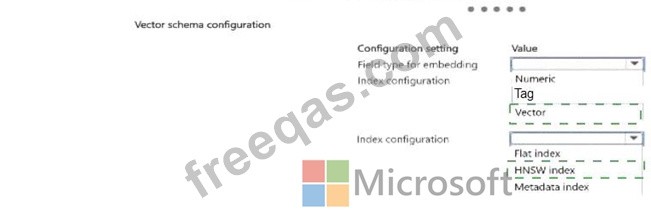

Correct Answer:

Explanation:
insert code

Question 33

You plan to deploy a container to an Azure App Service API app named api1. You host the source code for api1 in a GitHub repository. The container uses the API key at runtime to connect to a backend service.
The container must be able to retrieve the API key at runtime without exposing it in the source repository or Git commit history. The API key must not be stored in application configuration directly. The API key must be accessed securely from Azure Key Vault.
You need to ensure that the API key is stored securely in Azure Key Vault and is available to the container at runtime without being exposed in source control or Git commit history.
Solution: Store the API key as an App Service application setting configured through the Azure Portal.
Does the solution meet the goal?

Correct Answer: A
insert code

Question 34

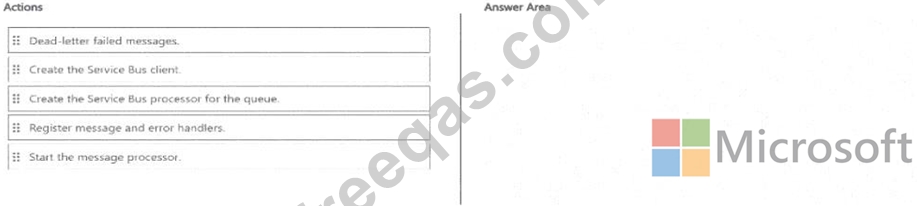
You are provisioning and configuring a Service Bus processor for AI batch jobs.
The processor must connect to an existing queue, register handlers for message and error processing, and then begin receiving messages.
You need to provision and configure the Service Bus processor for message and error handling.
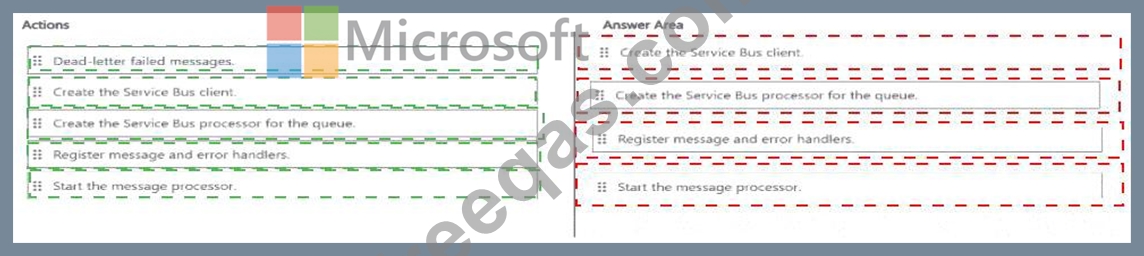
Which four actions should you perform in sequence? To answer, move the appropriate actions from the list of actions to the answer area and arrange them in the correct order.
Correct Answer:

Explanation:

Verified answer: 1) Create the Service Bus client; 2) create the queue processor/receiver; 3) register message and error handlers; 4) start the message processor.
Detailed Explanation: The processor depends on a namespace client/connection, so the client is created first.
Next, the queue-specific processor or receiver is created from that client. Message and error callbacks must be registered before processing starts so incoming messages and failures have defined handlers. Starting the processor is therefore the final step. Dead-lettering failed messages is an optional application settlement decision and is not a prerequisite for constructing and starting the processor.
Study Guide Alignment: Azure service integration: Service Bus, Event Grid, Azure Functions triggers
/bindings, and event-driven processing.
Official Microsoft Learn References: AI-200 Study Guide | Service Bus message transfers, locks, and settlement
insert code

Question 35

Note: This question is part of a series of questions that present the same scenario. Each question in the series contains a unique solution that might meet the stated goals.
You are using Azure Monitor Application Insights to investigate a production API. You open the Logs blade and set the time range to Last 24 hours.
An engineer recommends the following query to count requests by result code and sort the results from most frequent to least frequent:
requests
| summarize request_count = count() by resultCode
| order by request_count desc
You need to determine whether the query returns the number of requests grouped by result code and sorted from most to least frequent.
Solution: The query lists every individual request along with its result code.
Does the solution meet the goal?


Correct Answer: B
The solution statement is incorrect because the KQL query does not return every individual request . The summarize operator aggregates input records according to the grouping expression. In this query, count() calculates the number of request records in each group, while by resultCode creates one group for every distinct HTTP result code represented in the selected Application Insights time range. Microsoft documents that summarize produces one output row for each distinct combination of its by expressions.
The resulting dataset therefore contains columns equivalent to resultCode and request_count, not individual request rows. The subsequent order by request_count desc sorts those aggregate groups in descending order, placing the most frequent result code first. Microsoft provides essentially the same Application Insights pattern for displaying the distribution of requests by result code: summarize request counts by result code and order the resulting counts descending.
If the intent were to list individual requests, the query would omit summarize and typically use project to select fields such as timestamp, operation name, and result code.
Therefore, because the proposed solution incorrectly describes the query as listing each individual request, the answer is No .
Study Guide references: Azure Monitor Logs; Application Insights requests; KQL summarize; count(); grouping; descending sorting.
insert code
  • ««
  • «
  • …
  • 3
  • 4
  • 5
  • 6
  • 7
  • 8
  • 9
  • 10
  • 11
  • 12
  • …
  • »
  • »»
[×]

Download PDF File

Enter your email address to download Microsoft.AI-200.v2026-11-23.q122 Dumps

Email:

FreeQAs

Our website provides the Largest and the most Latest vendors Certification Exam materials around the world.

Using dumps we provide to Pass the Exam, we has the Valid Dumps with passing guranteed just which you need.

  • DMCA
  • About
  • Contact Us
  • Privacy Policy
  • Terms & Conditions
©2026 FreeQAs

www.freeqas.com materials do not contain actual questions and answers from Cisco's certification exams.