FreeQAs
 Request Exam  Contact
  • Home
  • View All Exams
  • New QA's
  • Upload
PRACTICE EXAMS:
  • Oracle
  • Fortinet
  • Juniper
  • Microsoft
  • Cisco
  • Citrix
  • CompTIA
  • VMware
  • ISC
  • SAP
  • EMC
  • PMI
  • HP
  • Salesforce
  • Other
  • Oracle
    Oracle
  • Fortinet
    Fortinet
  • Juniper
    Juniper
  • Microsoft
    Microsoft
  • Cisco
    Cisco
  • Citrix
    Citrix
  • CompTIA
    CompTIA
  • VMware
    VMware
  • ISC
    ISC
  • SAP
    SAP
  • EMC
    EMC
  • PMI
    PMI
  • HP
    HP
  • Salesforce
    Salesforce
  1. Home
  2. Microsoft Certification
  3. AI-200 Exam
  4. Microsoft.AI-200.v2026-11-23.q122 Dumps
  • ««
  • «
  • …
  • 2
  • 3
  • 4
  • 5
  • 6
  • 7
  • 8
  • 9
  • 10
  • 11
  • …
  • »
  • »»
Download Now

Question 26

An application performs similarity search across 5 million embeddings stored in Azure Database for PostgreSQL with pgvector. Queries often filter by department before ranking by cosine distance.
P95 latency for vector similarity queries exceeds the SLA target. Monitoring shows sustained high CPU use during query execution.
You need to reduce P95 latency for filtered vector similarity queries.
What should you do?

Correct Answer: A
Creating a B-tree index on the department column will help, but only if you use the correct indexing strategy, as a standard B-tree index alone is often ignored during vector searches.
When you run a query that filters by metadata before performing a vector similarity search, PostgreSQL must choose between filtering the rows first or searching the vector index first. In many cases, a standard B-tree index on the metadata column combined with an HNSW/IVFFlat index on the vector column results in pre-filtering that defaults to a sequential scan, or post- filtering that returns fewer results than requested.
Reference:
https://learn.microsoft.com/en-us/azure/horizondb/ai/vector-search-pgvector
insert code

Question 27

You are developing a Java application to be deployed in Azure. The application stores sensitive data in Azure Cosmos DB.
You need to configure Always Encrypted to encrypt the sensitive data inside the application.
What should you do first?

Correct Answer: A
To configure Always Encrypted (client-side encryption) for your Java application using Azure Cosmos DB, you must first create a customer-managed key (CMK) and store it in a new Azure Key Vault instance Reference:
https://lennilobel.wordpress.com/2022/08/20/configuring-client-side-encryption-aka-always-encrypted-in-azure-cosmos-db/
insert code

Question 28

You plan to deploy a web application to AKS.
The solution must:
* Scale out the application by adding more pods during peak CPU usage
* Expose the application internally within the cluster only
You need to configure a Kubernetes resource for each requirement
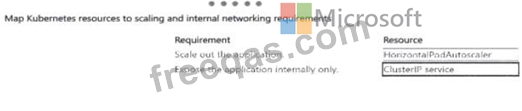
Which resources should you configure? To answer, move the appropriate resources to the correct requirements You may use each resource once, more than once, or not at all. You may need to move split bar between .. or scroll to view content.


Correct Answer:

Explanation:

Verified Answer: Scale out the application: HorizontalPodAutoscaler. Expose internally only: ClusterIP service.
Detailed Explanation: The Kubernetes HorizontalPodAutoscaler increases or decreases pod replicas in response to CPU, memory, or other metrics, so it is the resource that implements CPU-driven pod scale-out. A ClusterIP service creates an internal service IP that is reachable within the Kubernetes cluster and is the normal choice for an internal-only service. A Deployment defines the workload but does not itself implement metric-driven autoscaling, while Ingress is intended to route inbound network traffic.
Study Guide Alignment: Containerized Azure workloads: registry builds, App Service containers, Container Apps revision/scaling behavior, and AKS deployment choices.
Official Microsoft Learn References: AI-200 Study Guide | AKS scaling overview | Kubernetes services in AKS
insert code

Question 29

You are developing an AI search API that caches semantic search results in Redis.
Search results must remain cached for 10 minutes. If the underlying data changes, cached entries must NOT be returned.
You need to implement a cache aside strategy to ensure data consistency.
Which two actions should you perform? Each correct answer presents part of the solution. Choose two NOTE: Each correct selection is worth one point.

Correct Answer: A,D
Detailed Explanation: The cache-aside design needs both bounded lifetime and explicit invalidation. A ten- minute TTL ensures cached search results do not persist indefinitely, while deleting related keys when source data changes prevents known-stale entries from being returned during that ten-minute window. Sliding expiration would extend lifetime based on access and can preserve stale data. Keyspace notifications report Redis key events; they do not replace application logic that invalidates entries when the authoritative source changes.
Study Guide Alignment: AI data-management workloads: Cosmos DB, PostgreSQL, caching, vector storage, vector retrieval, consistency, and connection optimization.
Official Microsoft Learn References: AI-200 Study Guide | Azure Managed Redis documentation
insert code

Question 30

Hotspot Question
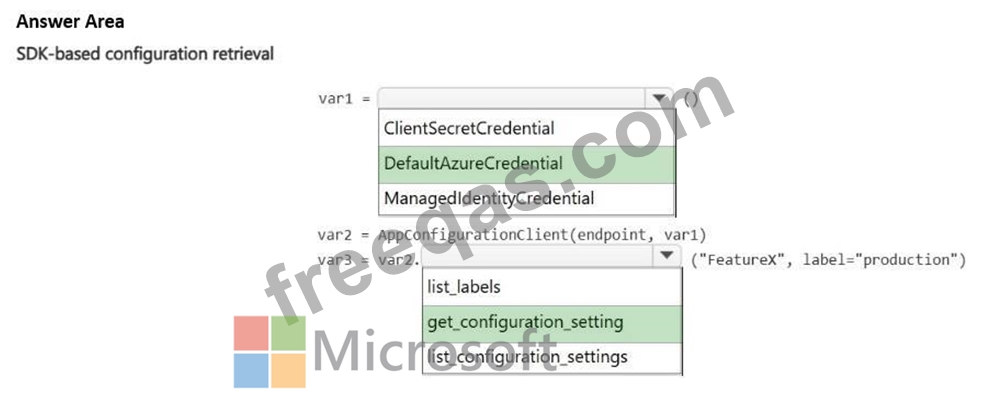
You are using Python SDK to develop a containerized AI application that retrieves the value of a runtime setting stored in an Azure App Configuration resource. The application will run in Azure in the security context of a managed identity.
The application must work in a local development environment without any code changes.
You need to complete the code that implements the retrieval.
How should you complete the code? To answer, select the appropriate options in the answer area.
NOTE: Each correct selection is worth one point.
Correct Answer:

Explanation:
Box 1: DefaultAzureCredential
This class from the azure-identity library provides an automated, sequenced token authentication flow. When running locally, it automatically falls back to your local development environment credentials (such as Azure CLI, environment variables, or VS Code login). Once deployed to Azure, it seamlessly switches to the environment's managed identity without requiring any code changes.
Box 2: get_configuration_setting
This method belongs to the AppConfigurationClient in the azure-appconfiguration SDK. It is used to fetch a specific configuration key-value pair using its key name ("FeatureX") and an optional label.
Reference:
https://learn.microsoft.com/en-us/azure/developer/python/tutorial-containerize-deploy-python-web-app-azure-04
insert code
  • ««
  • «
  • …
  • 2
  • 3
  • 4
  • 5
  • 6
  • 7
  • 8
  • 9
  • 10
  • 11
  • …
  • »
  • »»
[×]

Download PDF File

Enter your email address to download Microsoft.AI-200.v2026-11-23.q122 Dumps

Email:

FreeQAs

Our website provides the Largest and the most Latest vendors Certification Exam materials around the world.

Using dumps we provide to Pass the Exam, we has the Valid Dumps with passing guranteed just which you need.

  • DMCA
  • About
  • Contact Us
  • Privacy Policy
  • Terms & Conditions
©2026 FreeQAs

www.freeqas.com materials do not contain actual questions and answers from Cisco's certification exams.
