FreeQAs
 Request Exam  Contact
  • Home
  • View All Exams
  • New QA's
  • Upload
PRACTICE EXAMS:
  • Oracle
  • Fortinet
  • Juniper
  • Microsoft
  • Cisco
  • Citrix
  • CompTIA
  • VMware
  • ISC
  • SAP
  • EMC
  • PMI
  • HP
  • Salesforce
  • Other
  • Oracle
    Oracle
  • Fortinet
    Fortinet
  • Juniper
    Juniper
  • Microsoft
    Microsoft
  • Cisco
    Cisco
  • Citrix
    Citrix
  • CompTIA
    CompTIA
  • VMware
    VMware
  • ISC
    ISC
  • SAP
    SAP
  • EMC
    EMC
  • PMI
    PMI
  • HP
    HP
  • Salesforce
    Salesforce
  1. Home
  2. Microsoft Certification
  3. AI-200 Exam
  4. Microsoft.AI-200.v2026-11-23.q122 Dumps
  • «
  • 1
  • 2
  • 3
  • 4
  • 5
  • 6
  • 7
  • 8
  • 9
  • 10
  • …
  • »
  • »»
Download Now

Question 21

An AI application retrieves configuration values from App Configuration. The application uses static configuration.
You need to implement a solution that supports dynamic configuration updates and minimizes latency for application requests.
What should you do?

Correct Answer: B
You should cache configuration values with a refresh interval.
Enables Dynamic Configuration: Azure App Configuration providers natively support a cache- polling mechanism. Once the refresh interval expires, the application checks for updates and reloads configuration values automatically without requiring an application restart.
Minimizes Latency: By pulling configuration values from a local, in-memory cache for all intermediary requests, you completely bypass the network latency of making a remote API call to Azure on every single application request.
Prevents Throttling: Relying on cached values prevents your application from exhausting your App Configuration resource's request quota.
Reference:
https://learn.microsoft.com/en-us/azure/azure-app-configuration/howto-best-practices
insert code

Question 22

Drag and Drop Question
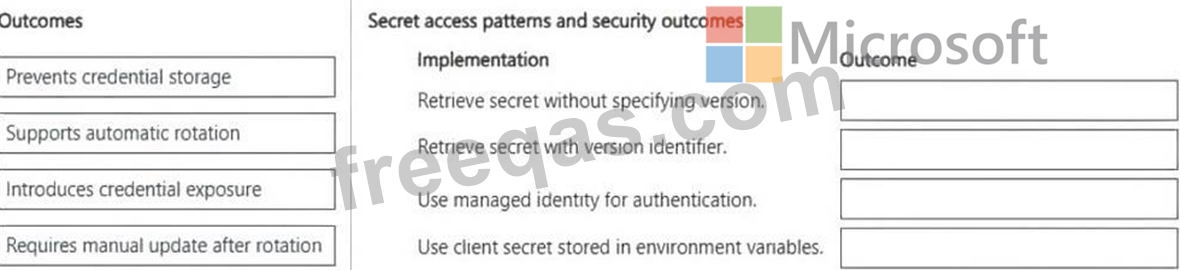
You are reviewing secret access patterns used by an AI application that retrieves credentials from Key Vault.
You need to evaluate the security impact of each implementation approach.
What is the outcome of each approach? To answer, move the appropriate outcomes to the correct implementations. You may use each outcome once, more than once, or not at all. You may need to move the split bar between panes or scroll to view content.
NOTE: Each correct selection is worth one point.
Correct Answer:

Explanation:
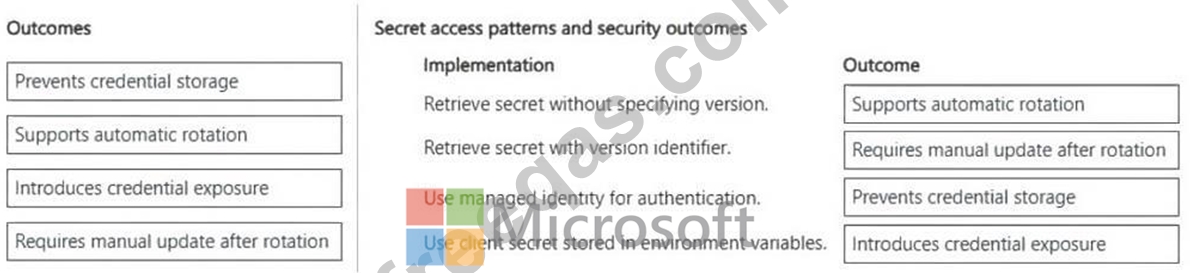
Box 1: Supports automatic rotation.
When an AI application retrieves a secret from Azure Key Vault without specifying a version, it always fetches the latest active version. This choice impacts your security and operations in the following ways:
Latest Version Fetch: The vault automatically serves the current active secret value.
No Code Changes: Your application reads the new credential immediately after rotation without a code redeployment.
Zero Downtime: Automated rotation pipelines can update the secret in Key Vault while the app seamlessly switches to the new token.
Box 2: Requires manual update after rotation
Using a specific version identifier when retrieving a secret from Key Vault means the application always requests one exact version of that secret. This choice requires manual update after rotation because the application code or configuration pins a specific version ID and will not fetch the new value when the secret rotates.
Box 3: Prevents credential storage
Prevents credential storage is the correct outcome of using managed identity for authentication.
No credentials to manage: Managed identities eliminate the need for developers to manage credentials entirely.
Automatic token handling: Azure automatically creates an identity for the application in Microsoft Entra ID and handles the service principal's lifecycle behind the scenes, ensuring that no secrets or connection strings are ever hardcoded or stored in configuration files.
Box 4: Introduces credential exposure
Introduces credential exposure and Requires manual update after rotation are the primary outcomes of storing a client secret in environment variables.
Storing clear-text secrets in environment variables poses a significant security risk. Any process, compromised dependency, or user with access to the execution environment (such as container details, application logs, or process dumps) can easily read them.
Reference:
https://medium.com/simform-engineering/building-automated-secret-rotation-using-azure-key-vault-and-net-01e0701f0a2e
https://www.varonis.com/blog/azure-managed-identities
insert code

Question 23

You are developing an AI API deployed to ACA. The API requires database credentials that are stored in Key Vault. Key Vault is configured to use Azure RBAC for access control.
The database credentials are rotated periodically by the security team. The application must always use the latest version of each credential without being redeployed and without exposing secrets in code or configurations.
You need to implement a secure secret access strategy that prevents credential exposure and fetches the latest version of each secret at runtime without redeploying the container.
Which three actions should you perform? Each correct answer presents part of the solution.
NOTE: Each correct selection is worth one point.


Correct Answer: A,D,E
Step-by-Step Implementation Guide
1. Assign a System-Assigned Managed Identity
2. Configure Key Vault RBAC Role Assignment
Role Selection: Assign the Key Vault Secrets User role to the container app's managed identity.
Scope Limitation: Limit the scope of this assignment to the specific Key Vault or individual secrets rather than the entire resource group.
3. Retrieve the Secret at Runtime Using the SDK
Reference:
https://oneuptime.com/blog/post/2026-02-16-how-to-use-managed-identity-with-azure-container-apps-to-access-azure-services/view
insert code

Question 24

You are troubleshooting a production Azure OpenAI service that is experiencing intermittent connectivity issues. All telemetry is sent to a Log Analytics workspace.
You must write a KQL query that analyzes the AppRequests table. The query must filter for requests that occurred within the last 30 minutes and have a failed status.
The final output must display the total number of failures for each unique operation.
You need to select the KQL operators required to filter the time range and aggregate the failure counts.
Which two operators should you use? Each correct answer presents part of the solution. Choose two.
NOTE: Each correct selection is worth one point.

Correct Answer: C,D
insert code

Question 25

You are designing an Azure Function that will process orders from a new Azure Service Bus queue.
You need to prevent the system from processing messages more than once and preserve failed messages for investigation.
Which two actions should you implement? Each correct answer presents part of the solution.
NOTE: Each correct selection is worth one point.

Correct Answer: A,C
Enable duplicate detection on the Azure Service Bus queue to suppress duplicate sends. Service Bus tracks application-defined MessageId values during the configured duplicate-detection window. If another message with the same MessageId arrives during that interval, Service Bus accepts the send operation but discards the duplicate message. Microsoft specifically recommends using a deterministic business identifier, such as an order ID, as the basis for MessageId when duplicate suppression is required. Duplicate detection must be enabled when the queue is created and is supported in the Standard and Premium tiers.
For failed or poison messages, implement dead-letter handling . A Service Bus queue has a dead-letter subqueue that retains messages that cannot be successfully processed, including messages that exceed the configured maximum delivery count. Those messages remain available for inspection, troubleshooting, correction, or controlled reprocessing rather than being silently discarded.
Sessions provide ordered/FIFO processing and session affinity; they do not primarily prevent duplicates. An HTTP trigger would bypass the required Service Bus processing architecture.
For strict production-grade exactly-once business effects, the consumer should additionally be idempotent , because a message can still be redelivered after a lock or settlement failure.
Study Guide references: Azure Service Bus # duplicate detection; MessageId; dead-letter queues; poison- message handling; reliable asynchronous processing.
insert code
  • «
  • 1
  • 2
  • 3
  • 4
  • 5
  • 6
  • 7
  • 8
  • 9
  • 10
  • …
  • »
  • »»
[×]

Download PDF File

Enter your email address to download Microsoft.AI-200.v2026-11-23.q122 Dumps

Email:

FreeQAs

Our website provides the Largest and the most Latest vendors Certification Exam materials around the world.

Using dumps we provide to Pass the Exam, we has the Valid Dumps with passing guranteed just which you need.

  • DMCA
  • About
  • Contact Us
  • Privacy Policy
  • Terms & Conditions
©2026 FreeQAs

www.freeqas.com materials do not contain actual questions and answers from Cisco's certification exams.