FreeQAs
 Request Exam  Contact
  • Home
  • View All Exams
  • New QA's
  • Upload
PRACTICE EXAMS:
  • Oracle
  • Fortinet
  • Juniper
  • Microsoft
  • Cisco
  • Citrix
  • CompTIA
  • VMware
  • ISC
  • SAP
  • EMC
  • PMI
  • HP
  • Salesforce
  • Other
  • Oracle
    Oracle
  • Fortinet
    Fortinet
  • Juniper
    Juniper
  • Microsoft
    Microsoft
  • Cisco
    Cisco
  • Citrix
    Citrix
  • CompTIA
    CompTIA
  • VMware
    VMware
  • ISC
    ISC
  • SAP
    SAP
  • EMC
    EMC
  • PMI
    PMI
  • HP
    HP
  • Salesforce
    Salesforce
  1. Home
  2. Microsoft Certification
  3. DP-600 Exam
  4. Microsoft.DP-600.v2026-10-12.q204 Dumps
  • ««
  • «
  • …
  • 11
  • 12
  • 13
  • 14
  • 15
  • 16
  • 17
  • 18
  • 19
  • 20
  • …
  • »
  • »»
Download Now

Question 71

You have a Fabric tenant that contains a lakehouse named Lakehouse1. Lakehouse1 contains a subfolder named Subfolder1 that contains CSV files. You need to convert the CSV files into the delta format that has V-Order optimization enabled. What should you do from Lakehouse explorer?

Correct Answer: D
To convert CSV files into the delta format with Z-Order optimization enabled, you should use the Optimize feature (D) from Lakehouse Explorer. This will allow you to optimize the file organization for the most efficient querying. References = The process for converting and optimizing file formats within a lakehouse is discussed in the lakehouse management documentation.
insert code

Question 72

You have a Fabric tenant that contains a warehouse named Warehouse!. Warehousel contains two schemas name schemal and schema2 and a table named schemal.city.
You need to make a copy of schemal.city in schema2. The solution must minimize the copying of data.
Which T-SQL statement should you run?

Correct Answer: B
INSERT INTO ... SELECT and SELECT INTO both physically copy all rows, which is heavy and not minimal.
CREATE TABLE AS SELECT (CTAS) also copies the data.
CREATE TABLE ... AS CLONE OF creates a shallow clone in Fabric Warehouse, meaning it references the existing data without duplicating it, minimizing storage and copying.
Correct answer: B.
Reference: Clone tables in Fabric warehouse
insert code

Question 73

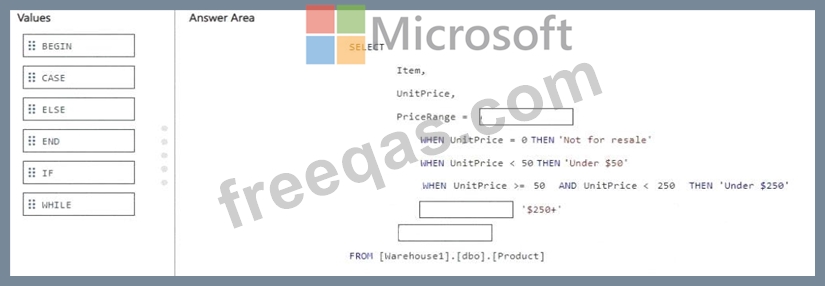
You have a Fabric warehouse named Warehouse1 that contains a table named dbo.Product. dbo.Product contains the following columns.

You need to use a T-SQL query to add a column named PriceRange to dbo.Product. The column must categorize each product based on UnitPrice. The solution must meet the following requirements:
* If UnitPrice is 0, PriceRange is "Not for resale".
* If UnitPrice is less than 50, PriceRange is "Under $50".
* If UnitPrice is between 50 and 250, PriceRange is "Under $250".
* In all other instances, PriceRange is "$250+".
How should you complete the query? To answer, drag the appropriate values to the correct targets. Each value may be used once, more than once, or not at all. You may need to drag the split bar between panes or scroll to view content.
NOTE: Each correct selection is worth one point.
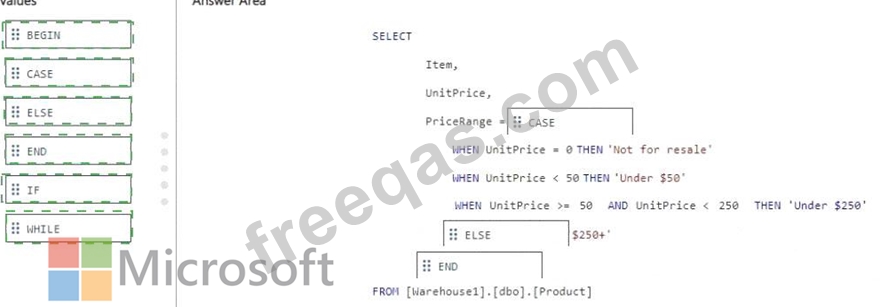
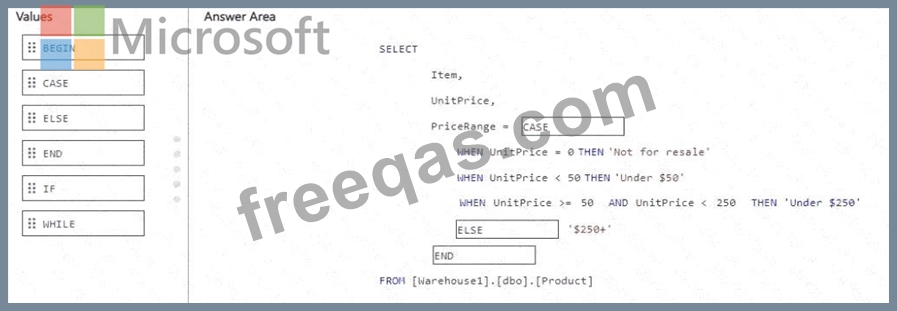
Correct Answer:

Explanation:
insert code

Question 74

You have a semantic model named Model 1. Model 1 contains five tables that all use Import mode. Model1 contains a dynamic row-level security (RLS) role named HR. The HR role filters employee data so that HR managers only see the data of the department to which they are assigned.
You publish Model1 to a Fabric tenant and configure RLS role membership. You share the model and related reports to users.
An HR manager reports that the data they see in a report is incomplete.
What should you do to validate the data seen by the HR Manager?

Correct Answer: A
To validate the data seen by the HR manager, you should use the 'Test as role' feature in Power BI service.
This allows you to see the data exactly as it would appear for the HR role, considering the dynamic RLS setup. Here is how you would proceed:
* Navigate to the Power BI service and locate Model1.
* Access the dataset settings for Model1.
* Find the security/RLS settings where you configured the roles.
* Use the 'Test as role' feature to simulate the report viewing experience as the HR role.
* Review the data and the filters applied to ensure that the RLS is functioning correctly.
* If discrepancies are found, adjust the RLS expressions or the role membership as needed.
References: The 'Test as role' feature and its use for validating RLS in Power BI is covered in the Power BI documentation available on Microsoft's official documentation.
insert code

Question 75

You have a Fabric warehouse named Warehouse1 that contains a table named dbo.Product. dbo.Product contains the following columns.

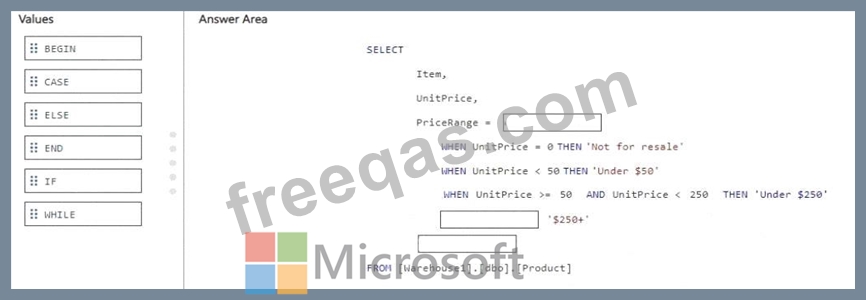
You need to use a T-SQL query to add a column named PriceRange to dbo.Product. The column must categorize each product based on UnitPrice. The solution must meet the following requirements:
* If UnitPrice is 0, PriceRange is " Not for resale " .
* If UnitPrice is less than 50, PriceRange is " Under $50 " .
* If UnitPrice is between 50 and 250, PriceRange is " Under $250 " .
* In all other instances, PriceRange is " $250+ " .
How should you complete the query? To answer, drag the appropriate values to the correct targets. Each value may be used once, more than once, or not at all. You may need to drag the split bar between panes or scroll to view content.
NOTE: Each correct selection is worth one point.
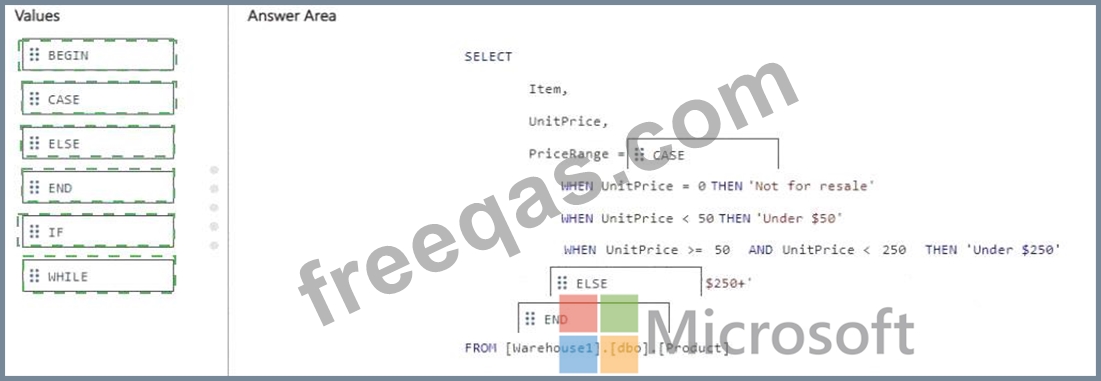
Correct Answer:

Explanation:

Comprehensive Detailed Explanation
We need to create a computed column PriceRange based on the UnitPrice column in the dbo.Product table.
Step 1: Requirements
If UnitPrice = 0 # " Not for resale "
If UnitPrice < 50 # " Under $50 "
If UnitPrice > = 50 AND UnitPrice < 250 # " Under $250 "
Otherwise # " $250+ "
This matches a CASE expression in T-SQL.
Step 2: CASE Expression Structure
The syntax is:
CASE
WHEN condition THEN result
ELSE result
END
Step 3: Apply to Problem
SELECT
Item,
UnitPrice,
PriceRange = CASE
WHEN UnitPrice = 0 THEN ' Not for resale '
WHEN UnitPrice < 50 THEN ' Under $50 '
WHEN UnitPrice > = 50 AND UnitPrice < 250 THEN ' Under $250 '
ELSE ' $250+ '
END
FROM [Warehouse1].[dbo] .[Product];
Step 4: Why This is Correct
CASE starts the conditional evaluation.
ELSE handles the default branch ( $250+ ).
END closes the expression.
Meets all requirements exactly.
References
CASE expression in T-SQL
Computed columns in T-SQL
insert code
  • ««
  • «
  • …
  • 11
  • 12
  • 13
  • 14
  • 15
  • 16
  • 17
  • 18
  • 19
  • 20
  • …
  • »
  • »»
[×]

Download PDF File

Enter your email address to download Microsoft.DP-600.v2026-10-12.q204 Dumps

Email:

FreeQAs

Our website provides the Largest and the most Latest vendors Certification Exam materials around the world.

Using dumps we provide to Pass the Exam, we has the Valid Dumps with passing guranteed just which you need.

  • DMCA
  • About
  • Contact Us
  • Privacy Policy
  • Terms & Conditions
©2026 FreeQAs

www.freeqas.com materials do not contain actual questions and answers from Cisco's certification exams.
