FreeQAs
 Request Exam  Contact
  • Home
  • View All Exams
  • New QA's
  • Upload
PRACTICE EXAMS:
  • Oracle
  • Fortinet
  • Juniper
  • Microsoft
  • Cisco
  • Citrix
  • CompTIA
  • VMware
  • ISC
  • SAP
  • EMC
  • PMI
  • HP
  • Salesforce
  • Other
  • Oracle
    Oracle
  • Fortinet
    Fortinet
  • Juniper
    Juniper
  • Microsoft
    Microsoft
  • Cisco
    Cisco
  • Citrix
    Citrix
  • CompTIA
    CompTIA
  • VMware
    VMware
  • ISC
    ISC
  • SAP
    SAP
  • EMC
    EMC
  • PMI
    PMI
  • HP
    HP
  • Salesforce
    Salesforce
  1. Home
  2. Microsoft Certification
  3. DP-600 Exam
  4. Microsoft.DP-600.v2026-10-12.q204 Dumps
  • ««
  • «
  • …
  • 15
  • 16
  • 17
  • 18
  • 19
  • 20
  • 21
  • 22
  • 23
  • 24
  • …
  • »
  • »»
Download Now

Question 91

You are analyzing customer purchases in a Fabric notebook by using PySpanc You have the following DataFrames:

You need to join the DataFrames on the customer_id column. The solution must minimize data shuffling. You write the following code.

Which code should you run to populate the results DataFrame?

Correct Answer: A
The correct code to populate the results DataFrame with minimal data shuffling is Option A. Using the broadcast function in PySpark is a way to minimize data movement by broadcasting the smaller DataFrame ( customers) to each node in the cluster. This is ideal when one DataFrame is much smaller than the other, as in this case with customers. References = You can refer to the official Apache Spark documentation for more details on joins and the broadcast hint.
insert code

Question 92

You have a Fabric warehouse that contains two tables named DimDate and Trips.
DimDate contains the following fields.

Trips contains the following fields.

You need to compare the average miles per trip for statutory holidays versus non-statutory holidays.
How should you complete the T-SQL statement? To answer, select the appropriate options in the answer area.
NOTE: Each correct selection is worth one point.

Correct Answer:

Explanation:

Comprehensive Detailed Explanation
Step 1: Requirement
We need to compare the average miles per trip for:
Statutory holidays (when IsHoliday = 1)
Non-statutory holidays (when IsHoliday = 0)
Step 2: Formula for average miles per trip
Average miles per trip = total miles ÷ number of trips
Total miles # SUM(t.tripDistance)
Number of trips # COUNT(t.tripID)
So the calculation is:
(SUM(t.tripDistance) / COUNT(t.tripID)) AS MilesPerTrip
Step 3: Grouping
We need a comparison by holiday status.
So we must group the results by:
GROUP BY d.IsHoliday
This ensures we get two rows: one for IsHoliday = 1 and one for IsHoliday = 0.
Step 4: Final Query
SELECT
d.IsHoliday,
(SUM(t.tripDistance) / COUNT(t.tripID)) AS MilesPerTrip
FROM DimDate d
INNER JOIN Trips t ON d.DateID = t.DateID
GROUP BY d.IsHoliday;
Why This is Correct
The formula ensures average miles per trip.
Grouping ensures comparison between holidays vs non-holidays.
Efficient aggregation, minimal computation.
References
Aggregate functions in T-SQL
GROUP BY clause
insert code

Question 93

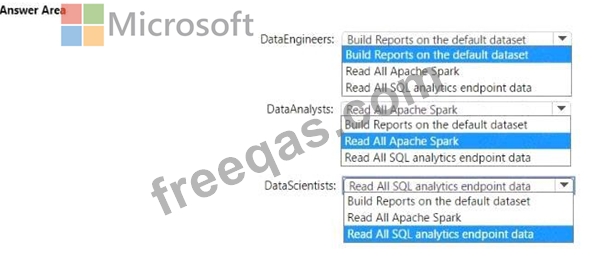
You to need assign permissions for the data store in the AnalyticsPOC workspace. The solution must meet the security requirements.
Which additional permissions should you assign when you share the data store? To answer, select the appropriate options in the answer area.
NOTE: Each correct selection is worth one point.
Correct Answer:

Explanation:
* Data Engineers: Read All SQL analytics endpoint data
* Data Analysts: Read All Apache Spark
* Data Scientists: Read All SQL analytics endpoint data
The permissions for the data store in the AnalyticsPOC workspace should align with the principle of least privilege:
* Data Engineers need read and write access but not to datasets or reports.
* Data Analysts require read access specifically to the dimensional model objects and the ability to create Power BI reports.
* Data Scientists need read access via Spark notebooks. These settings ensure each role has the necessary permissions to fulfill their responsibilities without exceeding their required access level.
insert code

Question 94

You have the following T-SQI statement.

Correct Answer:

Explanation:

The statement uses SUM(CASE WHEN RefundStatus = ' Refunded ' THEN SalesAmount ELSE 0 END) AS TotalRevenue, which calculates TotalRevenue by summing SalesAmount only when RefundStatus is ' Refunded ' , and 0 otherwise. This means Region values are returned regardless of RefundStatus, but the TotalRevenue reflects refunded items.
The WHERE (TransactionDate) - YEAR(GETDATE()) condition is incomplete and lacks proper comparison (e.g., no equality or range check), so it does not filter for the current year.
The TotalRevenue calculation does not aggregate all SalesAmount values with RefundStatus of ' Refunded ' ; it sums SalesAmount only for refunded items within the grouped data, with 0 for non-refunded items.
insert code

Question 95

You have a Fabric tenant that contains two lakehouses.
You are building a dataflow that will combine data from the lakehouses. The applied steps from one of the queries in the dataflow is shown in the following exhibit.

Use the drop-down menus to select the answer choice that completes each statement based on the information presented in the graphic. NOTE: Each correct selection is worth one point.

Correct Answer:

Explanation:

Folding in Power Query refers to operations that can be translated into source queries. In this case, " some " of the steps can be folded, which means that some transformations will be executed at the data source level. The steps that cannot be folded will be executed within the Power Query engine. Custom steps, especially those that are not standard query operations, are usually executed within Power Query engine rather than being pushed down to the source system.
References =
Query folding in Power Query
Power Query M formula language
insert code
  • ««
  • «
  • …
  • 15
  • 16
  • 17
  • 18
  • 19
  • 20
  • 21
  • 22
  • 23
  • 24
  • …
  • »
  • »»
[×]

Download PDF File

Enter your email address to download Microsoft.DP-600.v2026-10-12.q204 Dumps

Email:

FreeQAs

Our website provides the Largest and the most Latest vendors Certification Exam materials around the world.

Using dumps we provide to Pass the Exam, we has the Valid Dumps with passing guranteed just which you need.

  • DMCA
  • About
  • Contact Us
  • Privacy Policy
  • Terms & Conditions
©2026 FreeQAs

www.freeqas.com materials do not contain actual questions and answers from Cisco's certification exams.
