FreeQAs
 Request Exam  Contact
  • Home
  • View All Exams
  • New QA's
  • Upload
PRACTICE EXAMS:
  • Oracle
  • Fortinet
  • Juniper
  • Microsoft
  • Cisco
  • Citrix
  • CompTIA
  • VMware
  • ISC
  • SAP
  • EMC
  • PMI
  • HP
  • Salesforce
  • Other
  • Oracle
    Oracle
  • Fortinet
    Fortinet
  • Juniper
    Juniper
  • Microsoft
    Microsoft
  • Cisco
    Cisco
  • Citrix
    Citrix
  • CompTIA
    CompTIA
  • VMware
    VMware
  • ISC
    ISC
  • SAP
    SAP
  • EMC
    EMC
  • PMI
    PMI
  • HP
    HP
  • Salesforce
    Salesforce
  1. Home
  2. Microsoft Certification
  3. DP-600 Exam
  4. Microsoft.DP-600.v2026-10-12.q204 Dumps
  • «
  • 1
  • 2
  • 3
  • 4
  • 5
  • 6
  • 7
  • 8
  • 9
  • 10
  • …
  • »
  • »»
Download Now

Question 1

You have a Fabric tenant that contains a workspace named Workspace1 and a user named User1. Workspace1 contains a warehouse named DW1.
You share DW1 with User1 and assign User1 the default permissions for DW1.
What can User1 do?

Correct Answer: D
Assigning a user default permission ("Read") to a warehouse in a Fabric workspace enables them to connect to the SQL analytics endpoint, which is the equivalent of CONNECT permissions in SQL Server. However, this permission only allows them to connect; it doesn't grant them the ability to query tables, views, functions, or stored procedures within the warehouse unless they're also given access to those specific objects through T-SQL GRANT statements.
In essence, the default "Read" permission provides the necessary connectivity to the warehouse's SQL analytics endpoint, but it does not automatically grant access to the data and objects within the warehouse itself. Further permissions need to be granted through T-SQL or Fabric's workspace roles and item permissions system.
Reference:
https://learn.microsoft.com/en-us/fabric/data-warehouse/share-warehouse-manage-permissions
insert code

Question 2

You have a Fabric tenant that contains two workspaces named Workspace1 and Workspace2.
Workspace1 is used as the development environment.
Workspace2 is used as the production environment.
Each environment uses a different storage account.
Workspace1 contains a Dataflow Gen2 named Dataflow1. The data source of Dataflow1 is a CSV file in blob storage.
You plan to implement a deployment pipeline to deploy items from Workspace1 to Workspace2.
You need to ensure that the data source references the correct location in the production environment.
What should you do?

Correct Answer: C
Scenario:
Dev = Workspace1 with Dataflow Gen2 (source = blob storage CSV).
Prod = Workspace2, different storage account.
Need: ensure deployed dataflow points to the production storage location.
Analysis:
Data source rules: used to remap data sources between environments (e.g., blob storage dev # blob storage prod).
Parameter rules: used when the data source location is parameterized (for example, a parameter storing the file path or connection string).
Best practice: use parameters in the dataflow for connection strings, then apply parameter rules in deployment pipelines.
In this case, since the requirement is about ensuring the reference updates correctly, only parameter rules are needed (not data source rules).
insert code

Question 3

You have a Fabric tenant that contains a warehouse named Warehouse1. You have a large 1 TB dataset in an external data source. You need to recommend a method to ingest the dataset into Warehouse1. The solution must provide the highest throughput and support a low-code/no-code development model.
What should you recommend?

Correct Answer: C
insert code

Question 4

You have a Fabric tenant that contains a new semantic model in OneLake.
You use a Fabric notebook to read the data into a Spark DataFrame.
You need to evaluate the data to calculate the min, max, mean, and standard deviation values for all the string and numeric columns.
Solution: You use the following PySpark expression:
df.explain()
Does this meet the goal?

Correct Answer: B
The df.explain() method does not meet the goal of evaluating data to calculate statistical functions. It is used to display the physical plan that Spark will execute. References = The correct usage of the explain() function can be found in the PySpark documentation.
insert code

Question 5

You have a Fabric tenant that contains the workspaces shown in the following table.
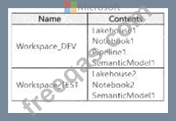
You have a deployment pipeline named Pipeline1 that deploys items from Workspace_DEV to Workspace_TEST. In Pipeline1, all items that have matching names are paired.
You deploy the contents of Workspace_DEV to Workspace_TEST by using Pipeline1.
What will the contents of Workspace_TEST be once the deployment is complete?


Correct Answer: A
Workspace_DEV contents:
Lakehouse1, Notebook1, Pipeline1, SemanticModel1
Workspace_TEST contents (before deployment):
Lakehouse2, Notebook2, SemanticModel1
After deployment:
SemanticModel1 # same name, so it will be paired and overwritten with the DEV version.
Lakehouse1 and Notebook1 # new items, so they will be added to TEST.
Lakehouse2 and Notebook2 # remain because they don't conflict in name.
Pipeline1 # new item, so it will also be added .
So the final content is:
Lakehouse1, Lakehouse2, Notebook1, Notebook2, Pipeline1, SemanticModel1
insert code
  • «
  • 1
  • 2
  • 3
  • 4
  • 5
  • 6
  • 7
  • 8
  • 9
  • 10
  • …
  • »
  • »»
[×]

Download PDF File

Enter your email address to download Microsoft.DP-600.v2026-10-12.q204 Dumps

Email:

FreeQAs

Our website provides the Largest and the most Latest vendors Certification Exam materials around the world.

Using dumps we provide to Pass the Exam, we has the Valid Dumps with passing guranteed just which you need.

  • DMCA
  • About
  • Contact Us
  • Privacy Policy
  • Terms & Conditions
©2026 FreeQAs

www.freeqas.com materials do not contain actual questions and answers from Cisco's certification exams.