You have a Fabric tenant that contains a workspace named Workspace1. Workspace1 uses Pro license mode and contains a semantic model named Model1. You need to ensure that Modell supports XMLA connections.
Which setting should you modify?
You have a Fabric tenant that contains a warehouse.
A user discovers that a report that usually takes two minutes to render has been running for 45 minutes and has still not rendered.
You need to identify what is preventing the report query from completing.
Which dynamic management view (DMV) should you use?
You have a Microsoft Fabric tenant that contains a dataflow.
You are exploring a new semantic model.
From Power Query, you need to view column information as shown in the following exhibit.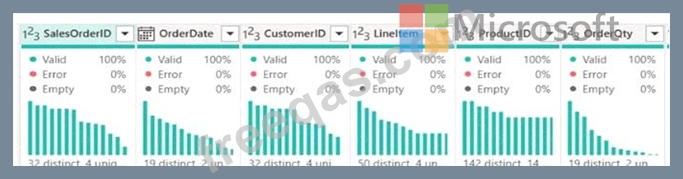
Which three Data view options should you select? Each correct answer presents part of the solution. NOTE:
Each correct answer is worth one point.
You have a Fabric eventhouse that contains a KQL database. The database contains a table named TaxiData that stores the following data.
You need to create a column named FirstPickupDateTime that will contain the first value of each hour from tpep_pickup_datetime partitioned by payment_type.
NOTE: Each correct selection is worth one point.


Note: This section contains one or more sets of questions with the same scenario and problem. Each question presents a unique solution to the problem. You must determine whether the solution meets the stated goals. More than one solution in the set might solve the problem. It is also possible that none of the solutions in the set solve the problem.
After you answer a question in this section, you will NOT be able to return. As a result, these questions do not appear on the Review Screen.
Your network contains an on-premises Active Directory Domain Services (AD DS) domain named contoso.com that syncs with a Microsoft Entra tenant by using Microsoft Entra Connect.
You have a Fabric tenant that contains a semantic model.
You enable dynamic row-level security (RLS) for the model and deploy the model to the Fabric service.
You query a measure that includes the USERNAME() function, and the query returns a blank result.
You need to ensure that the measure returns the user principal name (UPN) of a user.
Solution: You update the measure to use the USERPRINCIPALNAME() function.
Does this meet the goal?

