FreeQAs
 Request Exam  Contact
  • Home
  • View All Exams
  • New QA's
  • Upload
PRACTICE EXAMS:
  • Oracle
  • Fortinet
  • Juniper
  • Microsoft
  • Cisco
  • Citrix
  • CompTIA
  • VMware
  • ISC
  • SAP
  • EMC
  • PMI
  • HP
  • Salesforce
  • Other
  • Oracle
    Oracle
  • Fortinet
    Fortinet
  • Juniper
    Juniper
  • Microsoft
    Microsoft
  • Cisco
    Cisco
  • Citrix
    Citrix
  • CompTIA
    CompTIA
  • VMware
    VMware
  • ISC
    ISC
  • SAP
    SAP
  • EMC
    EMC
  • PMI
    PMI
  • HP
    HP
  • Salesforce
    Salesforce
  1. Home
  2. Microsoft Certification
  3. DP-600 Exam
  4. Microsoft.DP-600.v2026-10-12.q204 Dumps
  • ««
  • «
  • …
  • 2
  • 3
  • 4
  • 5
  • 6
  • 7
  • 8
  • 9
  • 10
  • 11
  • …
  • »
  • »»
Download Now

Question 26

You have a Fabric tenant that contains a machine learning model registered in a Fabric workspace. You need to use the model to generate predictions by using the predict function in a fabric notebook. Which two languages can you use to perform model scoring? Each correct answer presents a complete solution. NOTE:
Each correct answer is worth one point.

Correct Answer: C,D
The two languages you can use to perform model scoring in a Fabric notebook using the predict function are Spark SQL (option C) and PySpark (option D). These are both part of the Apache Spark ecosystem and are supported for machine learning tasks in a Fabric environment. References = You can find more information about model scoring and supported languages in the context of Fabric notebooks in the official documentation on Azure Synapse Analytics.
insert code

Question 27

You have a Fabric tenant that contains a data warehouse named DW1. DW1 contains a table named DimCustomer. DimCustomer contains the fields shown in the following table.
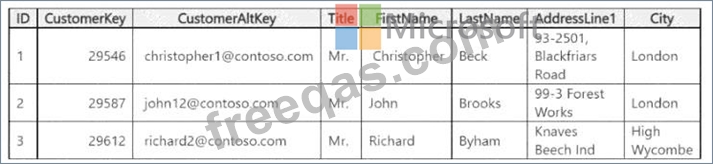
You need to identify duplicate email addresses in DimCustomer. The solution must return a maximum of
1,000 records.
Which four T-SQL statements should you run in sequence? To answer, move the appropriate statements from the list of statements to the answer area and arrange them in the correct order.


Correct Answer:

Explanation:

Step 1 - Select the required fields and count
We want to group by CustomerAltKey and count occurrences.
SELECT CustomerAltKey, COUNT(*)
Step 2 - From the table
FROM DimCustomer
Step 3 - Grouping by email
GROUP BY CustomerAltKey
Step 4 - Filtering duplicates (only values with count > 1)
HAVING COUNT(*) > 1
Step 5 - Limiting the result to 1,000 rows
LIMIT 1000
(or in T-SQL, SELECT TOP(1000) ...). Since both options are shown, we use LIMIT 1000 because Fabric Warehouse supports Synapse SQL T-SQL + ANSI SQL style.
Correct Sequence:
SELECT CustomerAltKey, COUNT(*)
FROM DimCustomer
GROUP BY CustomerAltKey
HAVING COUNT(*) > 1
LIMIT 1000
insert code

Question 28

You are analyzing customer purchases in a Fabric notebook by using PySpark.
You have the following DataFrames:
- transactions: Contains five columns named transaction_id,
customer_id, product_id, amount, and date and has 10 million rows, with each row representing a transaction.
- customers: Contains customer details in 1,000 rows and three columns
named customer_id, name, and country.
You need to join the DataFrames on the customer_id column. The solution must minimize data shuffling.
You write the following code.
from pyspark.sql import functions as F
results =
Which code should you run to populate the results DataFrame?

Correct Answer: A
https://sparkbyexamples.com/spark/broadcast-join-in-spark/"
insert code

Question 29

You have a Fabric warehouse that contains a table named SalesOrderDetail. SalesOrderDetail contains three columns named OrderQty, ProductID and SalesOrderlD. SalesOrderDetail contains one row per combination of SalesOrderlD and ProductID.
You need to calculate the proportion of the total quantity of each sales order represented by each product within the sales order.
Which T-SQL statement should you run?

Correct Answer: B
insert code

Question 30

You have a Fabric workspace that contains a warehouse named DW1. DW1 contains the following tables and columns.

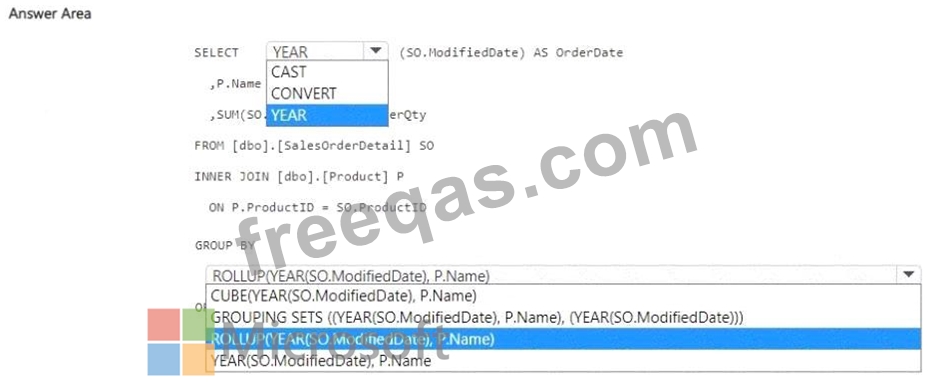
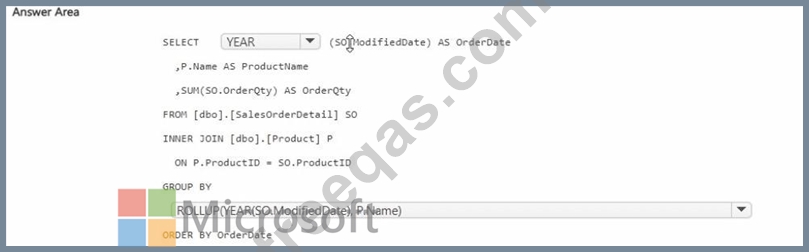
You need to summarize order quantities by year and product. The solution must include the yearly sum of order quantities for all the products in each row.
How should you complete the T-SQL statement? To answer, select the appropriate options in the answer area.
NOTE: Each correct selection is worth one point.
Correct Answer:

Explanation:
insert code
  • ««
  • «
  • …
  • 2
  • 3
  • 4
  • 5
  • 6
  • 7
  • 8
  • 9
  • 10
  • 11
  • …
  • »
  • »»
[×]

Download PDF File

Enter your email address to download Microsoft.DP-600.v2026-10-12.q204 Dumps

Email:

FreeQAs

Our website provides the Largest and the most Latest vendors Certification Exam materials around the world.

Using dumps we provide to Pass the Exam, we has the Valid Dumps with passing guranteed just which you need.

  • DMCA
  • About
  • Contact Us
  • Privacy Policy
  • Terms & Conditions
©2026 FreeQAs

www.freeqas.com materials do not contain actual questions and answers from Cisco's certification exams.
