A company deploys Mule applications with default configurations through Runtime Manager to customer-hosted Mule runtimes. Each Mule application is an API implementation that exposes RESTful interfaces to API clients. The Mule runtimes are managed by the MuleSoft-hosted control plane. The payload is never used by any Logger components.
When an API client sends an HTTP request to a customer-hosted Mule application, which metadata or data (payload) is pushed to the MuleSoft-hosted control plane?
An organization has created an API-led architecture that uses various API layers to integrate mobile clients with a backend system. The backend system consists of a number of specialized components and can be accessed via a REST API. The process and experience APIs share the same bounded-context model that is different from the backend data model. What additional canonical models, bounded-context models, or anti-corruption layers are best added to this architecture to help process data consumed from the backend system?
The implementation of a Process API must change.
What is a valid approach that minimizes the impact of this change on API clients?
A customer has an ELA contract with MuleSoft. An API deployed to CloudHub is consistently experiencing performance issues. Based on the root cause analysis, it is determined that autoscaling needs to be applied.
How can this be achieved?
Refer to the exhibit.
Three business processes need to be implemented, and the implementations need to communicate with several different SaaS applications.
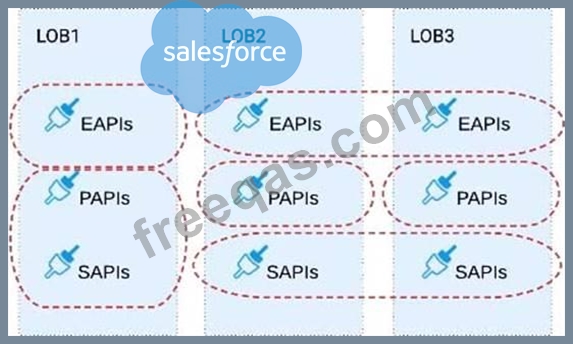
These processes are owned by separate (siloed) LOBs and are mainly independent of each other, but do share a few business entities. Each LOB has one development team and their own budget In this organizational context, what is the most effective approach to choose the API data models for the APIs that will implement these business processes with minimal redundancy of the data models?
A) Build several Bounded Context Data Models that align with coherent parts of the business processes and the definitions of associated business entities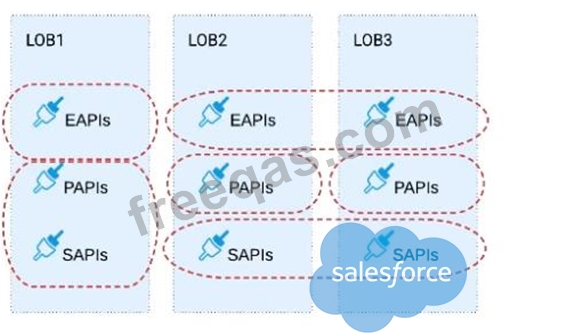
B) Build distinct data models for each API to follow established micro-services and Agile API-centric practices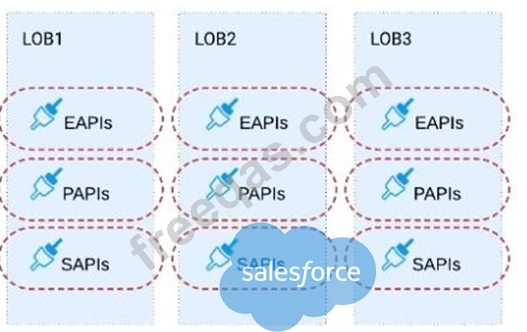
C) Build all API data models using XML schema to drive consistency and reuse across the organization
D) Build one centralized Canonical Data Model (Enterprise Data Model) that unifies all the data types from all three business processes, ensuring the data model is consistent and non-redundant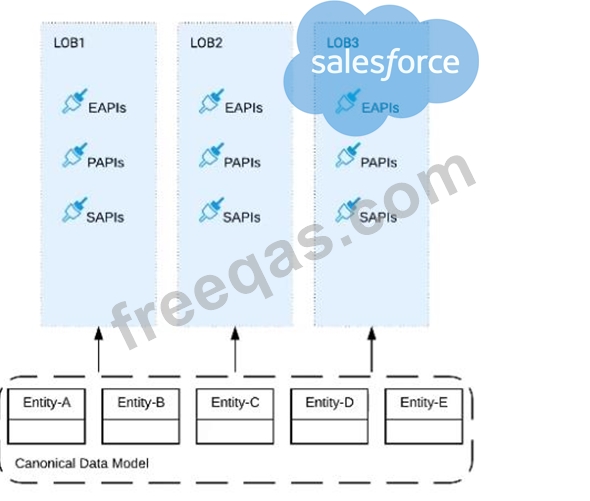
Enter your email address to download Salesforce.MuleSoft-Platform-Architect-I.v2025-10-22.q61 Dumps

