FreeQAs
 Request Exam  Contact
  • Home
  • View All Exams
  • New QA's
  • Upload
PRACTICE EXAMS:
  • Oracle
  • Fortinet
  • Juniper
  • Microsoft
  • Cisco
  • Citrix
  • CompTIA
  • VMware
  • ISC
  • SAP
  • EMC
  • PMI
  • HP
  • Salesforce
  • Other
  • Oracle
    Oracle
  • Fortinet
    Fortinet
  • Juniper
    Juniper
  • Microsoft
    Microsoft
  • Cisco
    Cisco
  • Citrix
    Citrix
  • CompTIA
    CompTIA
  • VMware
    VMware
  • ISC
    ISC
  • SAP
    SAP
  • EMC
    EMC
  • PMI
    PMI
  • HP
    HP
  • Salesforce
    Salesforce
  1. Home
  2. Microsoft Certification
  3. AI-200 Exam
  4. Microsoft.AI-200.v2026-11-23.q122 Dumps
  • ««
  • «
  • …
  • 16
  • 17
  • 18
  • 19
  • 20
  • 21
  • 22
  • 23
  • 24
  • 25
  • …
  • »
  • »»
Download Now

Question 96

You must ensure an Azure OpenAI-powered application never exceeds a defined token-per- minute budget across all users to avoid runaway costs. What should you configure?

Correct Answer: B
Each Azure OpenAI deployment can have Tokens-Per-Minute (TPM) and Requests-Per-Minute (RPM) limits configured, which cap consumption at the deployment level and directly control cost exposure.
insert code

Question 97

You are implementing a Retrieval-Augmented Generation (RAG) system by using the native vector search capabilities of Azure Cosmos DB for NoSQL API.
You have a container named Documents that stores technical articles. Each article includes a property named embedding.
You must ensure that the system can perform efficient similarity searches between user queries and the stored articles.
You need to configure the database resources to support semantic retrieval.
Which configurations should you use? To answer, move the appropriate configurations to the correct requirements. You may use each configuration once, more than once, or not at all. You may need to move the split bar between panes or scroll to view content.
NOTE: Each correct selection is worth one point.
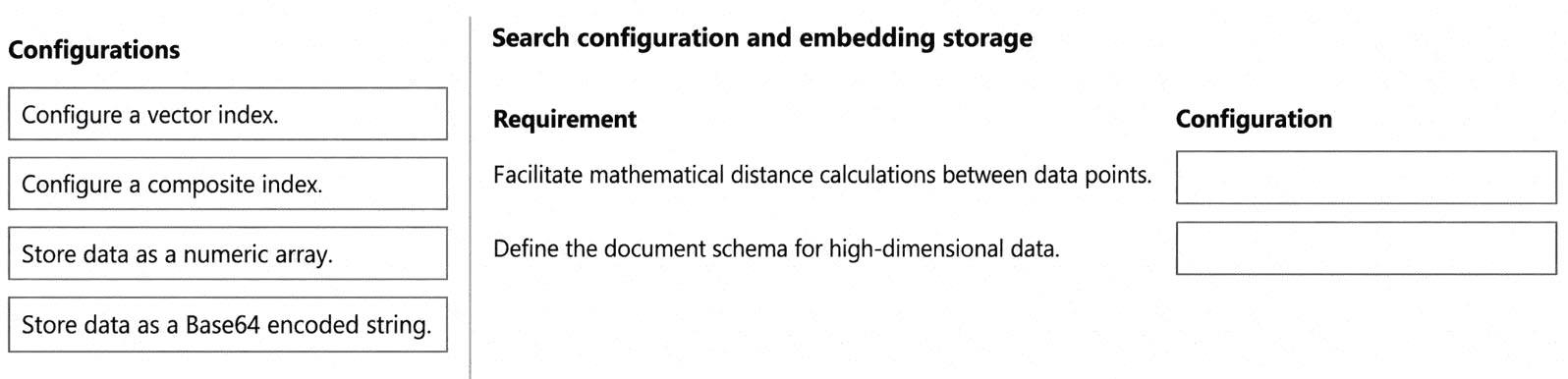
Correct Answer:

Explanation:
* Facilitate mathematical distance calculations between data points: Configure a vector index.
* Define the document schema for high-dimensional data: Store data as a numeric array.
Azure Cosmos DB for NoSQL supports native vector search by storing embeddings directly in JSON documents and defining a vector embedding policy plus a vector index on the embedding path. Microsoft documents that vector search compares a query vector with stored vectors by calculating similarity or distance through the VectorDistance() system function. A vector index materially improves this process by reducing search latency, increasing throughput, and lowering RU consumption compared with an unindexed vector scan.
The embedding property itself must be stored as an array of numeric values . Microsoft examples show embedding properties such as " contentVector " : [2, -1, 4, ...] and define the associated vector policy with attributes including path, data type, dimensions, and distance function. This representation is required because embeddings are high-dimensional numerical vectors generated by an embedding model.
A composite index optimizes queries involving multiple scalar properties but does not provide vector- distance indexing. A Base64-encoded string cannot be used directly for native vector similarity calculations because Cosmos DB expects the vector field to contain numeric values matching the configured dimensionality.
Study Guide references: Azure Cosmos DB for NoSQL # vector embedding policies; vector indexes; VectorDistance(); numeric embedding arrays; native vector search.
insert code

Question 98

Drag and Drop Question
A semantic search application queries Azure Database for PostgreSQL and stores document embeddings and metadata in a table with the following columns:
- embedding (pgvector)
- department
- created_at
The application must return the top five most similar documents for a given query embedding only from the finance department.
You need to implement semantic retrieval with metadata filtering.
Which query components should you select? To answer, move the appropriate query components to the correct requirements. You may use each query component once, more than once, or not at all. You may need to move the split bar between panes or scroll to view content.
NOTE: Each correct selection is worth one point.

Correct Answer:

Explanation:
Box 1: WHERE department = 'Finance'
Box 2: ORDER BY embedding <=> :query_vector LIMIT 5
To rank and return the top five most similar documents by similarity in Microsoft Learn, use the ORDER BY embedding <=> [query_vector] expression combined with LIMIT 5, where <=> computes the cosine distance.
Reference:
https://learn.microsoft.com/en-us/azure/postgresql/extensions/how-to-use-pgvector
insert code

Question 99

You need to detect whether an uploaded image contains adult or violent content before allowing it to be posted to a public forum. What should you use?

Correct Answer: B
Azure AI Content Safety's image moderation capability is purpose-built to detect categories such as sexual, violent, self-harm, and hate content in images, returning severity scores you can act on.
insert code

Question 100

An AI application retrieves configuration values from App Configuration. The application uses static configuration.
You need to implement a solution that supports dynamic configuration updates and minimizes latency for application requests.
What should you do?


Correct Answer: B
Use the Azure App Configuration provider ' s caching and dynamic refresh mechanism with a configured refresh interval . The application loads configuration into a local cache and periodically checks App Configuration for changes. When a registered key changes, the provider refreshes the cached configuration without requiring an application restart. Microsoft documents SetRefreshInterval and equivalent provider settings as the mechanism for controlling the minimum time between configuration-refresh checks.
This approach satisfies both requirements. The configuration is dynamic because updated values can be detected and reloaded at runtime, while request latency remains low because normal application requests read configuration from the local cached copy instead of making a remote App Configuration request every time.
For request-driven refresh, Microsoft notes that refresh occurs asynchronously and does not block the incoming request. Before the configured refresh interval expires, additional refresh calls effectively perform no remote operation.
Microsoft also recommends caching App Configuration values instead of loading them whenever they are used, both to reduce latency and to avoid excessive service requests, throttling, and unnecessary charges.
Environment variables remain static unless the application is restarted or redeployed. Retrieving configuration on every request increases latency and service load. Key Vault is primarily intended for secrets, not general dynamic application configuration.
Study Guide references: Azure App Configuration; dynamic configuration refresh; provider caching; refresh intervals; request-driven refresh; configuration resiliency.
insert code
  • ««
  • «
  • …
  • 16
  • 17
  • 18
  • 19
  • 20
  • 21
  • 22
  • 23
  • 24
  • 25
  • …
  • »
  • »»
[×]

Download PDF File

Enter your email address to download Microsoft.AI-200.v2026-11-23.q122 Dumps

Email:

FreeQAs

Our website provides the Largest and the most Latest vendors Certification Exam materials around the world.

Using dumps we provide to Pass the Exam, we has the Valid Dumps with passing guranteed just which you need.

  • DMCA
  • About
  • Contact Us
  • Privacy Policy
  • Terms & Conditions
©2026 FreeQAs

www.freeqas.com materials do not contain actual questions and answers from Cisco's certification exams.