FreeQAs
 Request Exam  Contact
  • Home
  • View All Exams
  • New QA's
  • Upload
PRACTICE EXAMS:
  • Oracle
  • Fortinet
  • Juniper
  • Microsoft
  • Cisco
  • Citrix
  • CompTIA
  • VMware
  • ISC
  • SAP
  • EMC
  • PMI
  • HP
  • Salesforce
  • Other
  • Oracle
    Oracle
  • Fortinet
    Fortinet
  • Juniper
    Juniper
  • Microsoft
    Microsoft
  • Cisco
    Cisco
  • Citrix
    Citrix
  • CompTIA
    CompTIA
  • VMware
    VMware
  • ISC
    ISC
  • SAP
    SAP
  • EMC
    EMC
  • PMI
    PMI
  • HP
    HP
  • Salesforce
    Salesforce
  1. Home
  2. Microsoft Certification
  3. AI-200 Exam
  4. Microsoft.AI-200.v2026-11-23.q122 Dumps
  • ««
  • «
  • …
  • 17
  • 18
  • 19
  • 20
  • 21
  • 22
  • 23
  • 24
  • 25
  • 26
  • »
Download Now

Question 111

You are developing a solution for a hospital to support the following use cases:
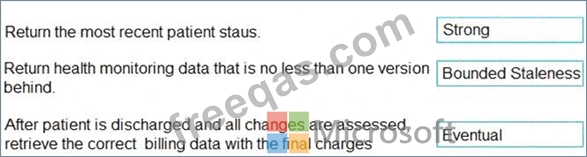
*The most recent patient status details must be retrieved even if multiple users in different locations have updated the patient record.
*Patient health monitoring data retrieved must be the current version or the prior version.
*After a patient is discharged and all charges have been assessed, the patient billing record contains the final charges.
You provision a Cosmos DB NoSQL database and set the default consistency level for the database account to Strong. You set the value for Indexing Mode to Consistent.
You need to minimize latency and any impact to the availability of the solution. You must override the default consistency level at the query level to meet the required consistency guarantees for the scenarios.
Which consistency levels should you implement? To answer, drag the appropriate consistency levels to the correct requirements. Each consistency level may be used once, more than once, or not at all. You may need to drag the split bar between panes or scroll to view content.
NOTE: Each correct selection is worth one point.

Correct Answer:

Explanation:

Strong consistency is required for the patient-status scenario because it provides linearizability : reads return the latest committed value. This is the appropriate guarantee when updates can originate from different locations and the application must never return an older patient status. Microsoft defines Strong as the highest Azure Cosmos DB consistency level and notes that it provides the strongest freshness guarantee, at the cost of greater latency and reduced availability compared with weaker models.
For health-monitoring data, Bounded Staleness is the intended consistency level. It explicitly limits how far reads can lag behind writes using a maximum number of versions (K) or a time interval (T). Conceptually, this matches a requirement that data may be current or only a limited number of versions behind.
For finalized billing data, Eventual consistency provides the lowest latency and highest availability. Once discharge processing is complete and no further billing writes occur , replicas eventually converge on the same final value. Microsoft specifically notes that, in the absence of further writes, weaker consistency levels ultimately yield the same converged data.
Azure Cosmos DB also permits requests to relax consistency below an account ' s Strong default , which is exactly the optimization pattern described here.
Study Guide references: Azure Cosmos DB for NoSQL # Strong consistency; Bounded Staleness; Eventual consistency; per-request consistency override; latency/availability trade-offs.
insert code

Question 112

You develop an ASP.NET Core app that uses Azure App Configuration. You also create an App Configuration containing 100 settings. The app must meet the following requirements:
* Ensure the consistency of all configuration data when changes to individual settings occur.
* Handle configuration data changes dynamically without causing the application to restart.
* Reduce the overall number of requests made to App Configuration APIs
You must implement dynamic configuration updates in the app.
What are two ways to achieve this goal? Each correct answer presents part of the solution.
NOTE: Each correct selection is worth one point.

Correct Answer: C,E
Detailed Explanation: A sentinel key allows the application to check one value and refresh all related configuration only when that sentinel changes, preserving a consistent set of settings instead of refreshing 100 keys independently. Increasing the refresh/cache interval reduces how frequently the application contacts App Configuration APIs. Together these measures support dynamic refresh without application restart while controlling request volume. Registering every key separately or decreasing the cache interval would increase API traffic, and Key Vault/environment variables do not solve coordinated App Configuration refresh.
Study Guide Alignment: Security and operations: Key Vault, App Configuration, managed identity, OpenTelemetry, Azure Monitor, and KQL-based troubleshooting.
Official Microsoft Learn References: AI-200 Study Guide | Dynamic configuration in ASP.NET Core
insert code

Question 113

Hotspot Question
You configure an Event Grid event subscription that routes AI file-upload events to an Azure Function endpoint.
Events must be delivered only in the following conditions:
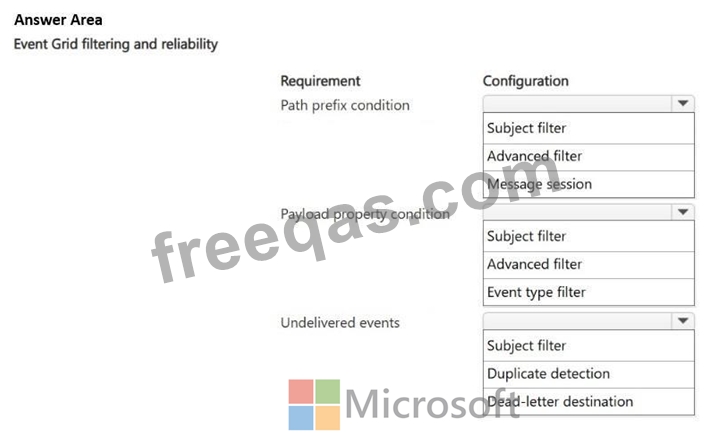
- The event path starts with /uploads/ai/.
- The payload property data.fileType is "pdf."
You must store undelivered events for later investigation and reprocessing if the subscriber endpoint cannot accept an event after multiple retries.
You need to configure the filtering and reliability settings.
Which configurations should you use? To answer, select the appropriate options in the answer area.
NOTE: Each correct selection is worth one point.
Correct Answer:

Explanation:
Box 1: Advanced filter
You should use an advanced filter to check that the path starts with /uploads/ai/ and that the payload property matches pdf.
Box 2: Advanced filter
Payload Property Condition: Use an Advanced Filter. While Subject filters handle prefix/suffix matching and Event Type filters handle the event schema type, Advanced filters are required to inspect deeply nested properties inside the event's data payload.
Box 3: Dead-letter destination
You should configure a Dead-letter destination to store undelivered events for later investigation and reprocessing.
Reference:
https://oneuptime.com/blog/post/2026-02-16-how-to-filter-azure-event-grid-subscription-events-with-advanced-filters/view
https://oneuptime.com/blog/post/2026-02-16-how-to-use-azure-event-grid-with-power-automate-to-react-to-blob-storage-events/view
insert code

Question 114

You optimize an AI inference API that uses Redis caching.
You must reduce the risk of serving outdated data while minimizing cache management overhead.
You need to implement the caching strategy that satisfies the requirements.
What should you do?

Correct Answer: A
Trigger invalidation when source data changes is the best action.
Data Freshness: This is a proactive cache-aside or write-through approach. By explicitly deleting or updating the specific Redis key when the underlying database or model data changes, you completely eliminate the risk of serving stale data.
Low Overhead: It keeps cache management overhead minimal because invalidation logic is execution-dependent (event-driven). Instead of constantly updating expirations or relying on heavy computing logic, you only trigger an action when a write/change event occurs.
Incorrect:
[not B]
Set eviction policy to allkeys-lru:
This policy is a memory management feature, not a data-freshness strategy. It only deletes the Least Recently Used (LRU) keys when your Redis instance runs out of RAM. If memory usage is stable, outdated data will sit in the cache forever, posing a major risk of serving stale inferences.
[not D]
Reset expiration on each read (Sliding TTL):
This actively increases the risk of serving outdated data. If a specific AI response is highly popular and read continuously, its expiration window will extend indefinitely. The data remains stuck in the cache even if the source data undergoes critical updates.
Reference:
https://oneuptime.com/blog/post/2026-01-30-llm-caching-strategies/view
insert code

Question 115

You are developing several microservices to run on Azure Container Apps. External HTTP ingress traffic has been enabled for the Microservices.
A deployed microservice must be updated to allow users to test new features. You have the following requirements:
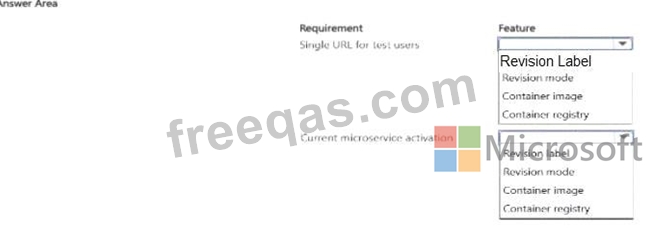
* Enable and maintain a single URL for the updated microservice to provide to test users.
* Update the microservice that corresponds to the current microservice version.
You need to configure Azure Container Apps.
Which features should you configure? To answer, select the appropriate options in the answer area.
NOTE: Each correct selection is worth one point.

Correct Answer:

Explanation:

Verified answer: Single URL for test users: Revision label. Current microservice activation behavior:
Revision mode.
Detailed Explanation: Azure Container Apps revision labels provide a stable label-specific URL that can be reassigned to a different revision, which is appropriate for a consistent test endpoint. Revision mode controls whether one or multiple revisions can be active at the same time and therefore governs how the current and updated application versions are activated. The container image and registry identify what is deployed, but they do not provide the stable test URL or the application-level revision activation behavior requested.
Study Guide Alignment: Containerized Azure workloads: registry builds, App Service containers, Container Apps revision/scaling behavior, and AKS deployment choices.
Official Microsoft Learn References: AI-200 Study Guide | Azure Container Apps revisions | Azure Container Apps revision labels
insert code
  • ««
  • «
  • …
  • 17
  • 18
  • 19
  • 20
  • 21
  • 22
  • 23
  • 24
  • 25
  • 26
  • »
[×]

Download PDF File

Enter your email address to download Microsoft.AI-200.v2026-11-23.q122 Dumps

Email:

FreeQAs

Our website provides the Largest and the most Latest vendors Certification Exam materials around the world.

Using dumps we provide to Pass the Exam, we has the Valid Dumps with passing guranteed just which you need.

  • DMCA
  • About
  • Contact Us
  • Privacy Policy
  • Terms & Conditions
©2026 FreeQAs

www.freeqas.com materials do not contain actual questions and answers from Cisco's certification exams.
