FreeQAs
 Request Exam  Contact
  • Home
  • View All Exams
  • New QA's
  • Upload
PRACTICE EXAMS:
  • Oracle
  • Fortinet
  • Juniper
  • Microsoft
  • Cisco
  • Citrix
  • CompTIA
  • VMware
  • ISC
  • SAP
  • EMC
  • PMI
  • HP
  • Salesforce
  • Other
  • Oracle
    Oracle
  • Fortinet
    Fortinet
  • Juniper
    Juniper
  • Microsoft
    Microsoft
  • Cisco
    Cisco
  • Citrix
    Citrix
  • CompTIA
    CompTIA
  • VMware
    VMware
  • ISC
    ISC
  • SAP
    SAP
  • EMC
    EMC
  • PMI
    PMI
  • HP
    HP
  • Salesforce
    Salesforce
  1. Home
  2. Microsoft Certification
  3. AI-200 Exam
  4. Microsoft.AI-200.v2026-11-23.q122 Dumps
  • ««
  • «
  • …
  • 17
  • 18
  • 19
  • 20
  • 21
  • 22
  • 23
  • 24
  • 25
  • 26
  • »
Download Now

Question 116

You are developing an application that must extract structured field data (invoice number, total, vendor name) from scanned invoices in multiple layouts.
You need a solution that requires no custom model training.
What should you use?

Correct Answer: B
Use the Azure AI Document Intelligence prebuilt invoice model . The prebuilt invoice model is specifically designed to analyze invoices and extract structured fields and line items without requiring an organization to train a custom model. Microsoft documents support for fields including InvoiceId , VendorName , InvoiceTotal , InvoiceDate, CustomerName, AmountDue, tax information, addresses, and invoice line items.
Because the model is pretrained to recognize common invoice structures, it can process invoices that use different layouts and formats while returning normalized structured output. This directly satisfies the requirement to extract invoice number, total, and vendor information from scanned documents while minimizing development and training effort.
The Azure AI Vision Read API performs OCR and can extract printed or handwritten text, but it does not provide invoice-specific semantic field extraction. Custom named entity recognition would require training and is designed for text entity extraction rather than document-layout understanding. A Document Intelligence custom neural model can handle organization-specific forms and layouts, but it requires custom model training, directly violating the requirement.
Therefore, the prebuilt invoice model provides the required combination of OCR, document understanding, structured extraction, and zero custom training.
Study Guide references: Azure AI Document Intelligence # prebuilt invoice model; structured field extraction; OCR; invoice fields and line items.
insert code

Question 117

You are building a semantic search feature for a chatbot. You store document embeddings in Redis.
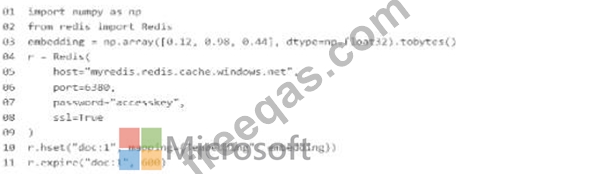
You review the following Python code that connects to Redis and stores an embedding value:
For each of the following statements, select Yes if the statement is true. Otherwise, select No.
NOTE: Each correct selection is worth one point.

Correct Answer:

Explanation:
Verified answer: Yes; No; Yes.
Detailed Explanation: `HSET` stores the binary embedding as a field in the Redis hash keyed by `doc:1`, so the first statement is true. The code does not create a RediSearch/Redis Query Engine vector index or define a vector field schema; merely storing bytes does not enable similarity search, so the second statement is false.
`EXPIRE doc:1 600` sets a 600-second lifetime, which is ten minutes, making the third statement true.
Study Guide Alignment: AI data-management workloads: Cosmos DB, PostgreSQL, caching, vector storage, vector retrieval, consistency, and connection optimization.
Official Microsoft Learn References: AI-200 Study Guide | Vector search in Azure Managed Redis
insert code

Question 118

Drag and Drop Question
You are developing a serverless Java application on Azure. You create a new Azure Key Vault to work with secrets from a new Azure Functions application.
The application must meet the following requirements:
- Reference the Azure Key Vault without requiring any changes to the
Java code.
- Dynamically add and remove instances of the Azure Functions host
based on the number of incoming application events.
- Ensure that instances are perpetually warm to avoid any cold starts.
- Connect to a VNet.
- Authentication to the Azure Key Vault instance must be removed if the Azure Functions application is deleted.
You need to grant the Azure Functions application access to the Azure Key Vault.
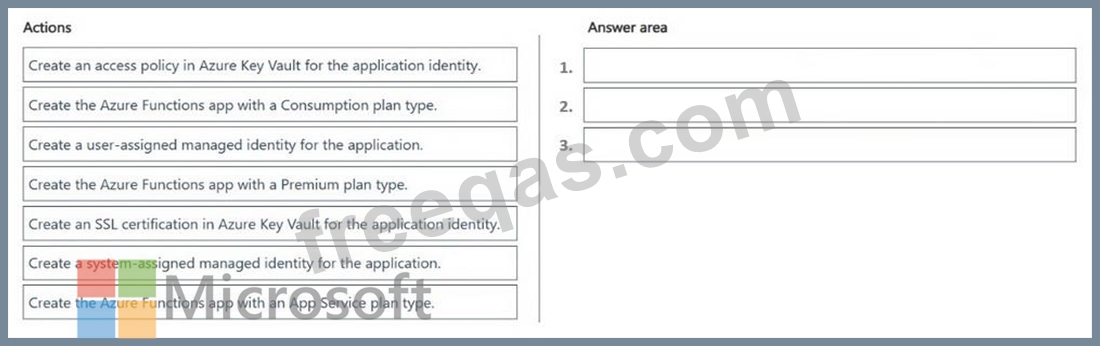
Which three actions should you perform in sequence? To answer, move the appropriate actions from the list of actions to the answer area and arrange them in the correct order.
Correct Answer:

Explanation:
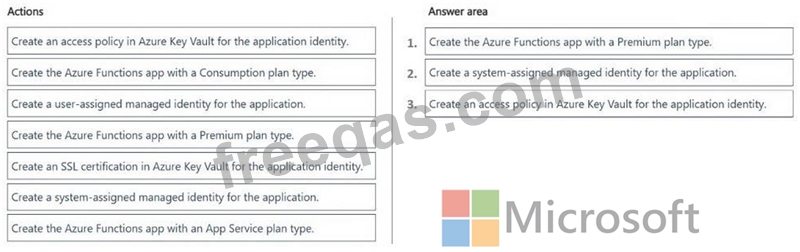
Step 1: Create the Azure Functions app with a Premium plan type
Perpetually Warm & VNet: The Premium plan type is the only serverless-scale hosting option that satisfies requirement 3 (keeping instances warm to eliminate cold starts) and requirement 4 (native regional VNet integration). The Consumption plan type does not keep instances warm and does not support VNet injection.
Event-Driven Scaling: It fulfills requirement 2 by dynamically adding and removing host instances using the event-driven scale controller.
Step 2: Create a system-assigned managed identity for the application
Lifecycle Coupling: It directly satisfies requirement 5. A system-assigned managed identity is tied strictly to the lifecycle of the Azure Functions resource. If the Functions application is deleted, Azure automatically removes the identity and its authentication token, ensuring that access to the Key Vault is immediately revoked. A user-assigned identity exists as an independent resource and would persist after the application's deletion.
Step 3: Create an access policy in Azure Key Vault for the application identity Granting Permissions: This step completes the access requirements. By adding an access policy (or an Azure RBAC role assignment) in Azure Key Vault specifically for the created system- assigned managed identity, you grant the runtime environment the necessary permissions to retrieve secrets.
No Code Changes: Combining the managed identity with an App Setting configured as an Azure Key Vault Reference allows the Functions platform to fetch secrets automatically at runtime, keeping your Java source code unchanged Reference:
https://learn.microsoft.com/en-us/azure/azure-functions/functions-best-practices
insert code

Question 119

A company is developing a solution that allows smart refrigerators to send temperature information to a central location.
The solution must receive and store messages until they can be processed. You create an Azure Service Bus instance by providing a name, pricing tier, subscription, resource group, and location.
You need to complete the configuration.
Which Azure CLI or PowerShell command should you run?

Correct Answer: C
insert code

Question 120

You are deploying a model in Azure AI Foundry and must ensure the endpoint can handle unpredictable bursts of traffic while keeping cost low during idle periods.
Which deployment type should you choose?


Correct Answer: B
Choose a Standard pay-as-you-go deployment . Microsoft Foundry documentation identifies Standard deployments as appropriate for low-to-medium volume workloads with high burstiness . Standard uses pay-per-token billing , so charges are based on actual inference consumption rather than continuously reserved model capacity. This makes it well suited to workloads whose traffic varies significantly and may have long idle periods.
By contrast, Provisioned Throughput Units (PTUs) reserve model-processing capacity and are designed for sustained, predictable high-throughput workloads where consistent latency is important. Microsoft states that PTUs are billed based on deployed capacity even when that capacity is not actively serving requests.
Consequently, PTU deployments can be economically inefficient when the endpoint is frequently idle or traffic is highly variable.
A Batch deployment is optimized for asynchronous, non-latency-sensitive processing and is not appropriate for an interactive endpoint receiving unpredictable live traffic. Dedicated managed compute with fixed capacity introduces continuously allocated infrastructure and therefore does not align with the requirement to minimize idle-period cost.
Microsoft also recommends Standard or Global Standard for variable, bursty traffic , while provisioned types are recommended for consistent high-volume workloads.
Study Guide references: Microsoft Foundry Models # Standard deployments; pay-per-token billing; bursty workloads; provisioned throughput; batch processing.
insert code
  • ««
  • «
  • …
  • 17
  • 18
  • 19
  • 20
  • 21
  • 22
  • 23
  • 24
  • 25
  • 26
  • »
[×]

Download PDF File

Enter your email address to download Microsoft.AI-200.v2026-11-23.q122 Dumps

Email:

FreeQAs

Our website provides the Largest and the most Latest vendors Certification Exam materials around the world.

Using dumps we provide to Pass the Exam, we has the Valid Dumps with passing guranteed just which you need.

  • DMCA
  • About
  • Contact Us
  • Privacy Policy
  • Terms & Conditions
©2026 FreeQAs

www.freeqas.com materials do not contain actual questions and answers from Cisco's certification exams.