FreeQAs
 Request Exam  Contact
  • Home
  • View All Exams
  • New QA's
  • Upload
PRACTICE EXAMS:
  • Oracle
  • Fortinet
  • Juniper
  • Microsoft
  • Cisco
  • Citrix
  • CompTIA
  • VMware
  • ISC
  • SAP
  • EMC
  • PMI
  • HP
  • Salesforce
  • Other
  • Oracle
    Oracle
  • Fortinet
    Fortinet
  • Juniper
    Juniper
  • Microsoft
    Microsoft
  • Cisco
    Cisco
  • Citrix
    Citrix
  • CompTIA
    CompTIA
  • VMware
    VMware
  • ISC
    ISC
  • SAP
    SAP
  • EMC
    EMC
  • PMI
    PMI
  • HP
    HP
  • Salesforce
    Salesforce
  1. Home
  2. Microsoft Certification
  3. AI-200 Exam
  4. Microsoft.AI-200.v2026-11-23.q122 Dumps
  • ««
  • «
  • …
  • 17
  • 18
  • 19
  • 20
  • 21
  • 22
  • 23
  • 24
  • 25
  • 26
  • »
Download Now

Question 106

Your Azure AI Search index must support both exact keyword matches on product SKUs and semantic similarity search on product descriptions in a single query. What should you configure?

Correct Answer: C
Hybrid search in Azure AI Search combines traditional keyword (BM25) search over text fields with vector similarity search over embedding fields in a single query, giving both exact-match precision (SKUs) and semantic recall (descriptions).
insert code

Question 107

You configure ACR Tasks to automate image builds.
Container images must rebuild when:
- Application updates occur.
- Base image updates occur, such as when the underlying OS image is
updated.
- Regular scheduled rebuilds are required.
You need to configure ACR Tasks to support automated image rebuilds.
Which three triggers should you configure? Each correct answer presents part of the solution.
NOTE: Each correct selection is worth one point.

Correct Answer: B,D,E
insert code

Question 108

You need to add a custom voice that matches your company's brand for a text-to-speech feature, distinct from any standard neural voice. What should you use?

Correct Answer: B
Custom Neural Voice lets you train a unique synthetic voice from recorded voice samples, producing a brand-specific voice rather than using one of the standard prebuilt neural voices.
insert code

Question 109

You plan to develop an Azure Functions app with an HTTP trigger.
The app must support the following functionality:
Event-driven scaling -
Ability to use custom Linux images for function execution
You need to identify the app ' s hosting plan and the maximum amount of time that the app function can take to respond to incoming requests.
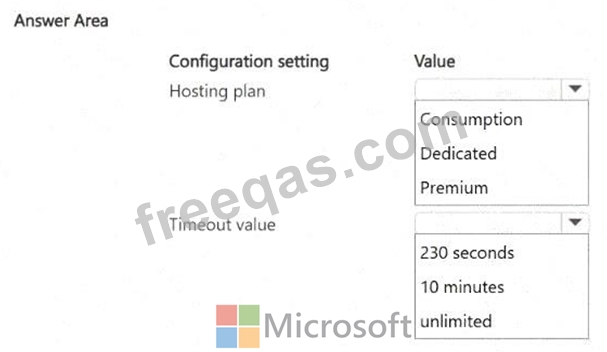
Which configuration setting values should you use? To answer, select the appropriate values in the answer area.
NOTE: Each correct selection is worth one point.
Correct Answer:

Explanation:
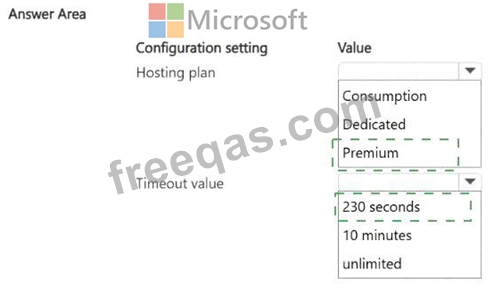
* Hosting plan: Premium
* Timeout value: 230 seconds
The correct hosting option is the Azure Functions Premium plan . Microsoft documents that the Premium plan supports event-driven scaling , where Azure Functions dynamically adds or removes host instances based on incoming trigger activity. It also supports Linux container deployments , which is required when the function app must execute from a custom Linux container image. A Dedicated App Service plan can host Linux containers, but it does not provide native Functions event-driven scaling. The legacy Consumption plan supports event-driven scaling but does not satisfy the custom Linux container requirement in this question.
For an HTTP-triggered function , the maximum time available to return an HTTP response is 230 seconds .
This limit applies even though a Premium-plan function can have a much longer or effectively unbounded execution timeout. Microsoft explains that the 230-second response limit results from the Azure Load Balancer ' s default idle timeout. If processing continues beyond this point, the function can continue executing, but the client will receive a timeout and the function cannot return its eventual response over that original HTTP connection.
Therefore, Premium + 230 seconds is the required combination.
Study Guide references: Azure Functions hosting options; Premium plan; Linux container support; event- driven scaling; HTTP-trigger timeout behavior.
insert code

Question 110

Hotspot Question
You are implementing semantic retrieval in Redis.
The solution must support low-latency, approximate nearest neighbor (ANN) vector similarity search for large-scale AI retrieval workloads.
You need to select the appropriate vector schema settings.
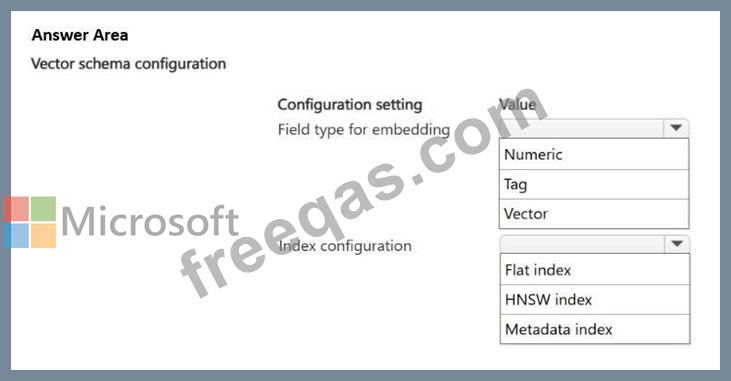
Which configuration values should you select? To answer, select the appropriate options in the answer area.
NOTE: Each correct selection is worth one point.
Correct Answer:

Explanation:
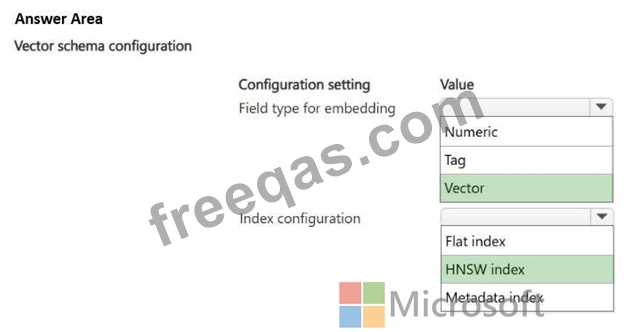
Box 1: Vector
The correct field type for storing and querying embeddings in Redis is VECTOR.
Box 2: HNSW index
To support low-latency, large-scale approximate nearest neighbor (ANN) vector search in Redis, you should use the HNSW (Hierarchical Navigable Small World) index type with Float32 data type.
Reference:
https://redis.io/docs/latest/develop/ai/search-and-query/vectors/
insert code
  • ««
  • «
  • …
  • 17
  • 18
  • 19
  • 20
  • 21
  • 22
  • 23
  • 24
  • 25
  • 26
  • »
[×]

Download PDF File

Enter your email address to download Microsoft.AI-200.v2026-11-23.q122 Dumps

Email:

FreeQAs

Our website provides the Largest and the most Latest vendors Certification Exam materials around the world.

Using dumps we provide to Pass the Exam, we has the Valid Dumps with passing guranteed just which you need.

  • DMCA
  • About
  • Contact Us
  • Privacy Policy
  • Terms & Conditions
©2026 FreeQAs

www.freeqas.com materials do not contain actual questions and answers from Cisco's certification exams.
