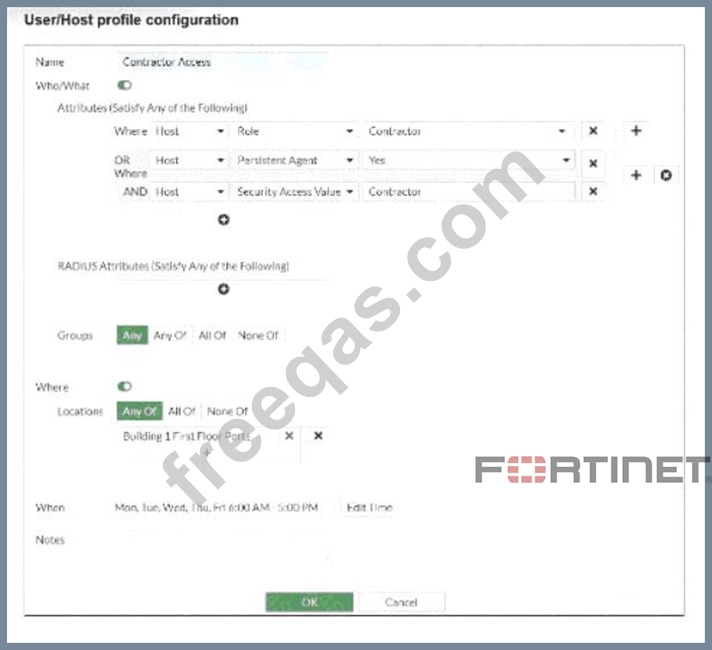
Refer to the exhibit. If a host is connected to a port in the Building 1 First Floor Ports group, what must also be true to match this user/host profile?
Correct Answer: D
TheUser/Host Profilein FortiNAC-F is the fundamental logic engine used to categorize endpoints for policy assignment. As seen in the exhibit, the configuration uses a combination of Boolean logic operators (ORandAND) to define the " Who/What " attributes. According to theFortiNAC-F Administrator Guide, attributes grouped together within the same bracket or connected by anORoperator require only one of those conditions to be met. In the exhibit, the first two attributes are " Host Role = Contractor " OR " Host Persistent Agent = Yes " . This forms a single logical block. This block is then joined to the third attribute ( " Host Security Access Value = Contractor " ) by anANDoperator. Consequently, a host must satisfyat least oneof the first two conditionsANDsatisfy the third condition to match the " Who/What " section. Furthermore, the profile includesLocationandWhen(time) constraints. The exhibit shows the location is restricted to the " Building 1 First Floor Ports " group. The " When " schedule is explicitly set toMon-Fri 6:00 AM - 5:00 PM. For a profile to match,allenabled sections (Who/What, Locations, and When) must be satisfied simultaneously. Therefore, the host must meet the conditional contractor/agent criteria, possess the specific security access value, and connect during the defined 6 AM to 5 PM window. " User/Host Profiles use a combination of attributes to identify a match. Attributes joined byORrequire any one to be true, while attributes joined byANDmust all be true. If aSchedule(When) is applied, the host must also connect within the specified timeframe for the profile to be considered a match. All criteria in the Who /What, Where, and When sections are cumulative. " -FortiNAC-F Administration Guide: User/Host Profile Configuration.
Question 52
When creating a device profiling rule, what are two advantages of registering the device in the host view? (Choose two.)
Correct Answer: B,C
In FortiNAC-F, theDevice Profileris a rule-based engine that evaluates unknown " rogue " devices and classifies them based on fingerprints and behavior. When a profiling rule matches a device, the administrator can configure the rule to automatically register that device. The registration process can place the device record in two primary locations: theTopology View(as a device) or theHost View(as a registered host). According to theFortiNAC-F Administration Guide, registering a device in theHost Viewprovides significant advantages for identity management and historical tracking. First, the devices can beassociated with a user (C). In the FortiNAC database architecture, the Host View is the primary repository for endpoint identity; placing a profiled device here allows the system to link that hardware (MAC address) to a specific user account, whether that user is an employee, guest, or a system-level " owner " . This association is essential for Role-Based Access Control (RBAC) and for tracking accountability across the network fabric. Second, devices registered in the Host View will haveconnection logs (B). FortiNAC-F maintains a detailed operational history for all host records, including every instance of the device connecting to or disconnecting from a port, its IP address assignments, and the specific policies applied during each session. These logs are invaluable for troubleshooting connectivity issues and for security forensic audits, as they provide a clear timeline of the device ' s lifecycle on the network. In contrast, devices managed only in the Topology View are typically treated as infrastructure components where the focus is on device availability rather than individual session history. " Devices that are registered and associated with a user are placed in theHost Viewand removed from the Profiled Devices window... Placing a device in the Host View allows for the tracking ofconnection historyand the association of the device with a specificidentity or user recordwithin the FortiNAC database. " - FortiNAC-F Administration Guide: Device Profiler How it Works.
Question 53
A healthcare organization is integrating FortiNAC-F with its existing MDM. Communication is failing between the systems. What could be a probable cause?
Correct Answer: C
The integration between FortiNAC-F and Mobile Device Management (MDM) platforms (such as Microsoft Intune, VMware Workspace ONE, or Jamf) is a critical component for providing visibility into mobile assets that do not connect directly to the managed infrastructure via standard wired or wireless protocols. According to the FortiNAC-F MDM Integration Guide, the communication between the FortiNAC-F appliance and the MDM server is handled through REST API calls. FortiNAC-F acts as an API client, periodically polling the MDM server to retrieve device metadata, compliance status, and ownership information. If communication is failing, it is most likely because the API credentials (Client ID/Secret) are incorrect, the MDM's API endpoint is unreachable from the FortiNAC-F service port, or the SSL certificate presented by the MDM is not trusted by the FortiNAC-F root store.