FreeQAs
 Request Exam  Contact
  • Home
  • View All Exams
  • New QA's
  • Upload
PRACTICE EXAMS:
  • Oracle
  • Fortinet
  • Juniper
  • Microsoft
  • Cisco
  • Citrix
  • CompTIA
  • VMware
  • ISC
  • SAP
  • EMC
  • PMI
  • HP
  • Salesforce
  • Other
  • Oracle
    Oracle
  • Fortinet
    Fortinet
  • Juniper
    Juniper
  • Microsoft
    Microsoft
  • Cisco
    Cisco
  • Citrix
    Citrix
  • CompTIA
    CompTIA
  • VMware
    VMware
  • ISC
    ISC
  • SAP
    SAP
  • EMC
    EMC
  • PMI
    PMI
  • HP
    HP
  • Salesforce
    Salesforce
  1. Home
  2. Fortinet Certification
  3. NSE6_FNC_AD-7.6 Exam
  4. Fortinet.NSE6_FNC_AD-7.6.v2026-11-16.q53 Dumps
  • «
  • 1
  • 2
  • 3
  • 4
  • 5
  • 6
  • 7
  • 8
  • 9
  • 10
  • …
  • »
  • »»
Download Now

Question 21

Which group type can have members added directly from the FortiNAC Control Manager?

Correct Answer: A
insert code

Question 22

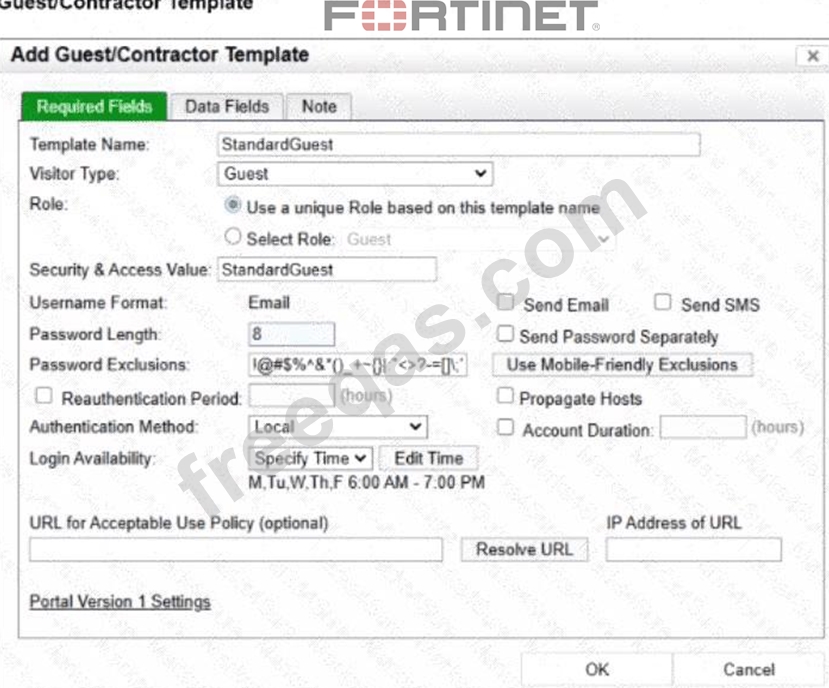
Refer to the exhibit.

An administrator wants to ensure that guest accounts created from this template are not allowed network access outside of the designated times.
To achieve this, all necessary configurations must be made to force isolation of hosts in which state?

Correct Answer: C
The correct answer is C . The exhibit shows a guest template with Login Availability set to Specify Time , allowing login only Monday through Friday from 6:00 AM to 7:00 PM . The study guide explains that the Account Duration and Login Availability fields define when the account is deleted from the database or what days and times the account is enabled. Therefore, outside the allowed login window, the guest cannot authenticate successfully using that guest account.
To stop network access outside those permitted times, FortiNAC-F must isolate hosts that are in the Not Authenticated state. The guide maps the Authentication captive network to hosts in the Not Authenticated state, and the isolation logic table shows that hosts in the Not Authenticated state are moved to the Authentication network when the point of connection is in the Forced Authentication group.
Option A is wrong because At-risk hosts are isolated to remediation/quarantine due to compliance or security posture problems, not because a guest login is outside allowed hours. Option B is wrong because Disabled hosts are intentionally disabled and sent to the dead-end network; the account here is time-restricted, not necessarily disabled. Option D is wrong because Rogue applies to unregistered or unclassified devices, while this scenario is about a known guest account that is not allowed to authenticate outside its login schedule.
insert code

Question 23

Which two statements are true about integrating a third-party device using SNMP traps from that device as input to generate an event? (Choose two.)

Correct Answer: A,C
The sending device must be modeled so FortiNAC-F can associate the incoming trap source with a known managed element and process it correctly. The trap definition must include the OIDs that carry the endpoint identifiers (IP and MAC) so FortiNAC-F can extract that data from the trap payload and generate the intended event.
insert code

Question 24

During an initial installation, which configuration must be applied to allow for the modeling of infrastructure devices?

Correct Answer: A
insert code

Question 25

When working with a FortiNAC-F Manager and cluster management, what will occur when a cluster manager recovers from a non-responsive state?

Correct Answer: C
The correct answer is C . In FortiNAC-F Manager clustering, the active cluster management role is the leader role, and other cluster members operate as worker nodes. Fortinet's FortiNAC-F 7.6 Manager Cluster Guide states that when a worker is promoted to leader during automatic transition, the original leader becomes a worker node when it comes back online. It also explains that a cluster has one leader and can have multiple workers, with leader/worker roles used for cluster management and heartbeat exchange.
So, if the cluster manager becomes non-responsive and another node takes over leadership, the recovered manager does not automatically reclaim the leader role. It rejoins as a worker node. Option A is wrong because recovery does not automatically remove it into a standalone group. Option B is wrong because automatic return to the previous manager/leader state would create instability and possible split-brain behavior. Option D is wrong because "standby" is not the role described for FortiNAC-F Manager clustering in this context; the documented cluster roles are leader and worker.
insert code
  • «
  • 1
  • 2
  • 3
  • 4
  • 5
  • 6
  • 7
  • 8
  • 9
  • 10
  • …
  • »
  • »»
[×]

Download PDF File

Enter your email address to download Fortinet.NSE6_FNC_AD-7.6.v2026-11-16.q53 Dumps

Email:

FreeQAs

Our website provides the Largest and the most Latest vendors Certification Exam materials around the world.

Using dumps we provide to Pass the Exam, we has the Valid Dumps with passing guranteed just which you need.

  • DMCA
  • About
  • Contact Us
  • Privacy Policy
  • Terms & Conditions
©2026 FreeQAs

www.freeqas.com materials do not contain actual questions and answers from Cisco's certification exams.