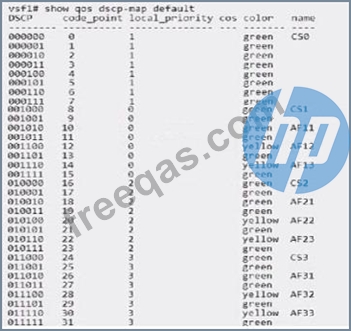
The ACME company has an AOS-CX 6200 switch stack with an uplink oversubscription ratio of 9.6:1. They are considering adding two more nodes to the stack without adding any additional uplinks due to cabling constraints One of their architects has expressed concerns that their critical UDP traffic from both wired and bridged AP clients will encounter packet drops. They have already applied the following configuration: Which strategy will complement this solution to achieve their objective?
Correct Answer: D
Given that the ACME company's concern is about UDP traffic potentially encountering packet drops due to uplink oversubscription, they need a strategy that prioritizes critical UDP traffic to minimize loss. Option D, edge mark critical UDP traffic with AF42, is the correct answer. Assured Forwarding (AF) classes provide a way to assign different levels of delivery assurance for IP packets. AF42 is typically used for traffic that requires low latency and low loss, such as voice and video, which often use UDP. Marking critical UDP traffic with AF42 will help ensure that this traffic is treated with higher priority over the network. Option A (edge mark lower priority TCP traffic with AF12) and Option C (edge mark lower priority TCP traffic with AF11) suggest marking lower priority TCP traffic, which does not directly address the concern for critical UDP traffic. Option B (edge mark critical UDP Traffic with CS5) suggests using Class Selector 5 for critical UDP traffic, which is also a valid approach but does not match the existing configuration that is focused on Assured Forwarding (AF) classes.
Question 17
Refer to the exhibit. A network administrator is validating client connectivity and executes the show command shown in the exhibit. Which authentication method was used by the wireless station?
Correct Answer: B
The provided output is from the command: (MC2) #show auth-tracebuf mac <MAC> This command traces the authentication exchange between the access point (or mobility controller) and the RADIUS server for a specific client. The trace provides insight into the 802.1X authentication sequence and RADIUS responses. From the exhibit: * EAPOL (Extensible Authentication Protocol over LAN) Messages Observed: * eap-id-req * eap-id-resp * eap-req * eap-resp * eap-success These messages clearly indicate that an 802.1X (EAP-based) authentication took place. MAC authentication (MAB) or WebAuth would not include multiple EAP identity and response messages. * RADIUS Messages: * rad-req, rad-resp, rad-accept from /RADIUS1 * The presence of rad-accept indicates successful authentication. Exact extract from ArubaOS (AOS-S/AOS 10 WLAN Authentication Guide): "When the trace output shows EAP identity requests, EAP responses, and a RADIUS Access-Accept message, the authentication method in use is 802.1X (EAP-based user authentication). The presence of EAP-Success following the Access-Accept confirms successful 802.1X authentication." * Follow-on WPA2 Key Exchange: * Lines show wpa2-key1, wpa2-key2, wpa2-key3, and wpa2-key4. * This sequence occurs after 802.1X authentication completes and is used to establish encryption keys for a WPA2 Enterprise session. Exact extract from Aruba WLAN Troubleshooting Guide: "After successful 802.1X authentication (EAP-Success), the controller exchanges four WPA2 keys with the station to derive the session keys used for data encryption. This confirms WPA2-Enterprise with 802.1X was used." * No Indication of MAC or WebAuth: * MAC authentication would show mac-auth or macauth messages instead of eap-id-req/resp. * WebAuth involves HTTP-based redirection and is not visible in auth-tracebuf as EAP transactions. Exact extract: "MAC authentication shows 'macauth start' and 'macauth accept' entries, not EAPOL frames. WebAuth authentication uses a web redirect and does not appear as EAP frames in the trace buffer." Therefore, the trace confirms a WPA2-Enterprise 802.1X user authentication, where the user's credentials were validated by the RADIUS server, followed by the WPA2 key handshake. Why the Other Options Are Incorrect: * A. MAC authentication:Would show MAC-based request/response entries (macauth), not eap-id-req /resp. * C. WEBauth authentication:WebAuth occurs over HTTP/HTTPS and does not involve EAP messages; thus, no eap-id or eap-success would be seen. * D. 802.1X machine authentication:Machine authentication occurs before user logon and is typically identified in logs by a computer account (e.g., host/computername$). Here, the username and context indicate a user-level session. References of HPE Aruba Networking Switching Documents or Study Guide: * ArubaOS 8/10 WLAN Authentication and Security Configuration Guide - "802.1X EAP Authentication and Trace Analysis." * Aruba WLAN Troubleshooting Guide - "Using show auth-tracebuf to validate EAP authentication." * Aruba Campus Wireless Design Fundamentals - "Understanding WPA2-Enterprise authentication flow (EAPOL, RADIUS, WPA2 4-Way Handshake)." * Aruba Access Security and AAA Implementation Guide - "Distinguishing between MAC, WebAuth, and 802.1X authentication in debug outputs."
Question 18
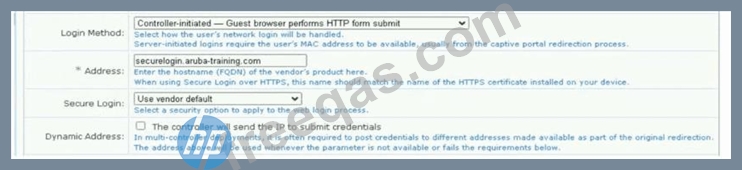
A customer reports that their HPE Aruba Networking ClearPass Guest captive portal is not functioning. The page loads but they are unable to browse after pressing connect. They have uploaded a valid and publicly trusted *. aruba-training.com certificate. Refer to the exhibit. Which would explain this issue?
Correct Answer: B
In HPE Aruba ClearPass Guest configuration, the "Address" field defines the Fully Qualified Domain Name (FQDN) of the captive portal server that users are redirected to when accessing the guest network. When a wildcard certificate is used, such as *.aruba-training.com, the derived FQDN for the captive portal redirection automatically becomes: captiveportal-login.aruba-training.com This naming convention is required so that the Common Name (CN) or Subject Alternative Name (SAN) in the SSL certificate matches the domain presented to the client browser during HTTPS redirection. If the "Address" field is incorrectly configured with just aruba-training.com, the certificate and the redirection URL will not match, causing the browser to block or fail the authentication process. This results in users being unable to browse after pressing Connect on the portal page. HPE Aruba documentation states: "When using a wildcard certificate (for example CN = *.domain.com) on ClearPass Guest, the web login redirection address must be configured as captiveportal-login.domain.com to ensure the HTTPS certificate name matches the redirection hostname." "If the address field does not match the derived hostname of the certificate, browser trust validation fails and users cannot proceed beyond the captive portal page." Additionally, the ArubaOS and ClearPass Guest deployment guide clarifies that wildcard certificates are fully supported for guest portals, provided that the Address field follows the proper naming pattern. Incorrect Configurations: * Setting "Address" to aruba-training.com causes SSL mismatch errors. * Leaving the "Address" blank defaults to a local IP or hostname mismatch. Correct Configuration: * "Address" should be set to captiveportal-login.aruba-training.com when the wildcard certificate is *. aruba-training.com. Option Explanations: * A. Incorrect - this does not follow the certificate's derived FQDN format. * B. Correct - matches the expected derived FQDN for wildcard certificates. * C. Incorrect - HTTPS certificates are required for secure guest portals. * D. Incorrect - Wildcard certificates are supported by ClearPass Guest and ArubaOS. Final Verified answer: B Reference Sources (HPE Aruba Networking Official Materials): * Aruba ClearPass Guest Configuration and Deployment Guide * ArubaOS 8.x User Guide - Captive Portal and Authentication Configuration * HPE Aruba ClearPass Certificates 101 Technical Note * ArubaOS-Switch and ClearPass Integration Guide
Question 19
A BGP routing table contains multiple routes to the same destination prefix. Referring to the table below which route would be marked with a ">" symbol?
Correct Answer: E
In BGP, the route marked with a ">" symbol is the best route that is chosen based on BGP attributes in the following order: highest weight (Cisco-specific), highest local preference, originated by BGP running on the local router, shortest AS path, lowest origin type, lowest MED, eBGP over iBGP, closest IGP neighbor, and lowest BGP router ID. Based on the table provided, Option E would be marked with a ">" symbol as it has the highest local preference of 100 which is a decisive factor in the BGP best path selection process.
Question 20
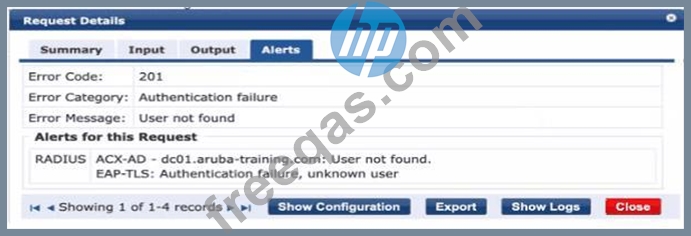
You configured" a bridged mode SSID with WPA3-Enterprise and EAP-TLS security. When you connect an Active Directory joined client that has valid client certificates. ClearPass shows the following error. What is needed to resolve this issue?
Correct Answer: C
The error message "User not found" indicates that the authentication source, in this case, Active Directory (AD), is not able to locate the user account based on the current search parameters. This often occurs when the User Principal Name (UPN) that the client is using to authenticate is not included in the search parameters of the AD authentication source within ClearPass. By modifying the AD authentication source to include the UPN in the search, ClearPass will be able to correctly locate the user account and proceed with the authentication using the valid client certificates.