A customer's infrastructure is set up to use both primary and secondary gateway clusters on the SSID profile based on best practices. Why do they have an equal split of their 260 APs across the primary and secondary gateway clusters?
Correct Answer: D
Comprehensive and Detailed Explanation From Exact Extract of HPE Aruba Networking Switching: In AOS-10 wireless deployments, HPE Aruba Networking supports the configuration of Primary and Secondary Gateway Clusters in the SSID profile to ensure high availability, redundancy, and load distribution. This configuration follows Aruba's gateway clustering best practices, where access points (APs) attempt to establish tunnels with their Primary Gateway Cluster first. If the AP cannot reach the primary cluster (due to reachability, latency, or network topology), it automatically connects to the Secondary Gateway Cluster. When both gateway clusters are active and reachable but some APs cannot reach the primary cluster-for example, due to Layer 3 routing, firewall restrictions, or network segmentation-those APs will associate with the secondary cluster instead. This results in an approximately equal split of APs across both clusters, even though the primary cluster is operational. Exact Extract from HPE Aruba Networking Switching and AOS-10 Gateway Documentation: "Access Points attempt to form tunnels with the Primary Gateway Cluster first. If the primary cluster is unreachable or fails to respond within the defined timeout, the AP establishes a tunnel with the Secondary Gateway Cluster." "When the primary and secondary gateway clusters are both up but APs are distributed across separate routed networks or VLANs, APs may select the gateway cluster that is most reachable at that time, resulting in an even or partial split of AP distribution." "This is expected behavior when APs in different subnets cannot reach the same primary cluster due to network topology. The secondary cluster provides redundancy and connectivity continuity." Therefore, the equal split of 260 APs is explained by the fact that while the primary cluster is active, a subset of APs cannot reach it due to routing or segmentation and thus join the secondary cluster-this behavior aligns with Aruba's gateway redundancy mechanism. Why the Other Options Are Incorrect: * A. The statement reverses the cause: APs that cannot reach the primary connect to the secondary- not the other way around. The secondary cluster's reachability does not affect AP selection when the primary is available and reachable. "APs first attempt the primary cluster; only failure to reach it triggers fallback to secondary." * B. Secondary cluster is homogeneous:Cluster homogeneity refers to identical hardware/software versions between gateways; it does not influence AP distribution or equal load split. "Homogeneity is a software version consideration, not an AP load-balancing factor." * C. Secondary cluster is heterogeneous:Heterogeneity (mixed hardware types) is unsupported or discouraged; it does not cause AP distribution behavior. "Heterogeneous gateway clusters are not a cause of AP distribution variation; cluster type does not dictate AP split." References of HPE Aruba Networking Switching Documents or Study Guide: * ArubaOS 10 Gateway and AP Deployment Guide - "Primary and Secondary Gateway Cluster Configuration and AP Association Logic." * Aruba High Availability and Clustering Best Practices Guide - "Gateway Cluster Failover, Redundancy, and AP Selection." * Aruba Central Cloud Management and Monitoring Guide - "SSID Profile Configuration: Primary and Secondary Gateway Clusters." * Aruba Campus Wireless Design Guide (AOS 10.x) - "Cluster Reachability, Redundancy, and Role Propagation Across Gateways."
Question 27
In a campus topology using VSX with two aggregation switches and downlinks to access switches, which LAG interface configuration at the aggregation layer is correct based on the parameters below? * ZTP VLAN 1001 * access switch MGMT VLAN 2002 * access switch MGMT VLAN is tagged * connectivity to the access switch should be maintained before and after the ZTP operation is complete
Correct Answer: C
Question 28
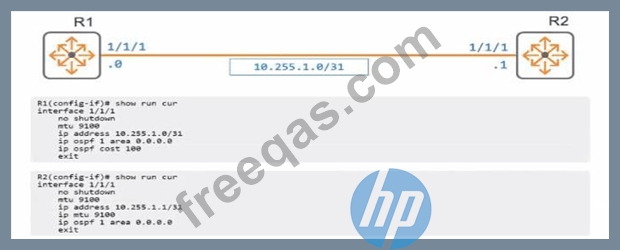
Exhibit. An engineer has applied the above configuration to R1 and R2 However the routers OSPF adjacency never progresses past the "EXSTART-DR" slate as shown below. Which configuration action on either router will allow R1 and R2 to progress past the "EXSTART/DR" state?
Correct Answer: A
In OSPF, the "EXSTART/DR" state indicates that the routers are trying to establish an adjacency but are unable to progress. This can happen if the OSPF network type is incorrectly configured for the type of connection between the routers. Given that R1 and R2 are connected via a point-to-point link (as suggested by the /31 subnet), setting the network type to point-to-point on both routers will remove the need for DR/BDR election, which is unnecessary on a point-to-point link, and allow OSPF to progress past the "EXSTART" state and form a full adjacency.
Question 29
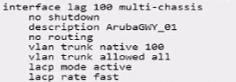
A campus topology uses VSX with a collapsed core topology. The customer added redundant SFP+ transceivers and reconfigured their mobility gateways from a single link to an aggregate Link. You are asked to verify the CLI output for the link aggregation configuration for one of the mobility gateway cluster members below. What is a valid configuration?
Correct Answer: A
The configuration shown in Option A is a valid configuration for a multi-chassis link aggregation (MC-LAG) setup. It specifies the use of LACP (Link Aggregation Control Protocol) with a fast rate of LACP PDUs exchange, which is appropriate for creating a resilient and high-throughput link aggregation. The 'vlan trunk allowed all' command allows all VLANs across the trunk, and 'vlan trunk native 100' sets VLAN 100 as the native VLAN for untagged traffic.
Question 30
Based on best practices if an SSID is configured Tor a primary and secondary gateway cluster with cluster preemption enabled, which will decide if the APs move to the secondary gateway cluster if all of the nodes in the primary gateway cluster are down?
Correct Answer: B
In an Aruba network, if an SSID is configured for a primary and secondary gateway cluster with cluster preemption enabled, each AP individually will decide to move to the secondary gateway cluster if all of the nodes in the primary gateway cluster are down. This decentralized decision-making process enhances network resilience and ensures uninterrupted service for clients connected to the APs.