FreeQAs
 Request Exam  Contact
  • Home
  • View All Exams
  • New QA's
  • Upload
PRACTICE EXAMS:
  • Oracle
  • Fortinet
  • Juniper
  • Microsoft
  • Cisco
  • Citrix
  • CompTIA
  • VMware
  • ISC
  • SAP
  • EMC
  • PMI
  • HP
  • Salesforce
  • Other
  • Oracle
    Oracle
  • Fortinet
    Fortinet
  • Juniper
    Juniper
  • Microsoft
    Microsoft
  • Cisco
    Cisco
  • Citrix
    Citrix
  • CompTIA
    CompTIA
  • VMware
    VMware
  • ISC
    ISC
  • SAP
    SAP
  • EMC
    EMC
  • PMI
    PMI
  • HP
    HP
  • Salesforce
    Salesforce
  1. Home
  2. HP Certification
  3. HPE7-A07 Exam
  4. HP.HPE7-A07.v2026-07-28.q58 Dumps
  • ««
  • «
  • …
  • 3
  • 4
  • 5
  • 6
  • 7
  • 8
  • 9
  • 10
  • 11
  • 12
  • …
  • »
  • »»
Download Now

Question 31

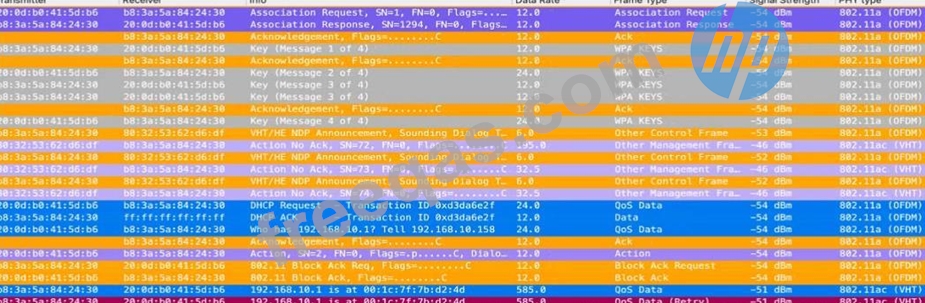
Exhibit.

A customer is reporting mat connectivity is Tailing for some wireless client Devices. What are your conclusions from the capture? (Select two.)
Correct Answer: B,D
The capture shows messages related to WPA key management, indicating WPA2-PSK is being used. Also, the capture includes a DHCP request from the client but no corresponding DHCP ACK, suggesting the client is not receiving an IP address, which could explain the connectivity failure.
insert code

Question 32


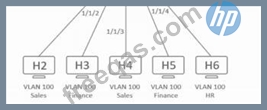
What is the expected behavior for ARP traffic sent from H1?

Correct Answer: A
In this scenario:
* All hosts are in VLAN 100
* Group-Based Policy (GBP) is applied
* H1 belongs to the Marketing role
* Policy table for Marketing:
Source
Destination
Action
Marketing
HR
Deny
Marketing
Sales
Permit
Marketing
Finance
Deny
Role Mapping:
* Sales: H2, H4
* Finance: H3, H5
* HR: H6
# Key Aruba GBP Behavior for ARP
Aruba AOS-CX GBP enforces policy at L3 and L2, and ARP is not treated as unconditional broadcast when GBP roles restrict communication.
Aruba documentation states:
"ARP requests are only forwarded to ports associated with permitted roles.
ARP behavior follows the GBP access-policy rules."
Since Marketing is only permitted to communicate with Sales, ARP from H1 must only be forwarded toward:
# H2 (Sales)
# H4 (Sales)
Interfaces:
* H2 # port 1/1/1
* H4 # port 1/1/3
Therefore, the ARP request is NOT flooded to Finance (H3/H5) or HR (H6), where communication is denied.
# Why Other Options Are Incorrect
Option
Why Wrong
B
Would ignore GBP enforcement; too wide of a flood
C
Not dropped - allowed paths exist to Sales
D
ARP is not broadcasted when GBP denies connectivity
insert code

Question 33

A customer is planning to add loT devices that connect wirelessly to the existing 802.1X SSID. The customer will use HPE Aruba Networking ClearPass to authenticate the loT devices by MAC address but other devices will still need to authenticate by only 802.1X.
Refer to the exhibit.
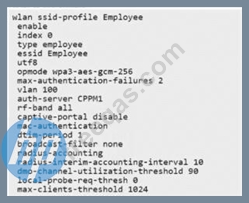
The customer provided the current configuration and reported their non-IoT 802.1X devices are no longer able to connect. Which configuration change can be made to fix the issue?

Correct Answer: C
In ArubaOS WLAN SSID profiles, the command mac-authentication enables MAC-based authentication on the SSID. When MAC authentication is enabled and l2-auth-failthrough is not configured, the AP treats MAC authentication as the decisive Layer-2 method: if the MAC check does not return an accept, the client is not allowed to proceed to another Layer-2 method (such as 802.1X). Aruba documentation states that l2-auth- failthrough allows a client to fall through to the next Layer-2 authentication method when the first method fails or is not matched.
Therefore, with IoT devices using MAC authentication and non-IoT devices using 802.1X on the same SSID, you must enable l2-auth-failthrough so that clients that do not match MAC authentication are allowed to attempt 802.1X.
* mac-authentication: enables MAC-auth on the SSID.
* l2-auth-failthrough: permits clients to continue to 802.1X when MAC-auth is not accepted.
* Changing opmode (WPA2 vs WPA3) or max-authentication-failures does not resolve the Layer-2 method selection behavior.
* Removing mac-authentication would prevent the IoT MAC-auth use case.
References (HPE Aruba Networking official guides):
* ArubaOS WLAN SSID Profile-Layer-2 Authentication Methods: mac-authentication and l2-auth- failthrough behavior and sequencing.
* Aruba ClearPass and ArubaOS Integration-MAC Authentication with 802.1X coexistence on a single SSID using fail-through.
insert code

Question 34

Refer to the exhibit.

Given the log output, which statement is true?

Correct Answer: B
* The show ata endpoint output lists the AP's AP Tunnel Agent (ATA) state transitions with a given gateway.
* Key state/result fields:
* CONNECTING # PROBE_TIMEOUT # INIT: the AP tries to bring up the IPSec tunnel, health probes to the gateway time out, then the state resets to INIT and retries.
* TUN_RECV_TIMEOUT: the AP stops receiving tunnel keepalives/packets from the gateway within the expected interval.
* SURVIVING indicates the AP is maintaining service with an already-up tunnel while control connectivity is impaired; it is not the state shown at the end here.
In the log, AP-01 repeatedly cycles through CONNECTING # PROBE_TIMEOUT # INIT, with intermittent TUN_RECV_TIMEOUT. This pattern is the documented symptom of the gateway being unreachable or down (no response to probes/keepalives), rather than a Central/orchestrator outage or PMTU problem.
Therefore, the correct conclusion is that the gateway at 192.168.1.92 is offline or not reachable.
* A is incorrect: the final/recurring state is not SURVIVING.
* C is incorrect: a Central/orchestrator issue would show SURVIVING (existing tunnel continues) rather than repeated probe timeouts to the gateway.
* D is incorrect: PMTU issues do not generate recurring PROBE_TIMEOUT/TUN_RECV_TIMEOUT cycles; they appear as ESP/IKE negotiation problems, not persistent probe loss.
insert code

Question 35

Exhibit.

What is me expected behavior for ARP traffic sent from H1?

Correct Answer: C
In a VXLAN environment, unknown unicast traffic, such as ARP requests from H1, which does not have a specific destination MAC address learned by the switch A2, will be flooded out of all interfaces. This flooding behavior is necessary because A2 needs to ensure that the ARP request reaches its intended destination, which might be on any of the interfaces. It's a part of the standard behavior of switches to handle ARP traffic when the destination hardware address is unknown.
insert code
  • ««
  • «
  • …
  • 3
  • 4
  • 5
  • 6
  • 7
  • 8
  • 9
  • 10
  • 11
  • 12
  • …
  • »
  • »»
[×]

Download PDF File

Enter your email address to download HP.HPE7-A07.v2026-07-28.q58 Dumps

Email:

FreeQAs

Our website provides the Largest and the most Latest vendors Certification Exam materials around the world.

Using dumps we provide to Pass the Exam, we has the Valid Dumps with passing guranteed just which you need.

  • DMCA
  • About
  • Contact Us
  • Privacy Policy
  • Terms & Conditions
©2026 FreeQAs

www.freeqas.com materials do not contain actual questions and answers from Cisco's certification exams.