You are using a Layer 3 VPN to connect two customer sites. The VPN routes for the customer networks appear as hidden in the bgp. 13vpn. o routing table on the PE routers. What is causing this problem?
Correct Answer: C
Question 27
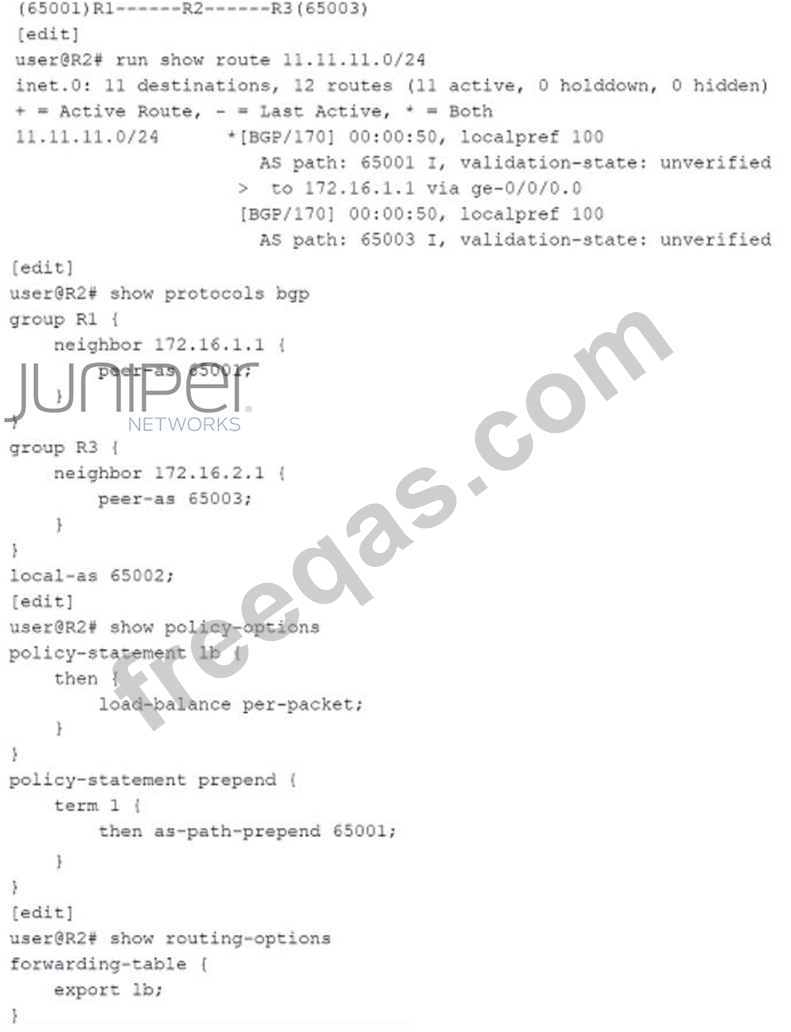
Exhibit R2 is receiving the same route from R1 and R3. You must ensure that you can load balance traffic for that route. Referring to the exhibit, which configuration change will allow load balancing?
Correct Answer: C
Question 28
An interface is configured with a behavior aggregate classifier and a multifield classifier How will the packet be processed when received on this interface?
Correct Answer: C
Explanation behavior aggregate (BA) classifiers and multifield (MF) classifiers are two types of classifiers that are used to assign packets to a forwarding class and a loss priority based on different criteria. The forwarding class determines the output queue for a packet. The loss priority is used by a scheduler to control packet discard during periods of congestion. A BA classifier maps packets to a forwarding class and a loss priority based on a fixed-length field in the packet header, such as DSCP, IP precedence, MPLS EXP, or IEEE 802.1p CoS bits. A BA classifier is computationally efficient and suitable for core devices that handle high traffic volumes. A BA classifier is useful if the traffic comes from a trusted source and the CoS value in the packet header is trusted. An MF classifier maps packets to a forwarding class and a loss priority based on multiple fields in the packet header, such as source address, destination address, protocol type, port number, or VLAN ID. An MF classifier is more flexible and granular than a BA classifier and can match packets based on complex filter rules. An MF classifier is suitable for edge devices that need to classify traffic from untrusted sources or rewrite packet headers. You can configure both a BA classifier and an MF classifier on an interface. If you do this, the BA classification is performed first and then the MF classification. If the two classification results conflict, the MF classification result overrides the BA classification result. Based on this information, we can infer the following statements: * The packet will be discarded. This is not correct because the packet will not be discarded by the classifiers unless it matches a filter rule that specifies discard as an action. The classifiers only assign packets to a forwarding class and a loss priority based on their match criteria. * The packet will be processed by the BA classifier first, then the MF classifier. This is correct because if both a BA classifier and an MF classifier are configured on an interface, the BA classification is performed first and then the MF classification. If they conflict, the MF classification result overrides the BA classification result. * The packet will be forwarded with no classification changes. This is not correct because the packet will be classified by both the BA classifier and the MF classifier if they are configured on an interface. The final classification result will determine which output queue and which discard policy will be applied to the packet. * The packet will be processed by the MF classifier first, then the BA classifier. This is not correct because if both a BA classifier and an MF classifier are configured on an interface, the BA classification is performed first and then the MF classification. If they conflict, the MF classification result overrides the BA classification result.
Question 29
Which two statements are correct about a sham link? (Choose two.)
Correct Answer: A,C
Explanation A sham link is a logical link between two PE routers that belong to the same OSPF area but are connected through an L3VPN. A sham link makes the PE routers appear as if they are directly connected, and prevents OSPF from preferring an intra-area back door link over the VPN backbone. A sham link creates an OSPF multihop neighborship between the PE routers using TCP port 646. The PEs exchange Type 1 OSPF LSAs instead of Type 3 OSPF LSAs for the L3VPN routes, which allows OSPF to use the correct metric for route selection1.
Question 30
Your network is receiving the 203.0.113.0/24 network using EBGP from AS 64500 and AS 64501. Both of these advertisements have identical local-preference values, AS-path lengths, and BGP origin codes. You want to influence the way your AS sends traffic to the 203.0.113.0/24 network. In this scenario, which attribute would you consider next when selecting the best path?
Correct Answer: B
To determine the correct answer, let's analyze the BGP path selection process and identify which attribute would be considered next in this scenario. Background on BGP Path Selection When multiple paths to the same destination are received via BGP, the router uses a step-by-step process to select the best path. The order of attributes considered is as follows (simplified for this scenario): Highest Local Preference : The path with the highest local preference is preferred. Shortest AS Path : The path with the shortest AS path length is preferred. Lowest Origin Code : Paths with an origin code of IGP are preferred over EGP, and EGP is preferred over Incomplete. Lowest MED (Multi-Exit Discriminator) : If the first three attributes are identical, the path with the lowest MED value is preferred. eBGP over iBGP : eBGP paths are preferred over iBGP paths. IGP Metric to Next Hop : The path with the lowest IGP metric to the next-hop router is preferred. Router ID : If all else is equal, the path from the router with the lowest Router ID is preferred. Peer IP Address : As a last tiebreaker, the path from the peer with the lowest IP address is preferred. Scenario Analysis In this scenario: You are receiving the 203.0.113.0/24 network via EBGP from two different autonomous systems (AS 64500 and AS 64501). Both advertisements have identical local-preference values , AS-path lengths , and BGP origin codes . Given that the first three attributes in the BGP path selection process are identical, the next attribute to consider is the MED (Multi-Exit Discriminator) value. Analysis of the Options Option A: Router ID Incorrect : The Router ID is considered much later in the BGP path selection process, only after other attributes like MED and IGP metric have been evaluated. Since MED is still relevant here, Router ID is not the next attribute to consider. Option B: MED value Correct : The MED value is used to influence inbound traffic from neighboring ASes. When local preference, AS path length, and origin code are identical, the path with the lowest MED value is preferred. This makes MED the next attribute to consider in this scenario. Option C: Peer IP Address Incorrect : The peer IP address is a tiebreaker used only at the very end of the BGP path selection process, after all other attributes have been evaluated. It is not relevant here because MED has not yet been considered. Option D: IGP Metric Incorrect : The IGP metric to the next-hop router is considered after MED. Since MED is still relevant in this scenario, IGP metric is not the next attribute to evaluate. Final Answer The correct answer is: B . MED value Summary When local preference, AS path length, and origin code are identical, the MED value is the next attribute considered in the BGP path selection process. MED is used to influence how traffic enters your AS from neighboring ASes.