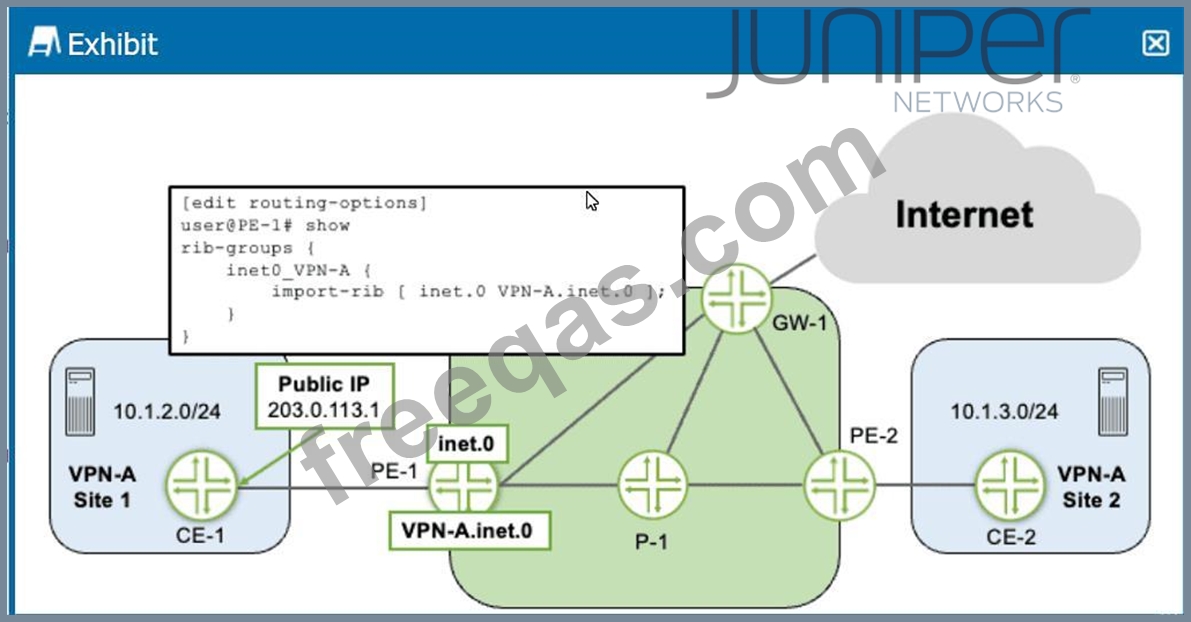
Click the Exhibit button. Referring to the exhibit, you must provide VRF Internet access over a single connection for VPN-A Site 1, which connects to PE-1. Which two statements are correct in this scenario? (Choose two.)
Correct Answer: A,B
In the provided exhibit, the configuration involves using a RIB (Routing Information Base) group to facilitate internet access for VPN-A Site 1 through PE-1. The goal is to provide VRF Internet access over a single connection. 1. **Understanding RIB Groups**: - RIB groups allow for the import and export of routes between different routing tables. - In this scenario, we have two RIBs: `inet.0` (the main routing table) and `VPN-A.inet.0` (the VRF-specific routing table). 2. **Statement Analysis**: - **A. You must use the RIB group to move a default route, which is learned through BGP, from the inet.0 table to the VPN-A.inet.0 table.** - Correct. To provide Internet access to VPN-A, the default route (0.0.0.0/0) learned via BGP in the `inet.0` table must be made available in the `VPN-A.inet.0` table. This is done using the RIB group to import the default route. - **B. You do not need to use the RIB group to move interface routes from the inet.0 table to the VPN-A.inet. 0 table.** - Correct. Interface routes (connected routes) are typically directly added to both the global and the VRF routing tables without needing a RIB group. These routes are known to the VRF because the interfaces are part of the VRF configuration. - **C. You do not need to use the RIB group default route, which is learned through BGP, from the inet.0 table to the VPN-A.inet.0 table.** - Incorrect. As discussed, the default route needs to be imported into the VRF's routing table using a RIB group to enable Internet access for the VRF. - **D. You must use the RIB group to move interface routes from the inet.0 table to the VPN-A.inet.0 table.** - Incorrect. Interface routes are directly associated with the VRF interfaces and are automatically known to the VRF routing table. There is no need to use a RIB group for these routes. **Conclusion**: The correct answers are: **A. You must use the RIB group to move a default route, which is learned through BGP, from the inet.0 table to the VPN-A.inet.0 table.** **B. You do not need to use the RIB group to move interface routes from the inet.0 table to the VPN-A.inet.0 table.** **References**: - Juniper Networks Documentation on RIB Groups: [RIB Groups Overview](https://www.juniper.net /documentation/en_US/junos/topics/concept/rib-groups-overview.html) - Junos OS VPNs Configuration Guide: [Junos VPNs Configuration](https://www.juniper.net/documentation /en_US/junos/topics/concept/vpns-overview.html)
Question 22
Exhibit Referring to the exhibit, which statement is correct?
Correct Answer: C
Explanation The route distinguisher (RD) is a BGP attribute that is used to create unique VPN IPv4 prefixes for each VPN in an MPLS network. The RD is a 64-bit value that consists of two parts: an administrator field and an assigned number field. The administrator field can be an AS number or an IP address, and the assigned number field can be any arbitrary value chosen by the administrator. The RD is prepended to the IPv4 prefix to create a VPN IPv4 prefix that can be advertised across the MPLS network without causing any overlap or conflict with other VPNs. In this question, we have two PE routers (PE-1 and PE-2) that are connected to two CE devices (CE-1 and CE-2) respectively. PE-1 and PE-2 are configured with VRFs named Customer-A and Customer-B respectively.
Question 23
Referring to the exhibit, what do the brackets [ ] in the AS path identify?
Correct Answer: D
Question 24
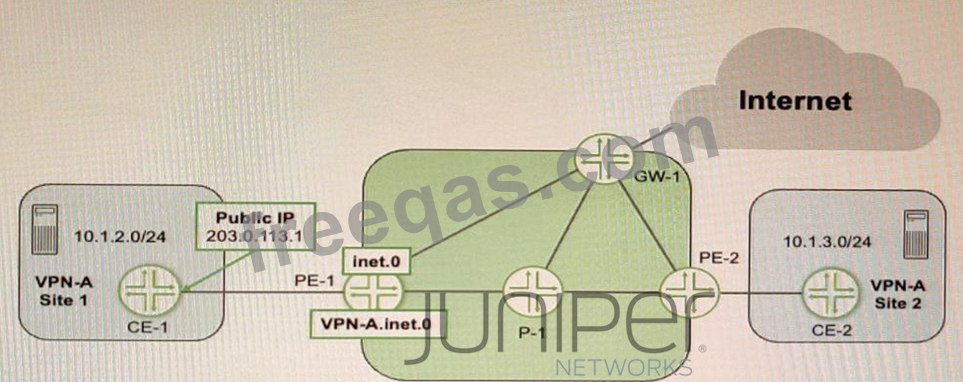
Exhibit Referring to the exhibit, CE-1 is providing NAT services for the hosts at Site 1 and you must provide Internet access for those hosts Which two statements are correct in this scenario? (Choose two.)
Correct Answer: B,D
Question 25
Which two statements are correct about the customer interface in an LDP-signaled pseudowire? (Choose two)
Correct Answer: C,D
The customer interface in an LDP-signaled pseudowire is the interface on the PE router that connects to the CE device. An LDP-signaled pseudowire is a type of Layer 2 circuit that uses LDP to establish a point-to-point connection between two PE routers over an MPLS network. The customer interface can have different encapsulation types depending on the type of traffic that is carried over the pseudowire. The encapsulation types are ethernet-ccc, vlan-ccc, extended-vlan-ccc, atm-ccc, frame-relay-ccc, ppp-ccc, cisco-hdlc-ccc, and tcc-ccc. Depending on the encapsulation type, the customer interface can accept or reject tagged or untagged frames in the data plane, and include or exclude VLAN tags in the control plane LDP advertisement. The following table summarizes the behavior of different encapsulation types: