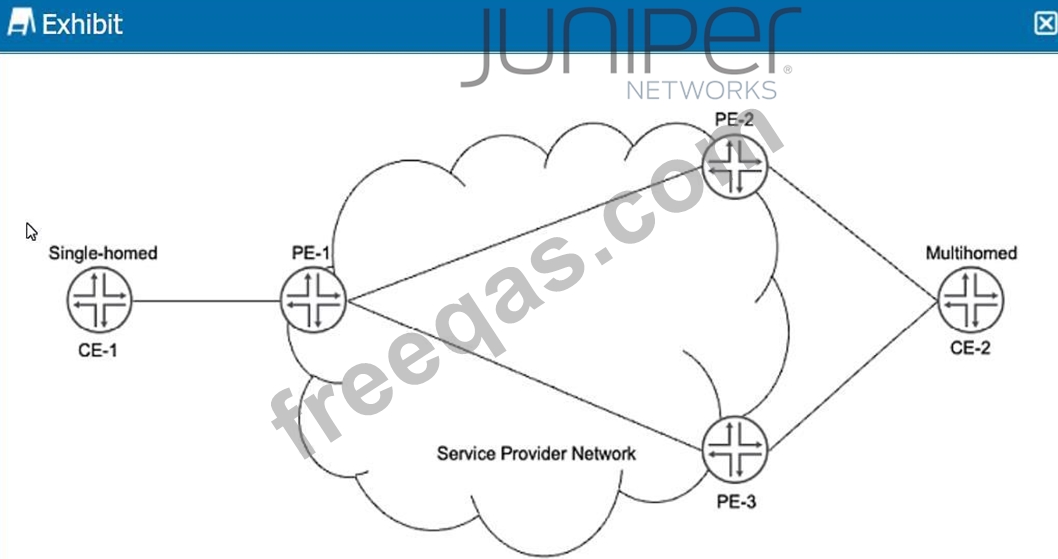
Click the Exhibit button. You have an EVI implemented between PE-1, PE-2, and PE-3 to allow communication between CE-1 and CE-2. CE-2 receives unicast traffic from CE-1 on both links to PE-2 and PE-3. When CE-1 sends broadcast traffic, CE-2 receives it on only one of the multihomed links. Referring to the exhibit, which EVPN route type enables this behavior?
Correct Answer: B
In the context of Ethernet VPN (EVPN) and the behavior described in the exhibit, it's essential to understand the different EVPN route types and their specific functionalities. Here, CE-2 is receiving unicast traffic on both of its multihomed links to PE-2 and PE-3, but broadcast traffic is received only on one of these links. **Explanation of EVPN Route Types**: 1. **Type 1 (Ethernet Auto-Discovery Routes)**: - These routes are used for auto-discovery of Ethernet segments and for advertising VLAN membership. - They do not directly influence the behavior described in the question. 2. **Type 2 (MAC/IP Advertisement Routes)**: - These routes are used to advertise MAC addresses and IP-to-MAC bindings within the EVPN. - They handle unicast traffic forwarding and are crucial for populating the MAC address tables on the PE devices. - While important, they do not explain the selective broadcast behavior. 3. **Type 3 (Inclusive Multicast Ethernet Tag Routes)**: - These routes are used to build multicast distribution trees for delivering broadcast, unknown unicast, and multicast (BUM) traffic. - They ensure that BUM traffic is sent only once per Ethernet segment, preventing duplicate frames from being sent to multihomed CEs. - This aligns with the behavior described where CE-2 receives broadcast traffic on only one link to prevent duplication. 4. **Type 4 (Ethernet Segment Routes)**: - These routes are used to advertise the presence of an Ethernet segment and are crucial for Designated Forwarder (DF) election processes in multihoming scenarios. - While relevant to multihoming, they are not directly responsible for the selective broadcast behavior. **Conclusion**: The behavior described, where CE-2 receives broadcast traffic on only one of its multihomed links, is controlled by Type 3 routes. These routes are specifically designed to handle inclusive multicast and broadcast traffic efficiently in EVPN environments, ensuring that such traffic is not duplicated across multiple links to the same CE. **References**: - Juniper Networks EVPN Documentation: [EVPN Overview](https://www.juniper.net/documentation/en_US/junos/topics/concept/evpn-overview.html) - RFC 7432, BGP MPLS-Based Ethernet VPN: [RFC 7432](https://tools.ietf.org/html/rfc7432) provides detailed descriptions of EVPN route types and their functions. - Junos OS EVPN Configuration Guide: [Junos OS EVPN Configuration Guide](https://www.juniper.net/documentation/en_US/junos/topics/topic-map/evpn.html)
Question 32
In IS-IS, which two statements are correct about the designated intermediate system (DIS) on a multi-access network segment? (Choose two)
Correct Answer: A,D
In IS-IS, a designated intermediate system (DIS) is a router that is elected on a multi-access network segment (such as Ethernet) to perform some functions on behalf of other routers on the same segment. A DIS is responsible for sending network link-state advertisements (LSPs), which describe all the routers attached to the network. These LSPs are flooded throughout a single area. A DIS also generates pseudonode LSPs, which represent the multi-access network as a single node in the link-state database. A DIS election is based on the priority value configured on each router's interface connected to the multi-access network. The priority value ranges from 0 to 127, with higher values indicating higher priority. The router with the highest priority becomes the DIS for the area (Level 1, Level 2, or both). If routers have the same priority, then the router with the highest MAC address is elected as the DIS. By default, routers have a priority value of 64. On a multi-access network, each router only forms an adjacency to the DIS, not to every other router on the segment. This reduces the amount of hello packets and LSP
Question 33
A packet is received on an interface configured with transmission scheduling. One of the configured queues In this scenario, which two actions will be taken by default on a Junos device? (Choose two.)
Correct Answer: B,C
https://www.juniper.net/documentation/us/en/software/junos/cos-security-devices/topics/concept/cos- transmission-scheduling-security-overview.html When a Junos device receives a packet on an interface with transmission scheduling, traffic is placed into different queues based on Class of Service (CoS) policies. If a queue exceeds its allocated bandwidth, Junos has default behaviors for handling excess traffic. Key Junos Behaviors for Transmission Scheduling * Queues Can Borrow Bandwidth from Other Queues # * If a queue has excess traffic, it can use bandwidth from underutilized queues, as long as bandwidth is available. * Reference from Juniper Documentation: "By default, each queue can exceed the assigned bandwidth if additional bandwidth is available from other queues." * Queues Have Credit-Based Tracking # * A queue that stays within its allocated bandwidth is considered to have positive bandwidth credit. * A queue that exceeds its allocation is considered to have negative bandwidth credit. * Reference from Juniper Documentation: "A queue receiving traffic in excess of its bandwidth allocation is considered to have negative bandwidth credit." Evaluating the Answer Choices # B. The exceeding queue will be considered to have negative bandwidth credit. * Correct, because when a queue exceeds its allocated bandwidth, Junos assigns it negative bandwidth credit. * This means the queue is in debt and must recover before it can transmit additional packets. # C. The excess traffic will use bandwidth available from other queues. * Correct, because Junos allows excess traffic to borrow bandwidth from underutilized queues by default. * If a forwarding class does not use its allocated bandwidth, other queues can borrow the unused bandwidth. Why the Other Answers Are Incorrect? # A. The excess traffic will be discarded. * Incorrect, because Junos does not immediately discard excess traffic unless the queue cannot borrow bandwidth. * By default, Junos allows bandwidth sharing, and only if no bandwidth is available does it drop packets. # D. The exceeding queue will be considered to have positive bandwidth credit. * Incorrect, because when a queue exceeds its assigned bandwidth, it gets negative bandwidth credit, not positive credit. Verified Juniper Official Reference # Junos CoS Transmission Scheduling Overview "By default, each queue can exceed the assigned bandwidth if additional bandwidth is available from other queues." "A queue receiving traffic in excess of its bandwidth allocation is considered to have negative bandwidth credit."
Question 34
A router running IS-IS is configured with an ISO address of 49.0001.00a0.c96b.c490.00. Which part of this address is the system ID?
Correct Answer: A
Question 35
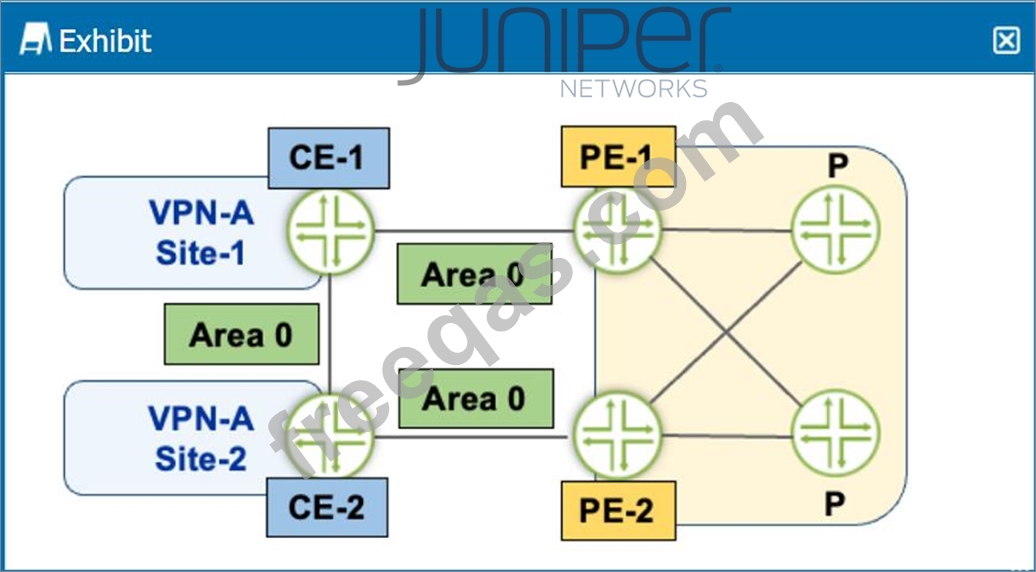
Refer to the exhibit. Click the Exhibit button. Referring to the exhibit, the PE-to-CE protocol being used is OSPF for the L3VPN. Also, there is an OSPF neighborship between CE-1 and CE-2. Which statement is correct in this situation?
Correct Answer: B
In the exhibit, the PE-to-CE protocol used is OSPF, and there is an OSPF neighborship between CE-1 and CE-2 within the same Area 0. Let's analyze the default OSPF routing behavior in this setup to determine the correct statement. 1. **OSPF Neighborship**: - CE-1 and CE-2 have an OSPF neighborship directly within Area 0. - OSPF prefers intra-area routes over inter-area and external routes. 2. **Default Routing Behavior**: - Since CE-1 and CE-2 are directly connected through an OSPF link within the same area, OSPF will prefer this direct intra-area path over any other paths learned via the PE routers and the L3VPN. - This is because intra-area routes have a lower metric compared to inter-area or external routes. 3. **Metric Considerations**: - By default, OSPF will route traffic between Site-1 and Site-2 through the direct link between CE-1 and CE-2, unless the link's metric is artificially increased to make it less preferable. - There is no need to adjust metrics for the CE-1 to PE-1 link to prefer the CE-1 to CE-2 path, as OSPF already prefers direct intra-area paths. **Conclusion**: Given the default behavior of OSPF and the topology shown in the exhibit, the correct statement is: **B. Hosts at Site-1 will reach hosts at Site-2 through the CE-1 and CE-2 link by default.** **Reference**: - OSPF Design Guide: [Juniper Networks OSPF Design Guide](https://www.juniper.net/documentation/en_US/junos/topics/concept/ospf-design-overview.html) - Juniper Networks Technical Documentation on OSPF: [Junos OS OSPF Configuration Guide](https://www.juniper.net/documentation/en_US/junos/topics/concept/ospf-routing-overview.html)