Which two EVPN route types are used to advertise a multihomed Ethernet segment? (Choose two.)
Correct Answer: A,B
Question 37
Click the Exhibit button. After adding Customer C to your Layer 3 VPN, you must ensure that PE2 is receiving VPN routes for all customers attached to PE1, as shown in the exhibit. Which operational command displays this information?
Correct Answer: A
In the context of Layer 3 VPNs (L3VPN) using MPLS, the routing information for different customers (VPNs) is typically stored in separate routing tables (VRFs). When you want to verify that PE2 is receiving the VPN routes for Customer C from PE1, you need to check the appropriate VRF routing table on PE2. 1. **Option A: show route table customer-c.inet.0** - This command displays the routing table specific to Customer C's VRF. - Since we want to verify that PE2 has received the VPN routes for Customer C, this is the most appropriate command to use. - It allows us to see all routes learned for Customer C's VPN. 2. **Option B: show route table bgp.l3vpn.0** - This command displays the BGP routing table for all L3VPN routes. - While this includes routes for Customer C, it also includes routes for all other VPNs, making it harder to isolate the specific information for Customer C. - This command is more useful for an overall view of BGP L3VPN routes rather than for a specific customer's VRF. 3. **Option C: show route summary** - This command provides a summary of the routes in all routing tables. - It doesn't give detailed information about the specific routes for Customer C's VRF. - It's useful for a high-level overview but not for verifying specific customer routes. 4. **Option D: show route table inet.0** - This command shows the global routing table, not the VRF-specific tables. - The global routing table doesn't contain the VPN-specific routes that are stored in the VRF tables. - Therefore, it won't help in verifying the routes for Customer C. **Conclusion**: To verify that PE2 is receiving VPN routes for Customer C from PE1, the most appropriate command is to check the specific VRF routing table for Customer C. Hence, the correct answer is: **A. show route table customer-c.inet.0** **References**: - Junos OS documentation on MPLS VPNs: [Junos MPLS VPNs Guide](https://www.juniper.net/documentation/en_US/junos/topics/topic-map/mpls-vpns.html) - Command Reference for Routing Tables: [Junos OS Routing Tables Command Reference](https://www.juniper.net/documentation/en_US/junos/topics/reference/command-summary/show-rout
Question 38
What is the correct order of packet flow through configurable components in the Junos OS CoS features?
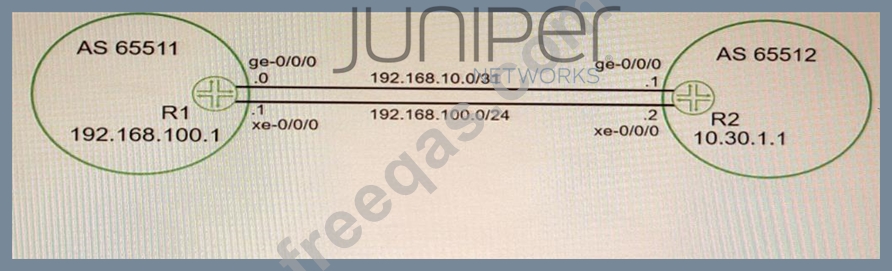
Exhibit You want to use both links between R1 and R2 Because of the bandwidth difference between the two links, you must ensure that the links are used as much as possible. Which action will accomplish this goal?
Correct Answer: D
Explanation VPLS is a Layer 2 VPN technology that allows multiple sites to connect over a shared IP/MPLS network as if they were on the same LAN. VPLS tunnels can be signaled using either Label Distribution Protocol (LDP) or Border Gateway Protocol (BGP). In this question, we have two links between R1 and R2 with different bandwidths (10 Gbps and 1 Gbps). We want to use both links as much as possible for VPLS traffic. To achieve this, we need to enable per-prefix load balancing on both routers. Per-prefix load balancing is a feature that allows a router to distribute traffic across multiple equal-cost or unequal-cost paths based on the destination prefix of each packet. This improves the utilization of multiple links and provides better load sharing than per-flow load balancing, which distributes traffic based on a hash of source and destination addresses4. Per-prefix load balancing can be enabled globally or per interface using the load-balance per-packet command.
Question 40
Exhibit You are asked to exchange routes between R1 and R4 as shown in the exhibit. These two routers use the same AS number Which two steps will accomplish this task? (Choose two.)