Which two statements are correct about reflecting inet-vpn unicast prefixes in BGP route reflection? (Choose two.)
Correct Answer: A,B
Explanation Route reflection is a BGP feature that allows a router to reflect routes learned from one IBGP peer to another IBGP peer, without requiring a full-mesh IBGP topology. Route reflectors do not change any existing BGP attributes by default when advertising routes, unless explicitly configured to do so. A BGP peer does not require any configuration changes to become a route reflector client, only the route reflector needs to be configured with the client parameter under [edit protocols bgp group group-name neighbor neighbor-address] hierarchy level.
Question 7
In IS-IS, which two statements are correct about the designated intermediate system (DIS) on a multi-access network segment? (Choose two)
Correct Answer: A,C
Option A (Correct): In IS-IS, the Designated Intermediate System (DIS) is elected based on the highest configured priority (as defined in Junos OS). If priorities are equal, the router with the highest MAC address becomes the DIS. A priority value of 10 will always override a lower priority (e.g., 1). Reference: Option C (Correct): On a multi-access network (e.g., Ethernet), all IS-IS routers form adjacencies with every other router on the segment. Unlike OSPF, IS-IS does not restrict adjacencies to only the DIS. The DIS is responsible for creating a pseudonode LSP to represent the broadcast network, but full mesh adjacencies are maintained. Why Other Options Are Incorrect: Option B: Incorrect. Higher priority always wins the DIS election. A priority of 1 cannot override a priority of 10. Option D: Incorrect. IS-IS routers form adjacencies with all neighbors, not just the DIS. Key Takeaways: DIS Election: Prioritizes highest numerical value (e.g., 10 > 1). Adjacency Behavior: Full mesh adjacencies are maintained, unlike OSPF. DIS Role: Primarily for generating pseudonode LSPs and optimizing flooding, not adjacency restriction. For further details, refer to Juniper's official IS-IS documentation: Juniper IS-IS Configuration Guide. https://www.juniper.net/documentation/us/en/software/junos/is-is/topics/concept/routing-protocol-is-is-security-designated-router-understanding.html
Question 8
Which two statements about IS-IS are correct? (Choose two.)
Correct Answer: A,C
Option A (Correct): * Complete Sequence Number PDUs (CSNPs) are periodically flooded by the Designated Intermediate System (DIS) on multi-access networks (e.g., Ethernet). * This ensures all routers on the segment synchronize their Link-State Databases (LSDBs).
Question 9
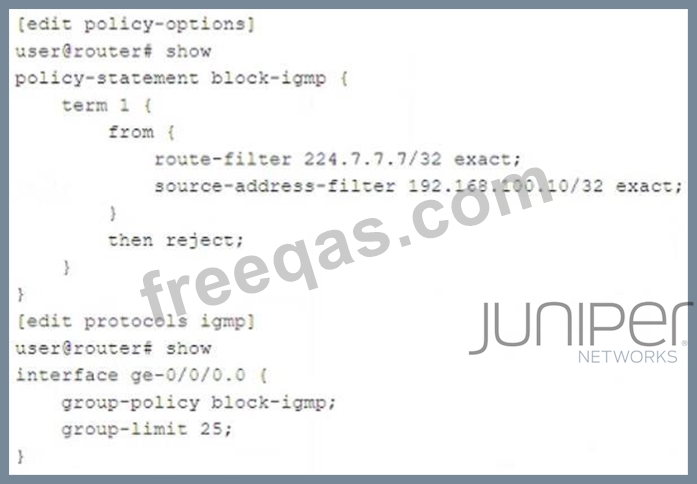
Based on the configuration contents shown in the exhibit, which statement is true?
Correct Answer: A
Question 10
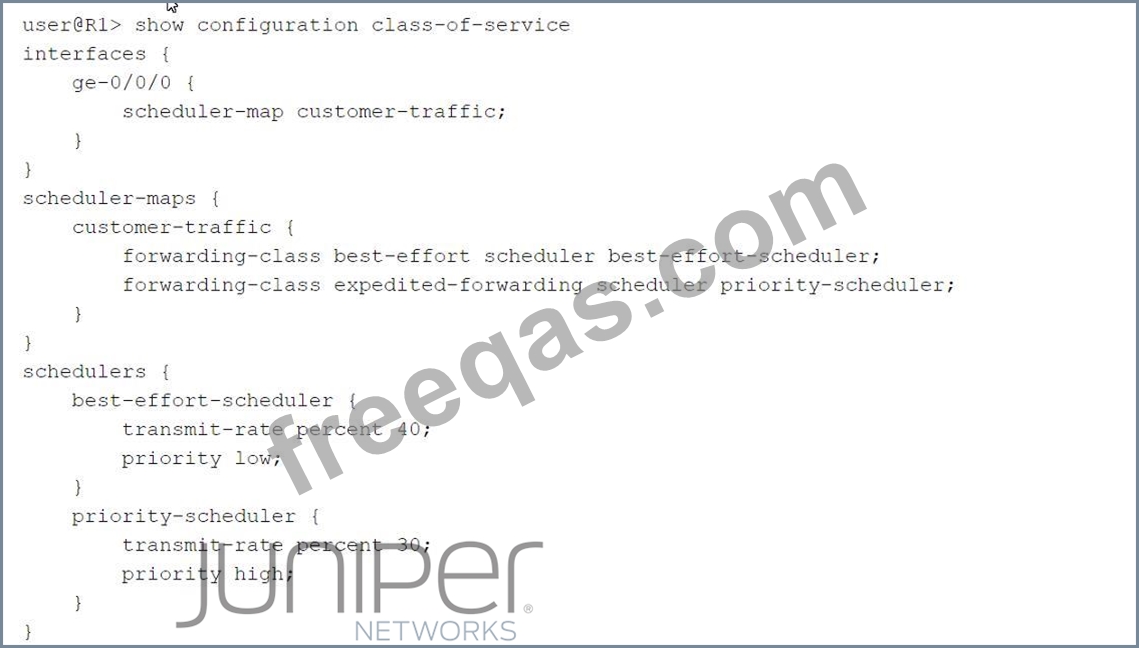
Click the Exhibit button. Which two statements are correct about the class-of-service configuration shown in the exhibit? (Choose two.)
Correct Answer: A,B
The class-of-service (CoS) configuration in the exhibit shows how traffic is scheduled on the ge-0/0/0 interface. Let's analyze each statement to determine its correctness: A: Incoming traffic will not be classified because no classifier exists in the configuration. * This statement is correct. The configuration shown does not include any classifier, so no explicit classification is defined. As a result, incoming traffic will not be classified according to any custom criteria. B: The best-effort queue can transmit more than 40% of the total bandwidth on the ge-0/0/0 interface, if no other queue is using that bandwidth. * This statement is correct. The transmit-rate percent 40 means that 40% of the bandwidth is guaranteed for the best-effort queue, but it can use more bandwidth if other queues (like the priority scheduler) are not utilizing their allocated bandwidth. C: Incoming traffic will be classified using the default classifier. * This statement is incorrect. Without an explicit classifier in the configuration, there is no mention of a default classifier being used. Therefore, the incoming traffic won't be classified based on the configuration shown. D: The best-effort queue can never transmit more than 40% of the total bandwidth on the ge-0/0/0 interface, even if that bandwidth is available. * This statement is incorrect. The transmit-rate percent 40 sets a guaranteed minimum bandwidth but does not set a maximum limit. The best-effort queue can utilize more bandwidth if other queues are not using their allocated portions.