Which two statements about IS-IS are correct? (Choose two.)
Correct Answer: A,D
Intermediate System to Intermediate System (IS-IS) is a link-state routing protocol used to move information efficiently within a computer network. It uses a series of Protocol Data Units (PDUs) to manage the network's topology and ensure consistency across all routers in the network. Specifically, Link State PDUs (LSPs), Complete Sequence Number PDUs (CSNPs), and Partial Sequence Number PDUs (PSNPs) play crucial roles in this process. 1. **PSNPs (Partial Sequence Number PDUs)**: - **Acknowledge a received LSP**: PSNPs are used to acknowledge the receipt of LSPs. When a router receives an LSP, it sends a PSNP back to the sender to confirm that the LSP has been received. - **Request a missing LSP**: PSNPs are also used to request missing LSPs. If a router identifies a missing LSP based on sequence numbers, it can send a PSNP to request the specific LSP from its neighbors. 2. **CSNPs (Complete Sequence Number PDUs)**: - **Summarize LSPs**: CSNPs are used to summarize all the LSPs known to a router. They are typically sent at regular intervals to provide a complete list of LSPs in a database. They are not used to acknowledge or request specific LSPs but provide an overview of all LSPs for database synchronization. Based on this understanding, let's evaluate the statements: - **A. PSNPs are used to acknowledge a received LSP.** - Correct. PSNPs serve the purpose of acknowledging LSPs received from other routers. - **B. CSNPs are used to acknowledge a received LSP.** - Incorrect. CSNPs are not used for acknowledging LSPs; they are used to provide a summary of all LSPs. - **C. CSNPs are used to request a missing LSP.** - Incorrect. CSNPs are not used to request missing LSPs; this is the role of PSNPs. - **D. PSNPs are used to request a missing LSP.** - Correct. PSNPs are used to request specific missing LSPs when a router detects that it is missing information. **Conclusion**: The correct statements about IS-IS are: **A. PSNPs are used to acknowledge a received LSP.** **D. PSNPs are used to request a missing LSP.** **References**: - Juniper Networks Documentation on IS-IS: [IS-IS Overview](https://www.juniper.net/documentation/en_US/junos/topics/concept/is-is-routing-overview.html) - RFC 1195, Use of OSI IS-IS for Routing in TCP/IP and Dual Environments: [RFC 1195](https://tools.ietf.org/html/rfc1195) which details the operation and use of IS-IS, including the roles of PSNPs and CSNPs.
Question 12
Exhibit Referring to the exhibit, which statement is correct?
Correct Answer: C
The route distinguisher (RD) is a BGP attribute that is used to create unique VPN IPv4 prefixes for each VPN in an MPLS network. The RD is a 64-bit value that consists of two parts: an administrator field and an assigned number field. The administrator field can be an AS number or an IP address, and the assigned number field can be any arbitrary value chosen by the administrator. The RD is prepended to the IPv4 prefix to create a VPN IPv4 prefix that can be advertised across the MPLS network without causing any overlap or conflict with other VPNs. In this question, we have two PE routers (PE-1 and PE-2) that are connected to two CE devices (CE-1 and CE-2) respectively. PE-1 and PE-2 are configured with VRFs named Customer-A and Customer-B respectively.
Question 13
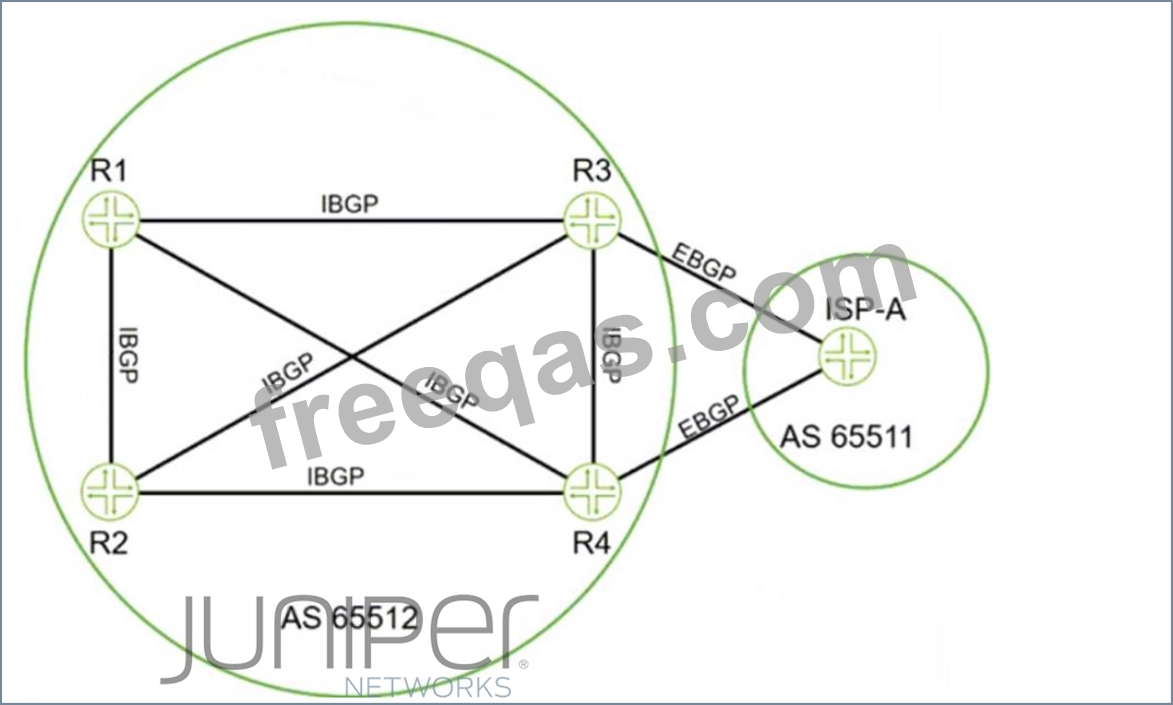
Exhibit Click the Exhibit button-Referring to the exhibit, which two statements are correct about BGP routes on R3 that are learned from the ISP-A neighbor? (Choose two.)
Correct Answer: B,D
Analyzing the Exhibit The diagram represents BGP peering between: AS 65512 (Enterprise Network) AS 65511 (ISP-A) R3 and R4 are peering with ISP-A using EBGP. R1, R2, R3, and R4 are peering within AS 65512 using IBGP. Understanding BGP Route Behavior Option A: "By default, the next-hop value for these routes is not changed by ISP-A before being sent to R3." ❌ Incorrect! EBGP behavior: When a BGP route is advertised via EBGP, the next-hop IP is changed to the router's own IP by default. Since ISP-A is advertising routes via EBGP to R3, the next-hop is changed to ISP-A's IP. Thus, this statement is incorrect. Option B: "The BGP local-preference value that is used by ISP-A is not advertised to R3." ✅ Correct! BGP Local Preference (LOCAL_PREF) is an IBGP-only attribute. Local Preference is NOT shared over EBGP because it is used within an AS to influence route selection. ISP-A will not send LOCAL_PREF to R3, as R3 is in a different AS. Thus, this statement is correct. Option C: "All BGP attribute values must be removed before receiving the routes." ❌ Incorrect! BGP does not remove all attributes when advertising routes. Some attributes are modified (e.g., next-hop, AS-PATH), but others (like MED, community) may be preserved. Thus, this statement is incorrect. Option D: "The next-hop value for these routes is changed by ISP-A before being sent to R3." ✅ Correct! As per default EBGP behavior, the next-hop is changed when a route is advertised to an EBGP peer. This means ISP-A changes the next-hop to its own IP before sending it to R3. Thus, this statement is correct. Final answer: ✅ B. The BGP local-preference value that is used by ISP-A is not advertised to R3. ✅ D. The next-hop value for these routes is changed by ISP-A before being sent to R3. Verification from Juniper Documentation: Juniper BGP Configuration Guide confirms that LOCAL_PREF is not advertised over EBGP. RFC 4271 (BGP-4) specifies that next-hop is changed by default when advertising routes via EBGP.
Question 14
You have an L2VPN connecting two CEs across a provider network that runs OSPF. You have OSPF configured on both CEs. Which two statements are correct in this scenario? (Choose two.)
Correct Answer: B,D
In an L2VPN scenario, the provider network connects two customer edge (CE) devices across a Layer 2 virtual private network. Let's analyze how OSPF operates in this setup. 1. **OSPF Neighborship in L2VPN**: - An L2VPN provides a Layer 2 connection between two sites, making it transparent to Layer 3 protocols like OSPF. This means the CEs can form OSPF adjacencies directly with each other as if they were on the same local network. 2. **OSPF Configuration on CEs and PEs**: - **Statement A: OSPF neighborship is formed between the CEs and PEs**: - Incorrect. In an L2VPN, the provider's network is transparent to the OSPF running on the CEs. OSPF neighborship forms directly between the CEs, not between the CEs and PEs. - **Statement B: The CE and PE OSPF areas can be different**: - Correct. Since OSPF adjacencies form directly between the CEs and not between CEs and PEs, the OSPF areas on the CEs and PEs can be different. The provider network acts as a transparent bridge, and OSPF doesn't see the PEs. - **Statement C: The CE and PE OSPF areas must match**: - Incorrect. As noted above, because the OSPF neighborship forms directly between the CEs, the OSPF areas on the CEs and PEs do not need to match. - **Statement D: OSPF neighborship is formed between the two CEs**: - Correct. The L2VPN makes the connection between the two CEs appear as a direct Layer 2 link, allowing them to form an OSPF adjacency directly. **Conclusion**: Given the above analysis, the correct statements are: **B. The CE and PE OSPF areas can be different.** **D. OSPF neighborship is formed between the two CEs.** **Reference**: - Juniper Networks Documentation on L2VPNs: [Configuring Layer 2 VPNs](https://www.juniper.net/documentation/en_US/junos/topics/task/configuration/layer-2-vpns-configuring.html) - OSPF Configuration Guide: [Junos OS OSPF Configuration](https://www.juniper.net/documentation/en_US/junos/topics/concept/ospf-routing-overview.html)
Question 15
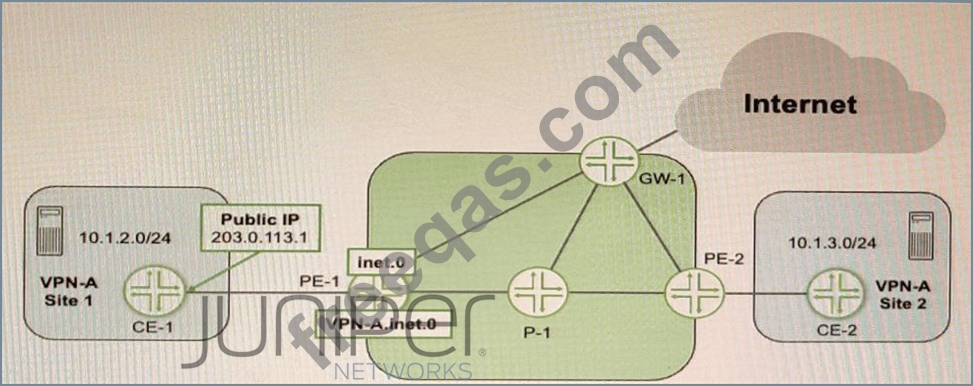
Exhibit Referring to the exhibit, CE-1 is providing NAT services for the hosts at Site 1 and you must provide Internet access for those hosts Which two statements are correct in this scenario? (Choose two.)